To save content items to your account,
please confirm that you agree to abide by our usage policies.
If this is the first time you use this feature, you will be asked to authorise Cambridge Core to connect with your account.
Find out more about saving content to .
To save content items to your Kindle, first ensure no-reply@cambridge.org
is added to your Approved Personal Document E-mail List under your Personal Document Settings
on the Manage Your Content and Devices page of your Amazon account. Then enter the ‘name’ part
of your Kindle email address below.
Find out more about saving to your Kindle.
Note you can select to save to either the @free.kindle.com or @kindle.com variations.
‘@free.kindle.com’ emails are free but can only be saved to your device when it is connected to wi-fi.
‘@kindle.com’ emails can be delivered even when you are not connected to wi-fi, but note that service fees apply.
Chapters 5 and 6 focus on clusters of re-narrated episodes in Cyril’s response to Julian. Chapter 5 is organized by one of Julian’s own categories: the “gifts of the gods” which, he had argued, were given in surpassing quality and quantity to the Hellenic people. This chapter groups Julian’s various iterations of gifts and Cyril’s sprawling responses in three, interrelated categories: exemplary characters, intellectual superiority, and military and political domination. In Cyril’s responses, Minos was no legendary hero but rather imitated the fallen angels’ lust for domination; the Attic language itself (not to mention the convention of writing) derived from proto-Christian sources; and the Jewish people’s turbulent history and the present ascendance of Roman superiority equally reflect the Christian God’s management of the cosmos.
How the Shepherd conceives of human–spirit relations leads me to examine two examples of the consequences of this entanglement of spirit possession and enslavement. I point first to how the holy spirit in the Shepherd functions similarly to the Roman enslaved overseer (vilicus) who represents the physically absent enslaver and surveils other enslaved persons. The Shepherd solves the problem that despotic writers (e.g., Cato, Columella) lament regarding how to guarantee that the vilicus is not mistaken for the absentee enslaver: God becomes both the enslaver and the vilicus, the ever-present surveillance over the enslaved through spirit possession. I also focus on one tricky passage in the Shepherd, a parable about an enslaved person working on a vineyard and its complex layers of interpretations offered by the Shepherd (Similitude 5), to better understand how the Shepherd conceptualizes the relationship between the holy spirit and the flesh that it treats as a vessel. I show how the Shepherd views enslavement to the holy spirit as a necessary risk for the enslaver, since the spirit can be polluted and defiled if the enslaved body in which it dwells is not constantly maintained.
This chapter uses a case study from Julian’s and Cyril’s engagement to introduce the central argument of the book: that Julian and Cyril are in narrative conflict, a type of intellectual disagreement that can obtain when strong traditions do not share adequate language or criteria by which their representatives can adjudicate weighty differences. The case study revolves around Julian’s and Cyril’s competing interpretation Leviticus 16, and of one ambiguous word: apopompaios. Julian and Cyril each offer confident interpretations, grounded in their traditions’ constituting narrative, but those interpretations look absolutely nothing alike. The chapter briefly explains the concept of narrative conflict and then summarizes the books’ chapters.
Chapter 6 turns to a cluster of broadly cosmological episodes: the events and agents of creation, the texts that tell of these events and agents, and the authors who wrote these more and less authoritative texts. It focuses on two stretches of Cyril’s Against Julian, broadly concerning the modes of divine management of the cosmos but covering topics ranging from the breadth of human diversity to the Mosaic sacrificial system to the Tower of Babel and Homer’s Aloadae giant brothers. Cyril’s consistent objective is to dislodge the characters of the gods from Julian’s Hellenic story while also demonstrating how much better sense they make within the Christian story as fallen demons. That “all the gods of the nations are demons” (LXX Ps 95:5) was, of course, a common apologetic line. But this re-narrating claim is more than a polemical trope, structuring in fact a surprising range of arguments.
This article revisits the concept of the ‘Christian city’ in Late Antique North Africa by shifting the focus from topography to the lived and perceived urban experience. While earlier scholarship has emphasized the accumulation of Christian buildings, this study argues that religious transformation is equally, if not more, visible through the evolving practices of city inhabitants. By analysing both Christian and continuing pagan traditions between the fourth and seventh centuries, the article explores how monuments and public religious practices shaped the perception and function of the city. Special attention is given to the volumetric presence of sacred architecture and to the role of public spaces, particularly streets, in hosting religious acts. Ultimately, the study offers a more nuanced understanding of the Christian city: one defined not solely by the presence of basilicas, but by the rhythms, gestures, and visibility of religious life within the broader civic landscape.
This Element offers the first comprehensive study of Hegel's views on European colonialism. In surprisingly detailed discussions scattered throughout much of his mature oeuvre, Hegel offers assessments that legitimise colonialism in the Americas, the enslavement of Africans, and British rule in India. The Element reconstructs these discussions as being held together by a systematic account of colonialism as racial domination, underpinned by central elements of his philosophy and situated within long-overlooked contexts, including Hegel's engagement with British abolitionism and Scottish four-stages theories of social development. Challenging prevailing approaches in scholarship, James and Knappik show that Hegel's accounts of issues like freedom, personhood and the dialectic of lordship and bondage are deeply entangled with his disturbing views on colonialism, slavery, and race. Lastly, they address Hegel's ambivalent legacy, examining how British Idealists and others adopted his pro-colonial ideas, while thinkers like C. L. R. James and Angela Davis transformed them for anti-colonial purposes. This title is also available as open access on Cambridge Core.
Intertextual linkages between Neo-Assyrian royal inscriptions and mythological narratives have significantly contributed to our understanding of royal self-presentation and historicization. Less explored, however, are how such linkages may be interpreted and visualized within royal art. In this paper, I propose an intervisual connection between Ninurta mythologies and Assyrian royal lion hunts by unpacking modes of display and interaction embedded between image, text, and lived experience in the palace art of Ashurbanipal at Nineveh. Intervisuality was arguably deployed as an innovative strategy to craft a sophisticated connection between royal and divine kingship. I explore how Anzû, a mythological adversary of Ninurta that embodies chaos and disorder, was conceptualized and manifested across media, including cylinder seals and in relief art. Consequently, the paper displaces the typical focus given to the Assyrian king by instead investigating the roles of animals and monsters in upholding royal narratives. I argue that the form and actions of Anzû as embodied and performed in objects act as powerful symbolic referents that anchor its transformed image in royal hunt narratives. In conclusion, I consider why Ashurbanipal may have employed visual references to Anzû in his palace art.
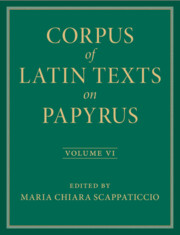
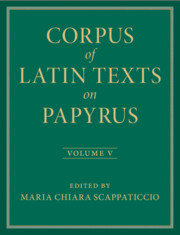
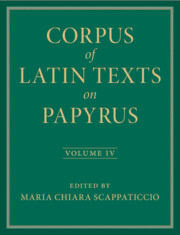
The Corpus of Latin Texts on Papyrus (CLTP) is a comprehensive, up-to-date, and unique reference tool in six volumes, gathering nearly 1,500 Latin texts on papyrus. Editions are provided with both a palaeographic and a critical apparatus, English translations, and detailed introductions. The texts in CLTP cover a wide chronological range and many different types and genres. They include both literary and documentary texts, dating from the first century BC to the Middle Ages. They provide new knowledge about the circulation of Latin, offering unique insights into textual transmission and indeed into Latin literature itself, but also into topics such as ancient education and multilingualism, economics, society, culture, and multiculturalism in the ancient Mediterranean world. The result is a lasting and crucial reference work for all those interested in the history of Latin and of the Roman world.
This paper investigates how Assyrian kings protected their material legacies for posterity and why in some prominent instances such protections failed, with a particular focus on the palaces of Kalḫu and Nineveh during the Sargonid Period. I approach this question through the lens of intergenerational reciprocity; Assyrian worldviews provided various channels through which past, present, and future kings could engage with one another in reciprocal and coercive relationships across time. Unlike curses and blessings, which were relatively easy for Assyrian kings to disregard, these reciprocal relationships provided more compelling incentives for rulers to honour and preserve their predecessors’ material legacies. However, practical or ideological concerns would sometimes result in the need to alter buildings in ways that damaged the material legacy of a past ruler. In some of these instances, steps were taken to symbolically compensate the past ruler in question for this damage. In this fashion, rulers were able to negotiate the ideological tension between tradition and innovation to preserve historical memory while adapting living cultural heritage to meet current needs.
The last decades have seen great scholarly interest in the fate of Roman temples and cult statues during the Christianisation of the Roman Empire. The surge of studies on spatiality and lived religion in Roman studies have demonstrated that ancient religious practice was not confined to sanctuaries but rather infused into all spheres of everyday life. Informed by these studies, I argue that the Christianisation effort was not confined to temples and cult statues in sanctuaries, despite the narrow focus on these monuments in legal and patristic sources. The spaces where people most frequently moved, lived, and practised religion in their everyday lives were equally important religious arenas. In this article I venture out of the temples and into the streets of late antique Ephesus to the Triodos intersection to highlight an array of subtle transformations that are unassuming in isolation, but together effectively Christianised the streetscape. I demonstrate that streetscapes were arenas of material Christianisation alongside monumental sanctuaries. The Triodos is used as a point of departure to show how the Roman streetscapes functioned as more-than-material religious assemblages. Human–material interaction in ritual and everyday movement and practices made the streetscapes active participants in the Christianisation process.
This chapter focuses on the domain of the vegetative soul that represents some of the simplest activities that distinguish the organic from the inorganic. It examines the central vegetative system consisting of the liver, the veins and their supporting organs, as well as the vegetative capacities present in all the tissues that are subservient to this system. The chapter not only discusses the relationship between the central parts and capacities in all of the body, but also examines the ways in which these capacities manifest themselves, arguing they represent Galen’s attempts to grapple with the notion of basic vitality. On some occasions, Galen also calls them ‘demiurgic’, implying a creative capacity. A discussion of how he engages with the pre-existing philosophical tradition and the notion of a biological demiurge helps to delineate the scope of these capacities.