To save content items to your account,
please confirm that you agree to abide by our usage policies.
If this is the first time you use this feature, you will be asked to authorise Cambridge Core to connect with your account.
Find out more about saving content to .
To save content items to your Kindle, first ensure no-reply@cambridge.org
is added to your Approved Personal Document E-mail List under your Personal Document Settings
on the Manage Your Content and Devices page of your Amazon account. Then enter the ‘name’ part
of your Kindle email address below.
Find out more about saving to your Kindle.
Note you can select to save to either the @free.kindle.com or @kindle.com variations.
‘@free.kindle.com’ emails are free but can only be saved to your device when it is connected to wi-fi.
‘@kindle.com’ emails can be delivered even when you are not connected to wi-fi, but note that service fees apply.
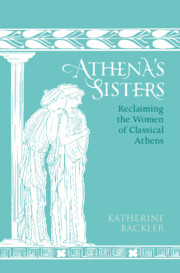
Athena's Sisters transforms our understanding of Classical Athenian culture and society by approaching its institutions—kinship, slavery, the economy, social organisation—from women's perspectives. It argues that texts on dedications and tombstones set up by women were frequently authored by those women. This significant body of women's writing offers direct insights into their experiences, values, and emotions. With men often absent, women redefined the boundaries of the family in dialogue with patriarchal legal frameworks. Beyond male social and political structures, women defined their identities and relationships through their own institutions. By focusing on women's engagement with other women, rather than their relationships to men, this timely and necessary book reveals the richness and dynamism of women's lives and their remarkable capacity to shape Athenian society and history.
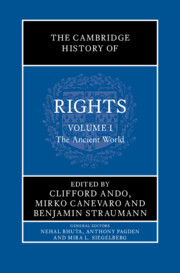
The ancient world existed before the modern conceptual and linguistic apparatus of rights, and any attempts to understand its place in history must be undertaken with care. This volume covers not only Greco-Roman antiquity, but ranges from the ancient Near East to early Confucian China; Deuteronomic Judaism to Ptolemaic Egypt; and rabbinic Judaism to Sasanian law. It describes ancient normative conceptions of personhood and practices of law in a way that respects their historical and linguistic particularity, appreciating the distinctiveness of the cultures under study whilst clarifying their salience for comparative study. Through thirteen expertly researched essays, volume one of The Cambridge History of Rights is a comprehensive and authoritative reference for the history of rights in the global ancient world and highlights societies that the field has long neglected.
This chapter situates classical education in late antique Gaul in its historical context, positioning the work within the current scholarly debates, and building on recent scholarship on late antique Gaul. Arranged thematically, Chapter 2 considers key developments in the political and military relationships between the western Roman empire, Gallo-Romans and barbarian groups, the prospects and prosperity of Gallo-Roman aristocrats, the increasing dominance of the Church and bishops in daily life, and the vitality and continuity of Gallo-Roman cities. It considers the conditions necessary for classical education to thrive and function and discusses how the structures that fostered education were affected by the political, military, religious, and cultural transformations of fifth-century Gaul.
Chapter 1 opens with a discussion of the foundational importance of classical education in Roman society and politics, and how it served as a basis for both office-holding and elite Roman identity and self-fashioning. The chapter also provides a prosopographical sketch of the teachers and students that are visible in the historical record from the fourth to early sixth centuries in Gaul, showing that identifiable teachers and students begin to fade from the sources from the later-fifth and early-sixth centuries. It discusses the marked shift in the visibility of these individuals, the changing nature of our sources for education throughout the period, the limitations of our sources, and what we can learn from those limitations. The chapter argues that, while classical education largely disappears from the historical record by the early sixth century, this by no means indicates that classical education ceased to exist entirely. Rather, it shows that classical education was no longer a ‘public’ institution as it had been under the Roman empire, and that it did not occupy that specific place within politics, society, and culture that allowed it to be visible and take a prominent place in the technical and literary texts of the period.
Tracing the development of Rome over a span of 1200 years, The Topography and Monuments of Ancient Rome offers an overview of the changing appearance of the city and the social, political, and military factors that shaped it. C. Brian Rose places Rome's architecture, coinage, inscriptions and monuments in historical context and offers a nuanced analysis regarding the evolution of the city and its monuments over time. He brings an interdisciplinary approach to his study, merging insights gained from cutting-edge techniques in archaeological research, such as remote sensing, core-sampling, palaeobotany, neutron-activation analysis, and isotopic analysis, with literary, epigraphic, and numismatic evidence. Rose also includes reconstructions of the ancient city that reflect the rapid developments in digital technology and mapping in the last three decades. Aimed at scholars and students alike, Rose's study demonstrates how evidence can be drawn from a variety of approaches. It serves as a model for studying and viewing the growth and structure of ancient cities.
This chapter argues that Augustine adopts a second-person perspective, which “is characterized by dialogical speech, shared awareness of shared focus with the second person, and an orientation to love that other person.” This perspective shapes his understanding of the moral life; it gives pride of place to second-person relations, whether in the virtuous love of God and neighbor or in the disordered friendship without which Augustine tells us he would not have stolen the pears. Examining three virtues – humility, mercy, and charity – the chapter shows how each of them can be understood only in terms of proper relatedness to some other person. Since these virtues are prominent in the Confessions but altogether absent from the Nicomachean Ethics, a close look at them reveals the considerable differences between an Augustinian and an Aristotelian approach to the virtues. It also sheds light on how to read Thomas Aquinas. Aquinas’ considerable inheritance from Augustine goes largely ignored by scholars focusing on Aquinas’s Aristotelianism. Attention to Augustine is accordingly crucial for a more balanced understanding of Aquinas; it also holds promise for future work in virtue ethics.
One of the conversion stories related to Augustine in the run-up to his own conversion was that of the philosopher and orator Marius Victorinus, who had translated the “books of the Platonists” that Augustine encountered in Book 7. What he does not tell us, however, is how important Victorinus was, not only as an exemplar of boldness in confessing Christ, but in shaping Augustine’s own reading of Plotinus. This chapter compellingly lays out Victorinus’ influence on Augustine’s Trinitarian theology as expressed in a brief and bewildering passage in Book 13. It shows that wherever Augustine departs from Plotinus, he does so in a way that he found in Victorinus; Victorinus also taught Augustine distinctions and arguments from Platonic and Aristotelian metaphysics that he could not have known from other Latin texts available to him. Through Augustine, then, Victorinus had a much larger influence on the history of metaphysics than has been appreciated up to now. Moreover, we find that “Augustine’s common designation as ‘Platonist’ would be more precise if it were revised to ‘Victorine Neoplatonist.’”
This chapter takes up the language-learning passage from Confessions 1.8.13, which Wittgenstein quoted at the beginning of his Philosophical Investigations. “Where Wittgenstein notices an impossible kind of foreignness in Augustine’s confessional account of first language-learning,” it observes, “Augustine negotiates the mystery of the soul’s alienation from God.” Here is another kind of foreignness, and that chapter aims at inducing a kind of perplexity in our consideration of Augustine’s superficially straightforward account of language-learning. Drawing on Augustine’s dialogue On the Teacher, it invites us to puzzle over Augustine’s insistence that language is for teaching – apparently to the exclusion of learning – only to find him concluding that no human being is ever a teacher. The only teacher is the Inner Teacher, the Word, who teaches not by signs but by the realities themselves, with an intimacy and interiority that the infant Augustine longed for but never captured. The Word’s teaching overcomes both the foreignness and the alienation with which Augustine began, though this resolution poses the temptation “to render the whole of the earth, indeed even creation itself, into a place of unlikeness.”
This chapter examines Augustine’s relationship to earlier biblical exegesis. It emphasizes three distinctive preoccupations of Augustine’s exegesis: “the constraints of language, the limits of the human mind’s capacity to know God or the author’s intention, and the habits of the flesh to follow the desires of its senses.” After elucidating Augustine’s approach to these issues – which in itself sets him somewhat apart from his predecessors and contemporaries – the chapter presents two informative case studies. The first concerns Genesis, the topic of Confessions 11–13. Augustine’s exegesis of Genesis is informed from the beginning by his determination to reject the Manichaean dismissal of that book as silly and anthropomorphic, but his engagement with Genesis matures over time: his earliest discussions are far more indebted to Ambrose than his later, more distinctive, exegesis. The second case study concerns the Song of Songs. Here Augustine insists upon the goodness, beauty, and order of the material world, redeeming the five senses as intimations of the divine.
This chapter gives fruitful attention to the role of the sacraments in the Confessions. It delineates the ways in which the sacrament of baptism structures the autobiographical books, with baptism foregrounded in the first book (Augustine’s baptism postponed), the central or hinge book (Book 5, in which Augustine’s baptism is again deferred), and the climactic book (Book 9, in which Augustine’s baptism is recounted, along with many other baptisms, quite a few of which did not take place within the chronological scope of Book 9). The Eucharist, which was for Augustine the other sacrament of initiation and for which baptism itself was a prerequisite, comes into clear view at the end of Book 9 and in Book 10. The exegetical books then treat Genesis as “a model for all of Christian life, and especially that of the church,” a life inaugurated in baptism and sustained by the Eucharist. Contrary to the view of some scholars, who see very few Eucharistic allusions in the Confessions, the chapter shows that many of Augustine’s images – especially of food and of milk – have Eucharistic overtones.
This chapter explores the many uses of Scripture in the Confessions. Augustine draws words, images, and themes from Scripture; he tells the story of his own successive (and sometimes unsuccessful) encounters with Scripture; he invites his readers into a lively relationship with Scripture. Augustine presents himself as living out the stories of Biblical characters – Adam, the prodigal son, Moses, the Apostle Paul – and as speaking the words of Scripture in his own voice, as his own words. Augustine’s extensive appropriation of the Psalms is of particular importance: “The Psalms do more than stage or frame Augustine’s narrative; they shape its presentation and supply its substance.” Scripture proves to be central both for Augustine’s self-dispossession, his casting away of the old life, and for his self-conception, his understanding and inhabiting of the new.
Grace and providence, much like the sacraments (which are instruments of grace), are pervasive in the Confessions. Yet we learn about them, not from any explicit theorizing or argumentation on Augustine’s part, but by examining their role in the dual narrative: the personal narrative of Augustine’s life and the cosmic narrative of creation and redemption. This chapter considers how grace (God’s unmerited favor) and providence (God’s directing of the course of events in the service of his own ends) shape, but do not determine, Augustine’s life. Although there is no explicit consideration in the Confessions of the relationship between grace and free choice, the overwhelming message of the work seems to be that grace is indispensable but not irresistible: God makes Augustine into the kind of person who can accept grace, but not someone who cannot help but accept it.
Chapter 5 discusses the relationship between Christians and classical education, and the emergence of Church schools in monasteries and episcopal households. It argues that while the Church never set out to consciously replace or compete with the classical schools, nor to destroy classical literary culture, the Church neither taught classical grammar and rhetoric, nor did it expect such high educational attainments for membership or promotion within its hierarchies. At the same time, the presence of new learning and career opportunities within the clergy, and the increasing rise of asceticism or monasticism indirectly contributed to the marginalisation of traditional classical educational institutions and the disappearance of schools of grammar and rhetoric from public life by the early sixth century.
The concluding chapter reflects upon how the themes and questions explored in the book speak to familiar concerns of families, communities, and societies across time. What is the purpose of education? What do we expect of our education, and in what ways does our pursuit of knowledge and our learning define who we are? The conclusion draws together the arguments from the preceding chapters, considering in what ways the ‘fall’ of Rome meant the end of the schools of grammar and rhetoric in Gaul. Without the superstructure of the Roman empire, the socio-political culture that valued literary education disappeared, and the schools soon followed suit; it was not primarily material changes caused by the political, cultural, and religious upheavals of the fifth century that led to the decline of the schools, but rather marked changes in the attitudes and mindset towards education and learning of the emerging power brokers of post-imperial Gaul – the barbarian kingdoms and the Church.