Metrics
Full text views
Full text views help
Loading metrics...
* Views captured on Cambridge Core between #date#. This data will be updated every 24 hours.
Usage data cannot currently be displayed.
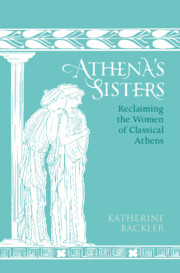
Athena's Sisters transforms our understanding of Classical Athenian culture and society by approaching its institutions—kinship, slavery, the economy, social organisation—from women's perspectives. It argues that texts on dedications and tombstones set up by women were frequently authored by those women. This significant body of women's writing offers direct insights into their experiences, values, and emotions. With men often absent, women redefined the boundaries of the family in dialogue with patriarchal legal frameworks. Beyond male social and political structures, women defined their identities and relationships through their own institutions. By focusing on women's engagement with other women, rather than their relationships to men, this timely and necessary book reveals the richness and dynamism of women's lives and their remarkable capacity to shape Athenian society and history.
‘Katherine Backler shows how much we can learn about women's actual lives and relationships to one another from fourth-century BC orations and inscriptions, all of which offer much more specific information about the authentic lives of women in the ancient Greek world than can be gleaned from epic and drama. The result is a more detailed, dynamic and positive picture of women's lives than can be derived from literary texts alone.'
Mary Lefkowitz - Mellon Professor Emerita in the Humanities and Professor Emerita of Classical Studies at Wellesley College
‘This is an exciting contribution to a growing body of scholarship showing that ancient Athenian women had distinct identities and agency beyond their roles as wives and mothers. Drawing on a range of sources including forensic oratory and inscriptions, Backler uncovers the perspectives and even possibly the voices of these multifaceted women from antiquity. This book is original and likely to gain a wide audience.'
Sara Forsdyke - Josiah Ober Collegiate Professor of Ancient History, University of Michigan
Loading metrics...
* Views captured on Cambridge Core between #date#. This data will be updated every 24 hours.
Usage data cannot currently be displayed.
This section outlines the accessibility features of this content - including support for screen readers, full keyboard navigation and high-contrast display options. This may not be relevant for you.
The PDF of this book is known to have missing or limited accessibility features. We may be reviewing its accessibility for future improvement, but final compliance is not yet assured and may be subject to legal exceptions. If you have any questions, please contact accessibility@cambridge.org.
Allows you to navigate directly to chapters, sections, or non‐text items through a linked table of contents, reducing the need for extensive scrolling.
Provides an interactive index, letting you go straight to where a term or subject appears in the text without manual searching.
You will encounter all content (including footnotes, captions, etc.) in a clear, sequential flow, making it easier to follow with assistive tools like screen readers.
You get concise descriptions (for images, charts, or media clips), ensuring you do not miss crucial information when visual or audio elements are not accessible.
You will still understand key ideas or prompts without relying solely on colour, which is especially helpful if you have colour vision deficiencies.
You gain clarity from ARIA (Accessible Rich Internet Applications) roles and attributes, as they help assistive technologies interpret how each part of the content functions.
