To save content items to your account,
please confirm that you agree to abide by our usage policies.
If this is the first time you use this feature, you will be asked to authorise Cambridge Core to connect with your account.
Find out more about saving content to .
To save content items to your Kindle, first ensure no-reply@cambridge.org
is added to your Approved Personal Document E-mail List under your Personal Document Settings
on the Manage Your Content and Devices page of your Amazon account. Then enter the ‘name’ part
of your Kindle email address below.
Find out more about saving to your Kindle.
Note you can select to save to either the @free.kindle.com or @kindle.com variations.
‘@free.kindle.com’ emails are free but can only be saved to your device when it is connected to wi-fi.
‘@kindle.com’ emails can be delivered even when you are not connected to wi-fi, but note that service fees apply.
This chapter investigates spiritual sight alongside the other spiritual senses, most notably hearing and touch. Drawing on the work of Hans Jonas, it offers a taxonomy of the spiritual senses in the Confessions. Spiritual sight is the noblest of the spiritual senses, as literal sight is the noblest of the physical senses, and the language of sight pervades Augustine’s account of his mystical ascent in Book 7. Yet sight is dethroned in the vision at Ostia, which Augustine shares with his mother, Monnica; it gives way to hearing and touch. Why, if sight is the noblest of the senses, is it replaced in this way? The chapter argues convincingly that “the critique of sight in the conf. is expressive of Augustine’s mature theology of the vision of God, which is increasingly critical of Platonic theoria and its attempt to ascend to a vision of the divine apart from the temporal and material modality of grace.” Eschatologically, sight is prior: “When he appears, we shall be like him, for we shall see him as he is.” But for now, touch and hearing are “means of arriving at this vision.”
This chapter examines Augustine’s discussion of time in Book 11. The contrast between eternity, in which there is no succession or change, and time, which is nothing but succession and change, is a crucial first step. Augustine uses this contrast to distinguish between ordinary utterances and God’s creative Word, the coeternal Son. Time is itself created, so there is no sense in asking what God was doing before he created, though Augustine’s understanding of the relationship between time and eternity raises difficult philosophical questions that Augustine himself does not address, though recent philosophers of religion have done so. Augustine appears to hold that only what is (temporally) present exists. The most contentious issue is whether Augustine holds a subjectivist theory of time, and if so, what exactly that theory is. After canvasing the merits of possible answers to that question, the chapter concludes that the most charitable reading is that Augustine “does not seem to offer an account of what time is but instead ‘merely’ offers an aporetic examination of certain puzzles concerning time and our experience of it.” This construal is "entirely in keeping with his frequently open-ended and exploratory manner of philosophical investigation.”
The present volume offers twelve new essays by leading scholars working from a variety of interdisciplinary perspectives: theology, both systematic and historical; ancient history and early Christian history; and ancient and medieval philosophy. It is a fitting variety of approaches for a work that emphatically – and sometimes bewilderingly – is not just one thing. The Confessions is an autobiography, a prayer, a song; it is a treatise on God and his providential governance, both of one life and of the whole sweep of history; it is a meditation on Scripture. It is meant to inform, to perplex, but above all to “lift the human heart and mind to God” (retr. 2.6.1). Even the word confessio has multiple meanings: solemn avowal or acknowledgment, the offering of praise and thanksgiving, and the admitting of one’s own sins.
This chapter considers the ideological aspects of classical education, exploring how the shifting political and cultural landscapes of Gaul changed the way Gallo-Roman aristocrats practiced and perceived education, and how this is reflected in our sources from the fourth to sixth centuries. While in the fourth century classical education is valued mainly for its tangible rewards and is closely linked to imperial structures of power, throughout the fifth century Gallo-Romans increasingly highlight the personal and ideological uses of education in shaping and affirming their status and identity. Teachers of grammar and rhetoric are more closely linked to aristocratic literary circles, which goes hand in hand with an increased blurring of the distinctions between grammatical and rhetorical teaching and a narrowing of education and literary networks. These changing attitudes and practices of education reflect the underlying political and social transformations of fifth-century Gaul and Gallo-Roman aristocratic anxieties and responses to them.
This chapter elucidates the ways in which “narrative can serve as a tool for the orientation of consciousness.” The dual narrative of the Confessions – nine books of personal narrative, joined by a book on memory to a cosmic narrative of creation and redemption – conveys, and is intended to convey, theological truth. In his theological work Augustine draws on, amplifies, and corrects (as he sees it) such figures as Origen (though only at second hand), Basil of Caesarea, and Ambrose to articulate his own distinctive views on knowing and willing, the condition of the fallen human will, and the source and destiny of creation. In concluding remarks that elegantly distil the unity of the Confessions, that chapter observes that “Augustine cannot give an account of his life that is not also an account of the work of God.”
This chapter emphasizes narrative as a vehicle for psychological analysis. It begins by noting the prominence of emotion in the Confessions; Augustine himself tells us in the Reconsiderations that the work is meant to arouse not just the mind but also the heart toward God. It argues that the Confessions contributes to ancient philosophical debates about the character of the emotions and how they should be controlled and moderated. The work presents a “therapy of the emotions” that is sometimes aligned with, and sometimes in critical tension with, the philosophical spiritual exercises proposed by earlier writers. Augustine is, in certain respects, more hopeful about progress in virtue than his philosophical predecessors; he presents his therapy of the soul for everyone, not just those with fortunate natural proclivities. Yet he insists that such progress can be made only by God’s grace. The techniques of ancient philosophy are, in themselves, unavailing for moral transformation.
This chapter focuses on the practical aspects of education, such as the organisation and funding of the classical schools. It traces the status of classical education as a public institution in the late imperial period, during the transformations of the fifth century, and within the early barbarian successor kingdoms. The chapter begins by establishing the extent of direct involvement of the imperial government in education, arguing that cities and individuals had always played a far more important role in patronising and funding classical schools. It then considers opportunities for ‘graduates’ of classical schools in late and post-imperial Gaul, the crucial difference between literacy and literary education, and emphasises the important connection between classical education and structures of power that promote and demand literary training.
This chapter lays out two key tasks in reading Scripture that Augustine identifies in the Confessions, and especially in his exegesis of Genesis: “the task of grasping meaning” and “the task of grasping truth.” The first task is that of discerning authorial intention; the second is that of “seeing for oneself that what the author is saying is in fact the case.” The task of grasping meaning is difficult in part because of the peculiar character of the Scriptures; they are both accessible to all, using ordinary language (which is open to misinterpretation), and yet full of profundities that only the wisest readers can come to appreciate. It is also difficult because we cannot really know what is in another person’s mind; any judgments about authorial intention are provisional at best, and only pride would claim to have identified the uniquely correct interpretation. The task of grasping truth is likewise difficult. When it comes to intelligible realities, Truth speaks inwardly, not through any text, even that of Scripture. When it comes to historical realities, including the central truths about the life of the Incarnate Word, we cannot have knowledge in the fullest sense.
The introduction sets out the approaches, sources, and scope of the book. It acquaints the reader with the main features of classical education and places the book within the modern historiography.
Economies are fundamental to all human societies by providing the material support for their populations and respective social institutions. This volume brings together scholars from archaeology, anthropology, and history in a collaborative examination of how premodern societies produced and mobilized resources to support social, political, and religious institutions. Thirteen societies from horticultural/pastoral groups to expansionistic states are used to develop a truly comparative view of economic development. Topics discussed include the nature of productive self-sufficiency, forms of economic specialization, the economics of labor and resource mobilization, economic inequality and stratification, commerce and the marketplace, and urban and ritual economies. The book's collective discussions have led to the construction of five generalizations and eighteen specific hypotheses about the way that ancient and premodern societies navigated the material worlds in which they lived. These hypotheses will serve as a basis for scholars exploring how societies in other times and places navigated their economic landscapes.
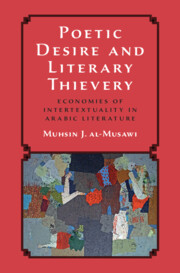
How do we define plagiarism in literature? In this wide-ranging and innovative study, Muhsin J. al-Musawi examines debates surrounding literary authenticity across Arabic and Islamic culture over seven centuries. Al-Musawi argues that intertextual borrowing was driven by personal desire alongside the competitive economy of the Abbasid Islamic Empire. Here, accusations of plagiarism had wide-ranging consequences, as competition among poets and writers grew fierce, while philologists and critics served as public arbiters over controversies of alleged poetic thefts. Taking in an extensive remit of Arabic sources, from Persian writers to the poets of Andalusia and Morocco, al-Musawi extends his argument all the way to Ibrāhīm ᶜAbd al-Qādir al-Māzinī's writing in Egypt and the Iraqi poet Nāzik al-Malā՚ikah's work in the twentieth century to present 'theft' as a necessary condition of creative production in Arabic literature. As a result, this study sheds light on a vast yet understudied aspect of the Arabic literary tradition, while raising important questions surrounding the rising challenge of artificial intelligence in matters of academic integrity.