To save content items to your account,
please confirm that you agree to abide by our usage policies.
If this is the first time you use this feature, you will be asked to authorise Cambridge Core to connect with your account.
Find out more about saving content to .
To save content items to your Kindle, first ensure no-reply@cambridge.org
is added to your Approved Personal Document E-mail List under your Personal Document Settings
on the Manage Your Content and Devices page of your Amazon account. Then enter the ‘name’ part
of your Kindle email address below.
Find out more about saving to your Kindle.
Note you can select to save to either the @free.kindle.com or @kindle.com variations.
‘@free.kindle.com’ emails are free but can only be saved to your device when it is connected to wi-fi.
‘@kindle.com’ emails can be delivered even when you are not connected to wi-fi, but note that service fees apply.
The fourteenth-century poet John Gower was a prodigiously Ovidian author, especially throughout his Latin Vox clamantis and English Confessio amantis. It is in the Vox clamantis, and its first book the Visio Anglie, where Gower fully engaged with Ovid in exile, and where he became the Ovidian exile in the ways theorised in Chapter 4. While Gower did not experience exile or marginalisation in real life, in the Visio he inhabits Ovidian exile to respond to the 1381 Uprising. Menmuir firstly speculates how Gower might have read Ovid’s exile poetry. She also considers different theoretical approaches to Gower’s use of Ovid, including cento. Thereafter, the chapter progresses sequentially through the Visio, charting Gower’s range of approaches to the exilic Ovid. At the opening of the Visio, Gower compresses prevailing themes of the exile poetry. Chapter 16 of the Visio is the height of Gower’s Ovidian exilic inhabitation, where Gower shifts to speaking in a first-person voice. The storm at sea in the Visio is drawn from Ovid in exile. Finally, a voice from Heaven speaks to the Gowerian narrator but is in fact a mouthpiece for Ovid in exile.
The Introduction establishes the primary arguments and scope of the book. It defines ‘Ovidian exile’ in two related ways: firstly, as the poetry written by Ovid in exile, namely the Tristia, Epistulae ex Ponto and Ibis; and secondly, as Ovid himself as the figure of the exiled poet. Ovidian exile in these terms had a vast influence across medieval culture, informing teaching, preaching, reading and writing – among a host of activities Menmuir terms ‘responses’ – in the later Middle Ages, offering a mode of voicing exile, marginalisation and poethood itself. After describing the circumstances of Ovid’s exile and the primary concerns of the exile poetry, Menmuir introduces the Ovid, or Ovids, of the Middle Ages, including the common perception of Ovid as the tripartite mythographer, lover and exile. Ovid and his works were deemed ethical, and even Christian, in medieval exegesis: the fact of his exile created a penitential arc which enabled Ovid’s transformation into Ovidius ethicus. Menmuir defines ‘responses and respondents’, where ‘response’ comprises a more active expression of ‘reception’. The book’s scope primarily includes responses between the twelfth and the fifteenth centuries and focuses on England, albeit as linked to the continent in several ways.
Chapter 3 examines the consanguinity of Ovid’s two bodies, or corpora: his body of work (his textual corpus) and his physical body, which here represents his living body, corpse, tomb and biographical life. Medieval commentators took great interest in the relationship between Ovid’s bodies, responding diversely to the opportunities – and challenges – posed by Ovid’s insistent focus on the relationship. Their responses illuminate the mechanisms by which Ovid was transformed from an immoral, salacious poet to a moral, edifying one. A surprising element of that metamorphosis is that the pagan Ovid became a justifiably Christian poet for the medieval age. The chapter discusses Ovid’s presentation of his corpora in the exile poetry and the medieval obsession with Ovid’s tomb, before focusing on three medieval case studies: the Nolo Pater Noster anecdote, a medieval Latin narrative where two clerics are visited by the spirit of Ovid; Guillaume de Deguileville’s Le pèlerinage de la vie humaine and John Lydgate’s English rendering of the text, The Pilgrimage of the Life of Man, where a figure on pilgrimage encounters Ovid’s exilic revenant; and Christine de Pizan’s Le livre de la cité des dames, in which Ovid is resurrected only to be castrated.
Chapters 4, 5 and 6 form Part II of this book, which turns to later medieval poets who became the Ovidian exile in some way, especially by inhabiting an Ovidian exilic voice. Chapter 4 is a manifesto for this theory of voice, drawing particularly on David Lawton’s concept of ‘public interiorities’. The first section of this chapter surveys the medieval and modern theories of voice which help us understand how Gower, Chaucer and other medieval authors conceptualised voice. The core of a theory of vox is Aristotle, whose ideas were developed in late antiquity and the Middle Ages. Next, the chapter considers medieval respondents who used Ovid’s exilic voice well before the fourteenth century. It focuses especially on Modoin (d. c. 840) and Baudri of Bourgueil (c. AD 1046–1130) as representative of the classicising of the Carolingian Renaissance and the ‘Loire School’, respectively. These writers engaged productively with Ovid’s exilic voice but did not inhabit it in the same way that Gower and Chaucer did. The third and final section of this chapter asks why Gower and Chaucer, writing in fourteenth-century Ricardian London, were impelled to ‘become’ Ovid in exile in a new way.
Chapter 6 explores Geoffrey Chaucer’s Ovidian exilic voice. Scholarly thought has long held that Chaucer did not read or even know Ovid’s exile poetry, a contention which this chapter refutes. While Gower relied on explicit linguistic borrowing to inhabit Ovid in exile, Chaucer instead took an indirect approach, embedding Ovidian refrains, themes and concerns across his corpus. Menmuir discusses Chaucer’s linguistic references to Ovid’s exile poetry, which are our most direct pieces of evidence demonstrating that he was aware of the exilic works and knew how they could be effectively deployed. Direct quotations of Ovid, however, do not constitute Chaucer inhabiting an exilic voice. The latter half of the chapter argues that Chaucer became the Ovidian exile in the figures of Troilus and the narrator in Troilus and Criseyde; the Prologue to The Legend of Good Women, where the narrator is an Ovidian exile responding to an irascible ruler; and in Chaucer’s ‘Retraction’, which closes The Canterbury Tales by appealing to Ovidian exilic ambiguity. These works show the extent to which Chaucer understood the fundamental concerns of Ovid in exile, adopting them for his own work and times, his own tense imperial relations and his own desire for poetic immortality.
Chapter 2 explores the influence of the exilic Ovid in medieval scholastic contexts by examining three types of medieval forms. Firstly, accessus (introductions to authors) shaped how Ovid’s poetry would be interpreted: their heavy reliance on Ovid’s exilic self-fashioning and biographising meant that Ovidian exile came to frame Ovid’s entire corpus. Secondly, manuscripts of Ovid’s exile poetry and their paratexts, especially glosses and marginal annotations, provided a framework for teaching and learning through Ovid’s exile. Finally, florilegia and excerpted forms of Ovid’s exile poetry posed a challenge to that life–work connection formed by the exile poetry, ostensibly withdrawing the context of Ovid’s full output; but they nevertheless retained enough order for Ovid’s exile to be recognisable. Examining these forms illustrates two key aspects of medieval responses to Ovid’s exile. Accessus, glosses and florilegia are all deeply connected to pedagogy and to a medieval ‘scholastic sphere’ – monastic and secular places of learning in which Ovidian exile could be used to teach and preach. Further, the proliferation, diversity and sheer quantity of these different types of exilic Ovidiana are evidence for the popularity and widespread knowledge of Ovid and his exile in the later Middle Ages.
Chapter 1 presents Ovid in exile as a highly self-conscious, reflexive figure whose ironic turns perforate a real desire to effect both an imperial pardon and poetic immortality. Moreover, the chapter situates Ovid as the first respondent to his exile, finding many points of commonality between the ways that Ovid and medieval respondents reacted to his exile (in other words, medieval audiences used Ovid as a model for their responses). This chapter makes these arguments from three perspectives. Firstly, it characterises Ovid’s response, focusing especially on his desire to control the narrative being relayed both to Augustus in Rome and to posterity. Secondly, it explores Ovid’s tendency to revise his works. He edits and revises his pre-exilic poetry from the perspective of his exile and reworks his exile poetry over the course of his relegation. Finally, it argues that Ovid’s depictions of his exile as severe are another vehicle for modelling a flexible response. Overall, Ovid constructed an authoritative hold over his life and works but nevertheless formed a response which allowed for ambiguities that could be embedded into that authority. This double model allowed medieval respondents to incorporate both equivocation and authority into their own poetic self-presentation.
Herodotus’ depiction of Miltiades’ transgression in the sanctuary of Demeter Thesmophoros on Paros is marked by the intriguing phrase κινήσοντά τι τῶν ἀκινήτων (6.134.2). We examine this proverbial phrase, whose implications for Herodotus’ portrayal of Miltiades’ downfall have not yet been fully acknowledged. The article draws attention to the widespread concept of sacred immovables (ἀκίνητα) that were protected by imprecations, and suggests that Miltiades triggered a contingent curse protecting divine property. Herodotus configures the episode of Miltiades on Paros as a narrative of entrapment and steers his readers to view Miltiades’ fate as the consequence of a curse at work.
According to an account that Felix Jacoby published as Philochoros (FGrH 328) F119, a gift of 30,000 medimnoi of grain was sent by Psammetichos from Egypt to Athens in the archonship of Lysimachides (445/4). When for its distribution a scrutiny (diapsēphisis) was held to check the citizen status of the claimants, 4,760 individuals appeared to be illegally listed as citizens, while 14,240 Athenians received a portion of grain. Brought together in this fragment, the events feature as a significant historical fact in studies of Pericles’ Citizenship Law, Athenian demography and the Athenian grain supply. However, in this article I argue that the account in F119 is not correct as it stands, but a conflation of historically disparate events into one episode. This confusing amalgam is not Philochoros’ mistake, but, with several possible causes, it must originate in the tradition between him and Plutarch, who incorporated it into his Life of Pericles (37). The most likely source of this conflated report for Plutarch’s version is the Alexandrian scholar Didymos. A major element in the confusion is the diapsēphisis of 346/5, when all male citizens scrutinized each other on their civic status, a one-off event that deeply affected Athenian society and its historical traditions.
This study examines the Ionic frieze of the Parthenon, focussing on the concept of ‘Divinespace’ and ‘Mortalspace’ within its artistic composition. I examine how divinities and mortal figures are depicted in specifically designated spaces and how they intersect during the Panathenaic procession. Notably, two gods, Aphrodite and Hermes, are observed crossing into ‘Mortalspace’, identified by the two groups of athlothetai—officials responsible for the festival’s organization. The casual nature of their presence and the lack of awareness shown towards divine intrusions add depth to the understanding of ancient Greek religious art and rituals. By analysing votive reliefs from the Athenian Akropolis and by comparing them to the frieze, this research sheds light on the intricacies of the depiction and symbolism in this remarkable ancient artwork.
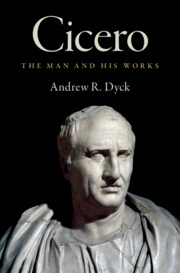
Cicero is one of the most important historical figures of classical antiquity. He rose from a provincial family to become consul at Rome in 63 BC and continued to play an active role in politics before his murder under the triumvirs Octavian, Mark Antony, and Lepidus. He also engaged in Roman intellectual culture, writing key works on both rhetoric and philosophy. We have a very large body of written evidence by and about him – far more than for any other figure of the Roman Republic – including private correspondence not intended for publication. However, previous biographers – in mapping his political career – have mostly overlooked his other activities. Taking a broader perspective enables a much fuller and richer profile of him to emerge. This epochal new portrait of Rome's great orator offers a more complete picture of the man, his personality, and his works in the overall context of his remarkable life.
This article examines the two families of denominative verbs from the semantic field of atimia: atimaô/atimoô and atimazô. By analysing their use in the Attic orators and other major prose texts from the Classical period (Herodotus, Thucydides, Xenophon, Plato and Aristotle), the article shows that these verbs were consistently employed in differentiated, well-defined ways: atimaô/atimoô for ‘effecting an actual loss of status’, and most normally for ‘imposing the legal penalty of atimia’ (especially in the orators), and atimazô for extra-legal examples of ‘dishonour’. This distinction is in part reflected also in the ratios of verbal aspect for the two families, with atimaô/atimoô being used mostly in aorist and perfective forms and atimazô mostly in imperfective forms.