To save content items to your account,
please confirm that you agree to abide by our usage policies.
If this is the first time you use this feature, you will be asked to authorise Cambridge Core to connect with your account.
Find out more about saving content to .
To save content items to your Kindle, first ensure no-reply@cambridge.org
is added to your Approved Personal Document E-mail List under your Personal Document Settings
on the Manage Your Content and Devices page of your Amazon account. Then enter the ‘name’ part
of your Kindle email address below.
Find out more about saving to your Kindle.
Note you can select to save to either the @free.kindle.com or @kindle.com variations.
‘@free.kindle.com’ emails are free but can only be saved to your device when it is connected to wi-fi.
‘@kindle.com’ emails can be delivered even when you are not connected to wi-fi, but note that service fees apply.
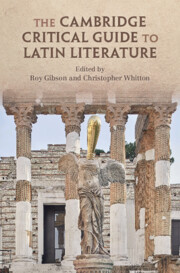
The Cambridge Critical Guide to Latin Literature offers a critical overview of work on Latin literature. Where are we? How did we get here? Where to next? Fifteen commissioned chapters, along with an extensive introduction and Mary Beard's postscript, approach these questions from a range of angles. They aim not to codify the field, but to give snapshots of the discipline from different perspectives, and to offer provocations for future development. The Critical Guide aims to stimulate reflection on how we engage with Latin literature. Texts, tools and territories are the three areas of focus. The Guide situates the study of classical Latin literature within its global context from late antiquity to Neo-Latin, moving away from an exclusive focus on the pre-200 CE corpus. It recalibrates links with adjoining disciplines (history, philosophy, material culture, linguistics, political thought, Greek), and takes a fresh look at key tools (editing, reception, intertextuality, theory).
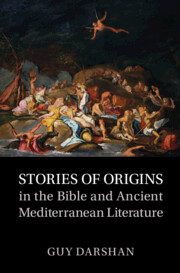
In this book, Guy Darshan explores stories of origins that lie at the heart of Pentateuchal sources in the context of literature created in neighboring societies of the ancient Mediterranean world. A comparative study, his volume analyses the parallels between Biblical origin stories – the narrative traditions arranged in geneaological sequence that recount the beginnings of humanity and origins of peoples -- in tandem with ancient Greek genealogical writings from the 7–5th centuries BCE onwards. He also considers Phoenician and Anatolian sources from the first millennium, several of which have only been published in recent years. This is the first scholarly study to trace the origins of this genre of narrative and the circumstances that led to appearances in the Hebrew Bible and ancient Mediterranean literature. It sheds new light on our knowledge of the history of literature, as well as the interconnections and interrelations between civilizations of the pre-Hellenistic eastern Mediterranean and Near East.
Sappho fr. 16V is often read as a repudiation of the heroic military ethos of Homer’s Iliad. It is argued here instead that the fragment presents Helen as an exemplar of how to negotiate erotic and personal preferences that lie outside of Homeric epic’s binaries. With Sedgwick’s “third alternative” as its model, the chapter traces some of the patterns that link Helen to Troy, in both epic and lyric, and explores how these intersect with the desire the singer of Sappho fr. 16V feels for her absent lover, Anactoria. Sappho, it is argued, chooses for herself the “third alternative” that the Iliad refuses, modeling her Anactoria on an almost-queer male hero from that poem, and at the same time celebrating Helen’s subversive orientation toward the poetics of female memory in the Odyssey.
This chapter offers a new reading of Sappho’s Tithonos Poem, and turns to Sedgwick’s “bardo” writings as a framework for exploring the feeling of suspension that characterizes Sappho’s poem. Sappho’s lyrics respond to the absences and silences in epic, as well as to what is more explicitly there. Often, the body in Sappho can be understood as providing cues for the voice, with symptoms arising within the body prompting the singer’s recall of certain mythical parallels. In the Tithonos Poem, for example, the singer’s sense of heaviness in her limbs prompts her recall of the mythical figure Tithonos, the ever-aging yet deathless lover of Dawn. It is argued that the singer’s own groaning lament becomes intertwined with that of Dawn for Tithonos, but it also potentially channels Achilles’ mourning for Patroklos. Sappho ventriloquizes the voices of Homeric characters. This has been acknowledged in the case of Helen but as this chapter argues, Achilles’ mournful lament also provides a surprising and powerful zone of contact between the worlds of epic and lyric.
Chapter 3 looks at the way Sappho responds to material objects in Homer, and explores how plaiting becomes a metaphor for Sappho’s own poetic production. With readings of some of the lesser-known fragments (e.g., frr. 102V, 110V, and 22), as well as a re-examination of Aphrodite’s famed epithet (poikilothronos) in fr. 1, this chapter highlights Sappho’s generic range and poetic creativity, as well as her noncompetitive appropriation of the affects of fear, desire, and breathlessness that are associated with weaponry in the Iliad. In Sappho’s lyrics, similar emotions are produced by women’s garments, jewelry, and other forms of bodily adornment. The chapter ends with an interpretation of Alcaeus 140V, whose orientation towards Homeric weaponry, it is argued, is distinctly more aspirational than wily and playful.
This chapter brings Sappho fr. 44V into dialogue with queer theorist Lee Edelman’s notion of reproductive futurism. As part of its represention of the wedding entourage of Andromache and Hector, Sappho fr. 44V invites us to reconsider the value of “undying fame” (aphthiton kleos) when this eminently heroic commodity is imported from martial epic into a poetic space where love, desire, and marriage overshadow military pursuits. It is argued that Sappho fr. 44V is a wedding song being queered at the very moment of its performance. It is not just not a real wedding song, and therefore a fictional wedding song – which is where those who have rejected the epithalamium hypothesis have tended to leave it. Rather, Sappho fr. 44V is a “wedding song” inverted, turned inside out.
A brief epilogue on Sappho’s playful inversion of epic temporalities, particularly night and day, concludes the book. Finding in the alienated nocturnal rhythms and domestic scenes material from which to fashion her own songs, Sappho amplifies the queer potential of Homeric narrative. She reassembles epic elements into new patterns, finding nurturance, and a source of light – literal and metaphorical – in both the blackness of night and the banks of Acheron.
This chapter introduces the concept of reparative reading and explains the benefits of reading Sappho and Homer through a reparative lens. It argues that previous scholarship has applied a notion of intertextuality that is competitive and hierarchical, thus missing out on key elements of Sappho’s engagement with Homer. It also introduces the reader to Eve Kosofsky Sedgwick as a queer theorist, poet, and fiber artist and anticipates some of the parallels between Sedgwick and Sappho as reparative readers. An overview of Sedgwick’s career, her understanding of queerness and the social and historical contexts for her evolving sensibilities as a reparative reader are provided, as is a preview of the following chapters.
This chapter focuses on Sappho fr. 1V and argues that as an attentive reader of the Iliad – and of the shame and humiliation experienced by its female characters, both divine and mortal – Sappho, rather than attempting to outdo Homer, or to contest his canonicity, amplifies and recasts “minor” episodes from Homeric epic. Her approach is neither overtly competitive with, nor subservient to, the older poet in that she does not aim to recreate the contours and feel of the original. Instead, in a manner designed to make visible what epic suppresses, she returns us to some of the Iliad’s marginal and dismissed characters, showing us the generative potential of painful experiences, such as Aphrodite’s defeat in Iliad 5 at the hands of Diomedes, and her feelings of shame as she is rebuked by the mortal warrior and demeaned by her father, Zeus. The consolation of her mother, Dione’s, reparative embrace anticipates the similar sort of “repair” Sappho herself, as named speaker of her “Ode to Aphrodite” finds in that poem’s evocation of Aphrodite.