To save content items to your account,
please confirm that you agree to abide by our usage policies.
If this is the first time you use this feature, you will be asked to authorise Cambridge Core to connect with your account.
Find out more about saving content to .
To save content items to your Kindle, first ensure no-reply@cambridge.org
is added to your Approved Personal Document E-mail List under your Personal Document Settings
on the Manage Your Content and Devices page of your Amazon account. Then enter the ‘name’ part
of your Kindle email address below.
Find out more about saving to your Kindle.
Note you can select to save to either the @free.kindle.com or @kindle.com variations.
‘@free.kindle.com’ emails are free but can only be saved to your device when it is connected to wi-fi.
‘@kindle.com’ emails can be delivered even when you are not connected to wi-fi, but note that service fees apply.
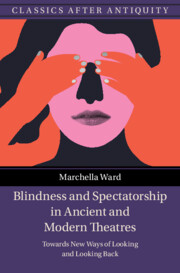
The use of disability as a metaphor is ubiquitous in popular culture – nowhere more so than in the myths, stereotypes and tropes around blindness. To be 'blind' has never referred solely to the inability to see. Instead blindness has been used as shorthand for, among other things, a lack of understanding, immorality, closeness to death, special insight or second sight. Although these 'meanings' attached to blindness were established as early as antiquity, readers, receivers and spectators into the present have been implicated in the stereotypes, which persist because audiences can be relied on to perpetuate them. This book argues for a new way of seeing – and of understanding classical reception - by offering assemblage-thinking as an alternative to the presumed passivity of classical influence. And the theatre, which has been (incorrectly) assumed to be principally a visual medium, is the ideal space in which to investigate new ways of seeing.
Past scholarship has ignored Davidic material after Matthew’s last mention of “David,” with the result that Davidic sonship is either overlooked or, even more drastically, subordinated to other messianic “titles” in Matthew’s passion narrative. Appealing to both intertextuality and messianic grammar, I call for a methodological corrective that attends to David material in Matthew’s passion with the goal of understanding Matthew’s startling claim that Jesus is the Davidic messiah despite his shameful death.
Building upon the foregoing chapter, Chapters 4 and 5 read Matthew’s passion psalm references Davidically, as was common in the Second Temple period. This chapter focuses on Matthew’s trial narratives before the Sanhedrin and Pilate, with the resulting portrait that Jesus– like the innocent-but-taciturn David of the lament psalms– is maligned by false witnesses but nevertheless remains silent.
Matthew’s passion constantly references the psalms. Though scholarship has frequently taken the speaker of these psalms to be “the Psalmist,” I show this to be a fourth-century neologism. Instead, Second Temple readers most often equate the speaker with the figure of David and his struggles. The result is that Matthew’s psalm references can be read Davidically.
Beginning with the puzzle of which “scriptures” Jesus claims direct his fate and demise, I detail the many parallels between Matthew’s arrest narrative and the Absalom revolt in the Davidic succession narrative– in both, the Davidic figure is betrayed and oppressed. After surveying Davidic messianic figures who were either the beneficiaries of divine violence or themselves militant leaders, I argued that, by contrast, Matthew draws upon a text in which David, like Jesus, suffers without retaliating, thus helping him make the case for his humiliated Davidic messiah.
The sum of the previous chapters suggests how Matthew uses scripture to present Jesus as a new David to his primarily Jewish audience. Matthew attempts to resolve the tension in his Gospel between Jesus as “the messiah, the son of David” (1:1) and Jesus as humiliated, executed criminal by situating Jesus’s suffering within the scriptural suffering of David. In so doing, Matthew attempts to make the startling case that Jesus is the Davidic messiah not despite, but because of, his trials and woes.
The psalms are everywhere in Matthew’s crucifixion narrative, but are rarely read Davidically– the first task of this chapter. Building off the results of Chapters 4 and 5, I then synthesize Matthew’s deployment of the psalms and situate them into Jesus’s biography. Such a reading strategy fits comfortably within the framework established in Chapter 3; that is, Matthew also sets the psalms within David’s life, and goes a step further by having the son of David reenact his sufferings.
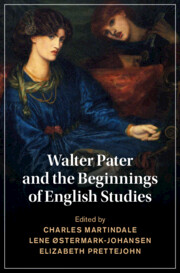
Walter Pater's significance for the institutionalization of English studies at British universities in the nineteenth century is often overlooked. Addressing the importance of his volume Appreciations (1889) in placing English literature in both a national and an international context, this book demonstrates the indebtedness of the English essay to the French tradition and brings together the classic, the Romantic, the English and the European. With essays on drama, prose, and poetry, from Shakespeare and Browne, to Lamb, Coleridge, Wordsworth and Pater's contemporaries Rossetti and Morris, Appreciations exemplifies ideals of aesthetic criticism formulated in Pater's first book, Studies in the History of the Renaissance (1873). Subjectivity pervades Pater's essays on the English authors, while bringing out their exceptional qualities in a manner reaching far into twentieth-century criticism. This title is part of the Flip it Open Programme and may also be available Open Access. Check our website Cambridge Core for details.
In this book, Nathan C. Johnson offers the first full-scale study of David traditions in the Gospel of Matthew's story of Jesus's death. He offers a solution to the tension between Matthew's assertion that Jesus is the Davidic messiah and his humiliating death. To convince readers of his claim that Jesus was the Davidic messiah, Matthew would have to bridge the gap between messianic status and disgraceful execution. Johnson's proposed solution to this conundrum is widely overlooked yet refreshingly simple. He shows how Matthew makes his case for Jesus as the Davidic messiah in the passion narrative by alluding to texts in which David, too, suffered. Matthew thereby participates in a common intertextual, Jewish approach to messianism. Indeed, by alluding to suffering David texts, Matthew attempts to turn the tables of the problem of a crucified messiah by portraying Jesus as the Davidic messiah not despite, but because of his suffering.
Pater published three essays on Shakespeare, and probably considered a longer series, possibly to culminate in a book. His attention in the completed essays is directed towards plays that were relatively unpopular in his own day, and in the case of two of these he can be said to occupy an important position in the history of their reception. Modern critics of Richard II and Love’s Labour’s Lost still regularly, if cursorily, cite Pater as a milestone. But Pater’s contribution to Shakespearean criticism more generally is rarely remembered or appraised. This chapter attempts to estimate and characterise the influence Pater has had on subsequent criticism of Shakespeare, sometimes in unexpected places, and also to draw out some of the insights of which later criticism takes less notice. Each of Pater’s Shakespeare studies attempts to formulate relations between ethics and aesthetics, and many of their central terms – fineness, justice, grace, etc. – are used with both moral and aesthetic significance. By examining these essays in the context of other Shakespearean criticism and of Pater’s wider work, it is possible to arrive at some idea of what Shakespeare meant to him.
A distinctive feature of Pater’s oeuvre is that, like many French critics of his generation, he wrote both literary and art criticism; in this respect his work parallels that of Dante Gabriel Rossetti, poet and painter. The chapter argues that, if Jerome McGann is right to describe Pater’s essay on Rossetti as ‘the best single study of Rossetti’s poetry we have’, that is because Pater provides the most persuasive interpretation of this double aspect of Rossetti’s work. The essay is densely intertextual with other writings of Pater’s in ways that can be surprising: verbal cross-references link Rossetti not only to his own chosen precursors (Dante as well as Blake and Michelangelo) but also to Gautier and Baudelaire, and, more importantly, to Plato. Thus it plays a more significant role in Pater’s overall critical project than previous scholars have recognised, not least explaining to us a historical fact that may seem difficult to understand: the extraordinary influence of Rossetti on both painters and poets of his own and succeeding generations, an influence out of all proportion, some may think, to his actual achievement in either art form.