To save content items to your account,
please confirm that you agree to abide by our usage policies.
If this is the first time you use this feature, you will be asked to authorise Cambridge Core to connect with your account.
Find out more about saving content to .
To save content items to your Kindle, first ensure no-reply@cambridge.org
is added to your Approved Personal Document E-mail List under your Personal Document Settings
on the Manage Your Content and Devices page of your Amazon account. Then enter the ‘name’ part
of your Kindle email address below.
Find out more about saving to your Kindle.
Note you can select to save to either the @free.kindle.com or @kindle.com variations.
‘@free.kindle.com’ emails are free but can only be saved to your device when it is connected to wi-fi.
‘@kindle.com’ emails can be delivered even when you are not connected to wi-fi, but note that service fees apply.
The first occurrences of the onomastic formula ‘Zeus Helios great Sarapis’ belongs to the reign of Trajan. Appearing in the military and economic context of the quarries of the Egyptian eastern desert, this divine name associates, in a single henotheistic entity, the great gods of Egypt (Amon-Ra-Helios), the Greco-Roman world (Zeus-Iuppiter) and Alexandria (Sarapis), giving pre-eminence to the latter. The iconographic translation of this theological evolution can be found in the provincial coinage of Alexandria during the Antonine period.
The divine beings of the ancient Near East were complex entities, endowed with numerous prerogatives. In light of their multiplicity, this chapter investigates the narrative and symbolic strategies used by the inhabitants of ancient Mesopotamia to describe and conceptualise the divine. Firstly, it focuses on how the polysemy and polyphony typical of cuneiform writing were skillfully used to express the multiple features of gods and goddesses. Subsequently, the text focuses on some of the oldest cuneiform sources ever known: the god lists, in which the many names and onomastic attributes of the divinities were listed, following a specific conceptual order. Finally, the importance of the name for the definition of a deity is investigated by examining the case of Marduk and Aššur, two gods who established their supremacy precisely through the accumulation of theonyms.
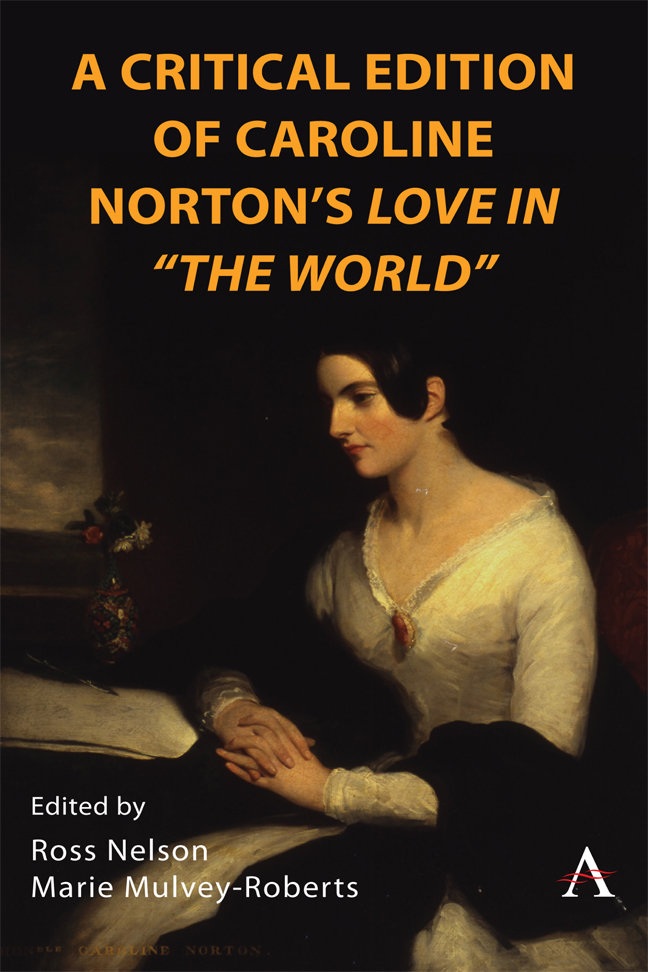
Caroline Norton's forgotten novel, which has remained unpublished until now, tells of the perils of courtship facing a naïve young girl Alixe, who has been launched onto the London social season. Her encounters with both a worthy and an undesirable suitor open an intriguing window onto the fashionable society of the 1820s in which Love in 'the World' takes place. In placing her heroine in these predicaments Norton was able to draw upon her own experiences of the bon ton, as the time in which the novel is set coincides with her first ball in March 1826, when she burst upon the scene with all her beauty and brilliance, later recalling, 'I came out […] to find all London at my feet.' She believed that London could be as callous as the metropolitan social scene might prove treacherous, and in alerting the reader to the dangers of fashionable society she makes ample use of her own observations as a debutante at her first London season. In a highly readable and coherent narrative with an indeterminate ending, which throws a spotlight onto her life and times, the plot of Love in 'the World' initially follows a pattern broadly representative of her own experience before developing in unexpected and surprising ways.
According to Vālmīki's Sanskrit Rāmāyaṇa (early centuries CE), Śambūka was practicing severe acts of austerity to enter heaven. In engaging in these acts as a Śūdra, Śambūka was in violation of class- and caste-based societal norms prescribed exclusively by the ruling and religious elite. Rāma, the hero of the Rāmāyaṇa epic, is dispatched to kill Śambūka, whose transgression is said to be the cause of a young Brahmin's death. The gods rejoice upon the Śūdra's death and restore the life of the Brahmin. Subsequent Rāmāyaṇa poets almost instantly recognized this incident as a blemish on Rāma's character and they began problematizing this earliest version of the story. They adjusted and updated the story to suit the expectations of their audiences. The works surveyed in this study include numerous works originating in Hindu, Jain, Dalit and non-Brahmin communities while spanning the period from Śambūka's first appearance in the Vālmīki Rāmāyaṇa through to the present day. The book follows the Śambūka episode chronologically across its entire history - approximately two millennia - to illuminate the social, religious, legal, and artistic connections that span the entire range of the Rāmāyaṇa's influence and its place throughout various phases of Indian history and social revolution.
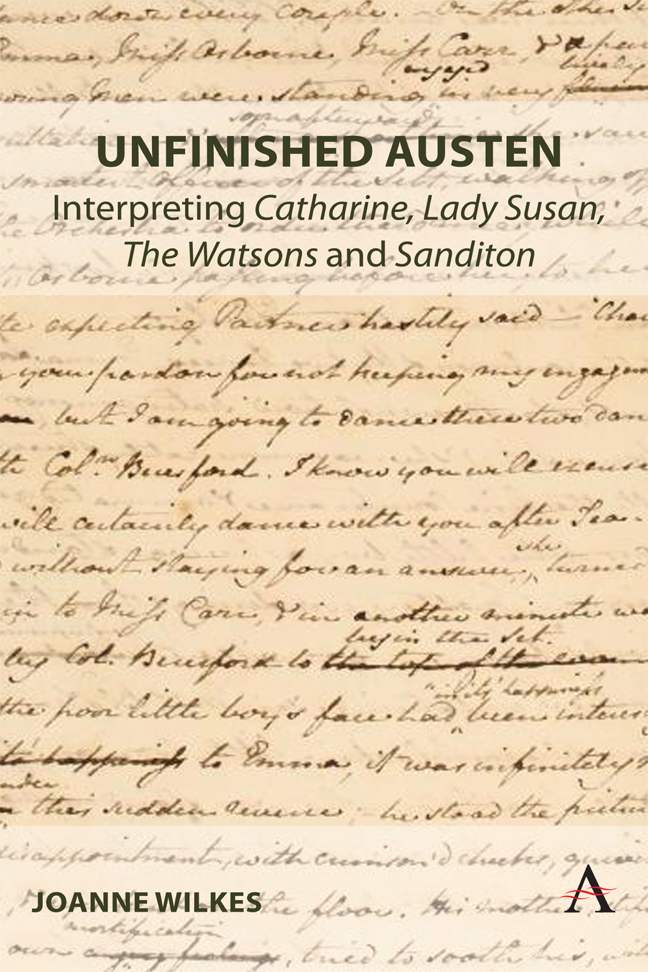
Unfinished Austen examines four texts that Jane Austen left incomplete: Catharine, or The Bower (1792-3), Lady Susan (1795?), The Watsons (1803-4?) and Sanditon (1817), none of them published till well after her death. Since very little in manuscript form survives from the six famous novels, these four manuscript texts offer insight into the novelist in the process of creation. They also problematize the romance plot prominent in the published novels by presenting this in a nebulous or incipient state that underlines its artificiality.
These texts sometimes show how the romance plot is inflected by the financial condition in which young marriageable women can find themselves. Moreover, the stories (other than Catharine) have aroused the interest of many later writers-including writers for theatre and screen-who are eager to complete or to amplify them. They may do this through developing the stories to some kind of dénouement. Perhaps more intriguingly, however, these texts induce some writers to question the very enterprise of concluding an unfinished text.
Kgositsile was born on 18 February 1938 in rural Dithakong, on the outskirts of Mafikeng. The town of Mafikeng as a colonial urban centre under the British protectorate is historically important. In the early nineteenth century, the capital of the Batlhaping sub-branch of the Barolong people was in Dithakong (erstwhile Dithakwaneng). Towards the mid-nineteenth century, the sub-branch of Kgositsile's lineage of the Barolong, the Molema, settled in small, clustered villages on the banks of the Molopo River, producing a flourishing urban area that the Dutch called ‘the Stadt’, or ‘the city’. Towards the end of that century, in 1895 Mafeking was selected as a location for the British colonial administrative offices of the Bechuanaland Protectorate outside the colony of Bechuana (now Botswana). This administration leased land from the Tswana chief immediately adjacent to the village clusters.
As a British protectorate, Mafeking became the ground for territorial fighting between the Dutch and the British during the Anglo-Boer war, with both sides waging a fierce battle for that region between 1899 and 1900 in what is known as ‘the Siege of Mafeking’. As a ‘final frontier’, Mafeking was a prime location, as it was near both the border and the railway between Bulawayo and Kimberly. The latter was a booming mining town at the time since diamonds had been discovered there in the 1860s. The ‘Siege of Mafeking’ also politically conscientized a young Barolong court interpreter and journalist, Solomon Plaatje, who, funded by the Tswana chief Silas Molema, founded the newspaper Koranta ea Becoana (Newspaper for Batswana) and later, Tsala ea Becoana (Friend of Batswana).
Plaatje's work through the newspaper medium addressed the Batswana directly, asking them to maintain a love for the Setswana language, cultures, and identity. He asked them to use Setswana even when the British were teaching them English language and mannerisms; he asked them to love their language, pray in it, study it, and develop it. This sensibility was crucially instilled in him by the womenfolk of his matricentric upbringing, whom Plaatje acknowledges in his various published works.
Kgositsile's work demonstrates how monopolized colonial geographies and politics of knowledge can be reconfigured through poetics of the body. In his poetry, his body is mobilized as a body of knowledge that enshrines principles of interconnectivity, interrelationality, and interdependence with other living bodies, human and non-human. His political commitment to Black liberation and solidarity in the Black world is fortified by gestures of intimacy, interiority, depthoffeeling, ‘breathing together’, and belonging. At the foundation of this sensibility is the bedrock of the matriarchive that attuned him to his feelings as a legitimate place from which to fashion a political identity as poet of the revolution. The matriarchive underlines his erotic registers and poetics that are productive in asserting and affirming his purposeful action: to his mother, he writes of the ‘slow sadness of your smile’ and ‘the slow sadness in your eye / remains fixed and talks’ (1975a: 9). Her unwavering eye, fixed and articulate, is ‘stronger than faith in some god who never spoke our language’ (1971: 28). Galekgobe's enunciating eye transmits knowledge in his mother tongue that he receives as gospel: her sadness commands a course of action to overturn the conditions that would have her live in so-called maids’ quarters in white suburbs of the white man's city, in the country of her birth. Her eye becomes his faith, the clear conscience and compass that orients his purpose in exile – ‘the determined desire / past the impotence of militant rhetoric’ (1971: 28). While the matriarchive entangles his political sensibilities with poetics of the body, it also demands – beyond the poetry – political action.
The matriarchive is his navigation system in exile, an internal guide with coordinates in a rich and substantive repository of mother tongue, Tswana oral/aural cultures, Southern African cosmologies, and philosophies of being. Kgositsile grounds his felt sense of self and orientation to the world in a creative grammar of geopoetics. In his poem to Madikeledi, ‘sadness’ appears thrice, which he writes of as ‘more solid’ than any system that ‘tried to break our back’, and which ‘strength[ens] the fabric of his heart, for us’ (1971: 80–1).
There is a throughline of continuity that Kgositsile aims to draw from the cultures, customs, and sense of community instilled in his homeplace by his mothers and bring to the cultures and politics of Johannesburg and those of the larger Black world. This is a non-linear line that he conceptualizes as a coil. The coil enables his poetics and politics to operate within cosmologies of Southern Africa and their conceptions of the human, temporality, spatiality, knowledge, and intersubjective relationality. The coil, harnessed for its etymology – to ‘gather together’ –, locates the aspirations and objectives of Kgositsile's life and work in an ongoing intergenerational interlocution contiguous with the structuring of the human as an onto-triad comprising of the living dead, the living, and the not-yet-born. This coil has been fashioned to suture Black America to Black South Africa, their oral/aural and literary traditions, histories, and politics. In his work, he devised several working terms and phrases that I have tasked myself with developing as critical theories from elsewhere with which we can disrupt and rupture the dominant, dehumanizing, hierarchical, gendering, differentiating, and mechanizing Europatriarchal terms of order. I have termed these poetics of possibilities. Much ink has been spilled pontificating on the crucial need for decolonial theory and concepts, but very few worlds, archives, vocabularies, practices, tools, material steps, processes, procedures, and approaches have been offered as interventions in these discourses.
My book has brought these poetics to the surface as an offering at this critical juncture in which the field of Black studies is preoccupied with imagining the human and the world anew to upend anti-Blackness and challenge the dominant paradigm of western civilization and its cosmologies of being, knowing, and doing. Kgositsile's work and the poetics of possibility it offers are crucial on many levels. This book draws from his work written in the 1960s and 1970s, critical decades that occasioned mass decolonization in Africa and the rest of the third world. Even though South Africa was not one of those countries that witnessed independence, I contend that Kgositsile, due to the internationalist nature of his work, should be read in the canon of decolonial theorists and poets of this era who sought to provide critical analysis of imperialism, culture, and liberation.
African cultures and cosmologies can provide a wealth of inexhaustible resources for the project of epistemic decentring. Having exhausted technoscientific reason and confronted the civilizational consequences of its impasses, new metaphors are required for the future. We must heed the call for a renewal of the very sources of the imaginary and of a thought coming from an elsewhere.
Felwine Sarr, Afrotopia (2019: 80, my emphasis)
When South African poet and statesman Keorapetse Kgositsile (1938–2018) was instructed by senior members of his party, the African National Congress (ANC), to flee the country into exile in 1961, he packed among his meagre belongings a corpus of Tswana literary classics. To him, they enshrined a set of valuables, of knowledge systems, aesthetic practices, cosmologies, and mythologies he could marshal to counter colonial modernity's anti-Black warfare. As a revolutionary writer, he used the worlds from these classics as a basis to assert the existence of other forms of being, knowing, and belonging that were otherwise to the Eurocentric, racist, capitalist, and Christian social orders imposed by colonialism and apartheid. The Tswana literatures that accompanied him into exile were material representations of the values instilled in his formative years, used as bridges to connect politics of the homeplace with those of his unfolding exile travels and writing life.
He arrived with this treasure trove in the nascent cultural and political ferment of the Black Power and Black Arts Movements (BAM) in the United States of America in 1962. He harnessed that Tswana archive – comprising dramas, novels, and an anthology of poetry – in his five collections of poetry published in the States with the intent to foster continuities between the African American struggle and the struggles of Black South Africa. Further, he understood the Black experience as connected, thereby embracing Black world politics as fundamentally opposed to the culture of Jim Crow, colonialism, and apartheid. Operating in this world of Blackness he sought to bridge geographical and linguistic chasms, to foster political solidarities through cultural relations with Black diasporans.
His literary corpus published in the States, as well as his political activities, illustrate an assertion of the existence of otherworlds within the dominant paradigm of anti-Blackness.
The previous chapter saw Kgositsile mobilize the names-songs-places dynamic to anchor his work in the bedrock of his beginnings, the homeplace of his formative years, in a poetics that centralizes the body as the most intimate of contact zones from which to foster revolutionary poetry and political solidarities. The matriarchive informed, shaped, and held together the zone of relationality and Black radical sociality through the internetworked bodies of the mothers, bodies of land, bodies of water, bodies of knowledge, and celestial bodies. In setting up this chapter's concerns as being continuous with the previous one, here I offer a recap of my findings from chapter 2. Kgositsile settled on the umbilical cord as a connective tissue between his mother and himself, the son, while birth rituals generated a poetics of relation between the mother, the land in which it is buried, and the son. Further, in his shifting and sifting, he linked the bodies of his mothers and bodies of land with celestial bodies: ‘the son must move on to set like the sun and lie buried in the west, or rise again to burn in this place with newborn fire’ (1973a: 64). Here the son is exiled from the land and enlists imageries from cosmological phenomena to transubstantiate himself from the son to the sun, setting in the west, and returning with ‘newborn fire’. The choice of ‘newborn’ sets his meditation up in a dialogue with the matriarchive that makes it possible for the new-to-beborn, ‘rising again’, a (re)birth – ‘Mother, what is my name?’ – to undergird his liberatory purpose that must always be tied to the collective.
The bodies of water, central and fundamental to these relational poetics grounded in the matriarchive, are the principle of creation and creativity, recreation and regeneration that make it possible for Kgositsile to fashion poetics of death and rebirth, destruction and recreation, and flowering creativity and creation in the desolation of exile. The bodies of water in the previous chapter located the matriarchive of his formative years in continuity and locution with those encountered in exile. These were understood as held together, or, to harness the uses of the coil, gathered together by forces of the Limpopo and Mississippi Rivers, which confluence in the Atlantic and other oceans.
No futurism is worthwhile unless it includes indigenous knowledges.
Kodwo Eshun, ‘The Algorithmic Poetics’ (2017a)
Kgositsile's ‘Towards a Walk in the Sun’ (1971) is a future memory. The poem interweaves and enfolds indigenous knowledges from Southern Africa with new political and aesthetic imperatives of exile in the Black world to produce otherwise possibilities. The ‘otherwise’ ‘bespeaks the ongoingness of possibility, of things existing other than what is given, what is known, what is grasped’ (Crawley 2016: 24). Kgositsile harnesses the otherwise from the Tswana literary corpus in his care, which enshrines the cosmologies, languages, mythologies, forms of being and relating, and terms of humanity, which he in turn refashions and transforms to reconfigure the political present in Black America. This chapter focuses on the cosmology of the sun and the native sons to reveal the infinitely generative nature of the Black Arts Movement archive in twenty-first-century African American social movements. In their quest to construct continuities between the past and the future, to walk in the footprints of their predecessors, twenty-first-century Black movements mine the Black arts archive in fashioning a radical imagination that responds to the unfinished project of white supremacy and Black liberation.
It is within this context that the Houston-based arts collective Otabenga Jones & Associates (OJ&A) retrieved ‘Towards a Walk in the Sun’, adapting it to operate within the realm of visual and material culture, as well as the sonic archive. The poem's radical convergence of two world systems – South African and African American literary classics, aesthetics, and oralities — spurred on that art collective's responses, which are generative and offer new reflections on discourses of Afrofuturism. Further, in framing OJ&A's work as part of dreamkeeping, a practice of intergenerational and ancestral dialogue that converges pastpresentfuture, here I theorize dreamkeeping as a musical practice of ‘digging in the crates’. Within this practice, rap's self-referential method and citational practices function as a naming device indexical of Black alternative histories of thought, sounding the antiphonic utterance across space and time.