To save content items to your account,
please confirm that you agree to abide by our usage policies.
If this is the first time you use this feature, you will be asked to authorise Cambridge Core to connect with your account.
Find out more about saving content to .
To save content items to your Kindle, first ensure no-reply@cambridge.org
is added to your Approved Personal Document E-mail List under your Personal Document Settings
on the Manage Your Content and Devices page of your Amazon account. Then enter the ‘name’ part
of your Kindle email address below.
Find out more about saving to your Kindle.
Note you can select to save to either the @free.kindle.com or @kindle.com variations.
‘@free.kindle.com’ emails are free but can only be saved to your device when it is connected to wi-fi.
‘@kindle.com’ emails can be delivered even when you are not connected to wi-fi, but note that service fees apply.
For a variety of reasons, it is often presumed that the ancient Mediterranean world of Roman Corinth was a culture of near universal marriage. Peter Laslett, for example, classified household composition in traditional Europe into four broad categories based on geographical region: the West, the West/central, the Mediterranean, and the East.1 The Mediterranean household in Laslett’s typology (including Greece and what was Roman Corinth) was characterized by high proportions of both male and female marrying and a low proportion of solitary households.2 From her extensive analysis of Roman sources, Susan Treggiari also has concluded that there was a strong cultural disposition toward marriage and it was rare for a man to reach age sixty without having married, at least among the propertied classes.3 The case has been further bolstered by later studies and some demographic modelling from the same period.4
Having considered vital aspects of the shape of secular singleness in the Roman world, we turn attention now to examine Paul’s interaction in 1 Corinthians 7 on topics related to marriage and singleness. As we have observed, a major challenge of the chapter is evident in the opening clause: Περὶ δὲ ὧν ἐγράψατε (‘Now concerning the matters about which you wrote’), which indicates that what follows is Paul’s response to a question raised by his addressees. Any interpretation of the chapter requires some reconstruction of what the Corinthians had asked or written and the motivations they had for doing so. The resulting interpretation must also cohere with both the literary context of the remaining Corinthian correspondence and the historical-cultural context of the first-century Corinthian world.
The overall aim of the present study has been to advance the understanding of Paul’s discussion of singleness and marriage in 1 Corinthians 7 by offering a fresh reconstruction of the Corinthian context in light of secular Graeco-Roman singleness. The intent of this project has been to develop further the proposal advocated by Will Deming that the fundamental basis for discussion between Paul and the Corinthians was the secular Graeco-Roman marriage question apart from ascetic motivations. We have done so first by extending the literary discussion to examine the Greek marriage debate beyond a strictly Stoic-Cynic caricature. We have also examined literary and non-literary evidence in support of the likelihood that a non-trivial unmarried population existed at Corinth generally. As a framework for considering factors that likely would have motivated first-century secular singleness, we have employed Ruth Dixon’s three variables for analysing the timing and quantity of nuptiality among various populations: the desirability of marriage, the availability of mates, and the feasibility of marriage. Based on the findings of the sources, we have proposed a non-ascetic reading of the text that resolves the lynchpin exegetical difficulty that primarily accounts for why interpreters have continued to ascribe ascetic motivations to the Corinthians – the statement in 7:1b, ‘it is good for a man not to touch a woman’.
Given the proposed resolution of two major interpretive cruces in 1 Corinthians 7, we proceed next to show how the reconstruction provides an improved reading for the chapter as a whole. Here we show how the details of the chapter support the reconstruction and how the reconstruction improves our understanding of the text.
Paul’s discussion of marriage and singleness in 1 Corinthians 7 has long presented interpreters with an array of exegetical challenges. As William M. Ramsay once acknowledged, ‘There are not many passages in Paul’s writings that have given rise to so many divergent and incorrect views as this chapter.’1 A fundamental crux interpretum arises with the opening words of the chapter, ‘Now concerning the matters about which you wrote, it is good for a man not to touch a woman.’ Paul is clearly responding to previous non-extant correspondence of the Corinthians, but the reader must make some conjecture of what the situation was that prompted the Corinthians to write to Paul, and the primary nature of their concern, whether it concerned their marital status or sexual behaviour. A related question is whether the statement in 7:1b, ‘it is good for a man not to touch a woman’ reflects the Corinthians’ viewpoint, Paul’s viewpoint, both, or neither. A second major difficulty arises concerning the relationship of the issue that Paul responds to in 7:1 with the issue apparent in 7:25–26 that reflects very similar language. The latter may be an entirely separate concern or interconnected in some direct way to the prior. However readers navigate through the parts of the chapter, they are forced to proceed with some rudimentary reconstruction of what is prompting the overall discussion to which Paul responds. Such a reconstruction requires placing the Corinthians within some context with regard to how they thought about sexuality, singleness, and marriage and the motivations that prompted them to raise the questions they did with the apostle.
In his Progymnasmata, the first-century rhetorician, Aelius Theon, observes that as an exercise of verbal inquiry, thesis is to be differentiated from topos. Theon explains that whereas topos is an amplification of some matter of agreement, thesis admits controversy, such as whether one should marry or whether one should have children.1 Theon was not alone among rhetoricians of the Imperial period in using marriage to illustrate the bifurcated nature of rhetorical thesis.2 The Ars rhetorica indicates that the thesis of the desirability of marriage was assigned to young students for writing more often than any other subject.3
Paul's discussion of marriage and singleness in 1 Corinthians 7 has long presented exegetical challenges, beginning with the chapter's opening statement: 'It is good for a man not to touch a woman.' Interpreters continue to debate whether the ascetic language of the statement reflects the views of Paul or the Corinthians. They also debate the motivations for the rise of an ascetic movement in Corinth. In this ground-breaking study, Barry N. Danylak offers a fresh solution to these conundra. Using evidence from Egyptian census papyri, he demonstrates the prevalence of secular singleness in Roman urban environments. He also draws on classic Greek marriage debates to argue that the Corinthians' disposition likely reflected an Epicurean perspective of secular singleness; and that Paul himself was responsible for the 'touch' language as a rhetorical adaptation in his response to the Corinthians' question. Combining fresh evidence with attentive analysis, Danylak's study thus proposes a viable resolution to these long-standing exegetical challenges.
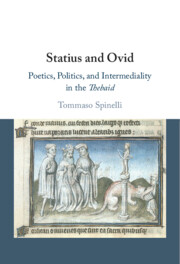
This is the first in-depth exploration of the extent and significance of Ovidian intertexts in Statius' Thebaid, with particular emphasis on the interplay between poetics, politics, and material culture. Introducing New Historicist, Cultural Materialistic, and Intermedial approaches to Latin literature, it suggests that, despite their Virgilian patina, Statius' depictions of landscapes, heroes, and gods are pervaded by verbal and semantic allusions to Ovid's mythical narratives. This multi-layered allusivity not only prompts alternative readings of the Augustan classics, but also challenges the reader's perceptions of the Augustanising worldview that the urban landscape of Flavian Rome was arguably meant to convey. The poetic and political significance of Statius' Theban saga thereby moves from critically rewriting the Aeneid to reflecting on the new socio-political issues of Flavian Rome. This title is part of the Flip it Open Programme and may also be available Open Access. Check our website Cambridge Core for details.