To save content items to your account,
please confirm that you agree to abide by our usage policies.
If this is the first time you use this feature, you will be asked to authorise Cambridge Core to connect with your account.
Find out more about saving content to .
To save content items to your Kindle, first ensure no-reply@cambridge.org
is added to your Approved Personal Document E-mail List under your Personal Document Settings
on the Manage Your Content and Devices page of your Amazon account. Then enter the ‘name’ part
of your Kindle email address below.
Find out more about saving to your Kindle.
Note you can select to save to either the @free.kindle.com or @kindle.com variations.
‘@free.kindle.com’ emails are free but can only be saved to your device when it is connected to wi-fi.
‘@kindle.com’ emails can be delivered even when you are not connected to wi-fi, but note that service fees apply.
Ecphrasis, as we saw in Chapter 4, is a characteristic feature of the enargeia of epic, but there is one case in which an expected ecphrasis is conspicuous for its absence. The Argonautica of Apollonius of Rhodes tells the myth of Jason, Medea, and the Argonauts, already encountered in Chapter 2. The Golden Fleece, one of the most famous supernatural objects in all mythology, calls for a detailed description, but Apollonius does not provide one. Films that retell the myth must, however, show it. Hence the concept of neo-mythologism, a useful term coined by director Vittorio Cottafavi: an original work based on myth must be changed for its visual adaptation. The chapter reviews and interprets the different appearances of the Golden Fleece in romantic adventure films (Hercules, The Giants of Thessaly, Jason and the Argonauts), art-house cinema (Medea, The Golden Thing), Ray Harryhausen’s stop-motion animation, and computer-generated images.
This chapter takes us to the classical precursors of the cinema and its pre-modern origin. The camera obscura was the earliest film apparatus, and Aristotle was believed to have known of it. The chapter next describes pre-cinema and traces this concept’s influence and its ramifications. While the moving bodies in prehistoric cave paintings were the first to exhibit cinematism, archaic Greek poet Simonides expressly pointed to the affinities between word and image; the Augustan Roman poet Horace later put them in canonical terms: ut pictura poesis. The chapter then surveys the pre-cinematic nature of ancient visual arts by interpreting a variety of examples (the Minoan fresco of bull jumpers, Greek vase paintings, the Roman Alexander mosaic, Trajan’s Column, many others) and introduces the rhetorical principles of enargeia (“vividness”) and epic ecphrasis. The chapter closes with an appreciation of the ingenious stage automata of Damascius and Heron of Alexandria.
Aristotle’s concept of tragic catharsis in The Poetics is one of the most controversial topics in classical literature. It has repeatedly been adduced to describe the emotional impact of explicit screen violence, especially in the films of Sam Peckinpah. Peckinpah initially justified the graphic violence in some of his films with Aristotelian catharsis but later reversed himself. This chapter presents a vindication of Peckinpah’s original understanding of catharsis in connection with his best-known film. The Wild Bunch was one of the most controversial works of its time but later became an acknowledged masterpiece of American cinema. The chapter reviews current classical and film scholarship on catharsis and adduces Euripides’ tragedy The Bacchae as an ancient parallel to Peckinpah’s film regarding cathartic violence. The destructive ecstasy of Greek Maenadism even finds a specific expression in The Wild Bunch. Finally, the chapter interprets the film’s protagonist as a tragic figure.
This chapter juxtaposes Plato’s Cave Allegory and our visual media. Plato’s detailed text, in which Socrates describes the projection of shadows onto a wall by means of firelight, readily lends itself to a cinematic understanding. Various film theorists, directors, and cinematographers have pointed to this analogy for their own approaches to cinema. Henri Bergson was the first to incorporate the Cave Allegory into his philosophy of the cinematographic mind. The chapter traces such a development from the birth of cinema until today, e.g. in texts by Maxim Gorky, Susan Sontag, and others. Specific films, such as Chris Marker’s La Jetée and Bernardo Bertolucci’s The Conformist, address the Platonic symbolism of light and shadow as stages of knowledge or enlightenment. Related to this topic is the power of moving images (e.g. in A Clockwork Orange), the question of their truth or reliability (documentaries, “fake news”), and their relation to historical memory (Agnès Varda, Marcel Ophuls).
Like Aristotle, the Roman epic poet Lucretius was mistakenly credited with knowledge, or even use, of the camera obscura. Few classical scholars today are aware of this strange but fascinating facet in Lucretius’ intellectual afterlife. The error arose from the misunderstanding of a passage in On the Nature of Things, in which Lucretius referred to the changes and movements of bodies in dreams. Nineteenth-century scientists compared Lucretius’ lines to stroboscopic light effects. Although Belgian scientist Joseph Plateau, inventor of the phenakistiscope, set the record straight, the misunderstanding continued into the age of cinema. The first part of this chapter traces the error through the historiography of the cinema with all its amusing misconceptions, which include an anecdote about Lucretius himself. The chapter’s second part examines the striking resemblances to Lucretius’ epic in Stanley Kubrick’s 2001: A Space Odyssey.
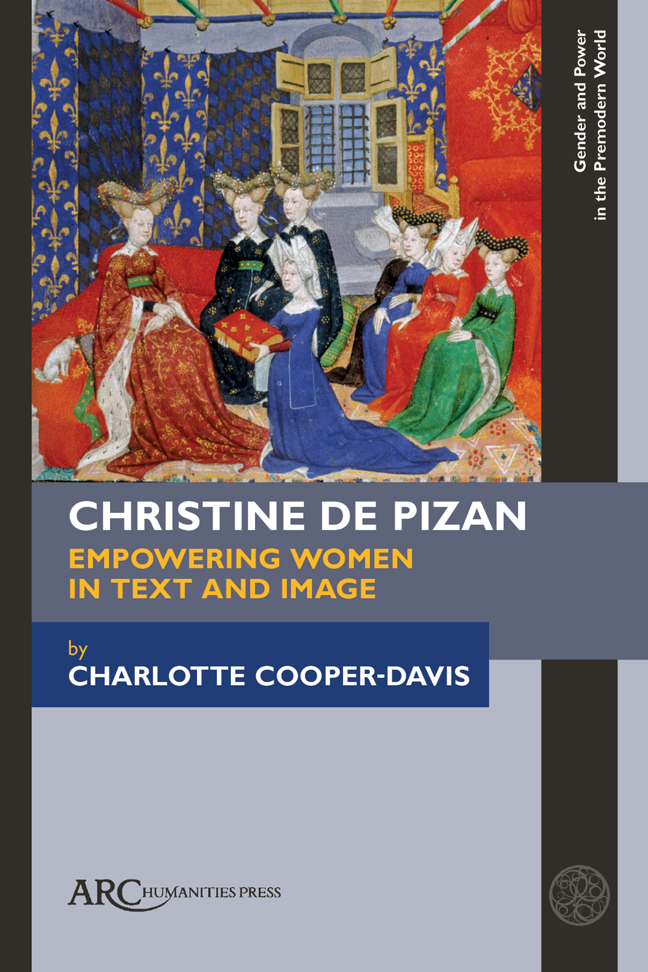
It is well known that in several of her works, Christine de Pizan actively sought to valorize and empower women; she notably made the case for women's education, argued for the protection of widows, and famously attacked the misogyny of the all-pervasive Roman de la Rose. Whilst numerous examinations have shown that Christine sought to empower women through her texts, this book demonstrates that the visual programmes of her works offer further evidence of Christine's championing women in their role as educators and activists, whilst challenging some assumptions made about gender in Christine's works. It also examines the conduits and structures by which power is conferred upon women within them. When read together, the text and image across Christine's œuvre reveal a consistent picture: one in which women educate and empower one another.
This book aims to enhance our appreciation of the modernity of the classical cultures and, conversely, of cinema's debt to ancient Greece and Rome. It explores filmic perspectives on the ancient verbal and visual arts and applies what is often referred to as pre-cinema and what Sergei Eisenstein called cinematism: that paintings, statues, and literature anticipate modern visual technologies. The motion of bodies depicted in static arts and the vividness of epic ecphrases point to modern features of storytelling, while Plato's Cave Allegory and Zeno's Arrow Paradox have been related to film exhibition and projection since the early days of cinema. The book additionally demonstrates the extensive influence of antiquity on an age dominated by moving-image media, as with stagings of Odysseus' arrow shot through twelve axes or depictions of the Golden Fleece. Chapters interpret numerous European and American silent and sound films and some television productions and digital videos.
Ancient historians regularly argue that the classical Athenians held sailors in much lower esteem than hoplites. They cite in support of this the extant funeral speech of Pericles. Certainly, this famous speech said a lot about courageous hoplites but next to nothing about sailors. Yet, it is also clear that this was not a typical example of the genre. Funeral speeches usually gave a fulsome account of Athenian military history. In rehearsing military history, funeral speeches always mentioned naval battles and recognised sailors as courageous. Old comedy and the other genres of public oratory depicted sailors in the same positive terms. All these non-elite genres assumed that a citizen fulfilled his martial duty by serving as either a sailor or a hoplite. They used a new definition of courage that both groups of combatants could easily meet. In tragedy, by contrast, characters and choruses used the hoplite extensively as a norm. In spite of this, tragedy still recognised Athens as a major seapower and could depict sailors as courageous. In Athenian democracy, speakers and playwrights had to articulate the viewpoint of non-elite citizens. Their works put beyond doubt that the Athenian people esteemed sailors as highly as hoplites.
The Invention of Athens by Nicole Loraux was the first book-length study of the Athenian funeral oration. Before its publication, ancient historians had accorded little importance to this genre. Loraux established for the first time the vital importance of this almost annual speech in the formation of Athenian self-identity. She showed how each staging of it helped the Athenians to maintain the same civic identity for over a century. Yet, in spite of its impact, Loraux’s first book was still far from complete. It left unanswered important questions about each of the surviving funeral speeches. An even larger gap concerned intertextuality: Loraux rightly saw traces of the funeral oration right across Athenian literature, but she never systematically compared the funeral oration with other types of public speech as well as drama. Therefore, she was unable to demonstrate whether the other literary genres of classical Athens were ever a counterweight to the funeral oration’s cultural militarism. The principal aim of this volume is to finish The Invention of Athens. Our book answers the important questions that Loraux left unanswered. It completes the vital intertextual analysis of the genre that is missing in The Invention of Athens.
Funeral orators came to rehearse four ‘standard’ myths. The classical Athenians believed that the earliest was the victory of their ancestors against an army that the Thracian Eumolpus had led into Attica. The widely held position is that these four mythical erga were a part of the genre from its beginning. Yet, this chapter firmly establishes that this position simply does not hold when it comes to the myth about Eumolpus. Indeed, the first funeral speech to mention it was only the one that Plato wrote soon after the end of the Corinthian War. Before this, there had existed an older myth about Erechtheus, an early Athenian king, and Eumolpus fighting each other. Importantly, however, this myth presented their fight as a civil war between Eleusis, a deme in Attica, and Athens. The new myth, which, by contrast, made Eumolpus and his army foreign invaders, first appeared in Erechtheus, which Euripides wrote at the end of the 420s. As Euripides regularly changed old myths or, simply, invented new ones, Hanink argues that the epitaphic exploit about Eumolpus was originally his invention.