To save content items to your account,
please confirm that you agree to abide by our usage policies.
If this is the first time you use this feature, you will be asked to authorise Cambridge Core to connect with your account.
Find out more about saving content to .
To save content items to your Kindle, first ensure no-reply@cambridge.org
is added to your Approved Personal Document E-mail List under your Personal Document Settings
on the Manage Your Content and Devices page of your Amazon account. Then enter the ‘name’ part
of your Kindle email address below.
Find out more about saving to your Kindle.
Note you can select to save to either the @free.kindle.com or @kindle.com variations.
‘@free.kindle.com’ emails are free but can only be saved to your device when it is connected to wi-fi.
‘@kindle.com’ emails can be delivered even when you are not connected to wi-fi, but note that service fees apply.
In this chapter, I argue that Plato borrows from Euripides’ Antiope, in order to frame the terms of the debate between Socrates and Callicles in the last part of the Gorgias about whether the philosophical or the political life is best. I argue that Plato’s engagement with this tragedy is an instance of paratragedy, that is, the non-parodic adaptation of a work of tragedy in order to enrich the dramatic situation. What redeems the Antiope in Plato’s eyes is its endorsement of the superiority of the intellectual over the political life. In adapting the Antiope for his own purposes, Plato defends an account of good life as spent in the cooperative pursuit of wisdom and virtue. This life runs up against two limits that are thematized in the Gorgias: human obstinacy, the refusal to cooperate and recognize the force of argument; and endemic uncertainty due to our finite capacity for argument. Since Socrates is portrayed as both defending the life of philosophy in argument, and actively living it, then the Gorgias itself counts as an ideal tragedy. This reading of the dialogue sheds important light on the arguments concerning the nature and value of rhetoric. In the end, I assess the dialogue in light of the constraints on ideal tragedy articulated in Chapter 4.
In this chapter, I argue that Plato’s depiction of the last day of Socrates in the Phaedo is not only a tragedy in Plato’s ideal sense, but it also repeatedly contrasts its own presentation of the death of Socrates with how a traditional tragedy might portray it. This contrast brings into stark relief the intellectual, moral and emotional gap between ideal and actual tragedy, in addition to an important disagreement about the nature and goodness of death. For actual tragedy, death is the worst thing that can happen. In the Phaedo, death is presented as a kind of liberation from the body, but this conception of death reveals the insurmountable limitations on the attainment of knowledge that living embodiment entails. The problem is not with argument itself, but with our all-too-human grasp of it. This means that, because of our embodied finitude, we can never actually be certain that the arguments for Socrates’ optimistic picture of divine redemption really are sound. My interpretation highlights Socrates’ epistemic uncertainty and the role of hope, and it makes misology passage more central to the dialogue’s argument than usually recognized. In the end, I assess the dialogue in light of the constraints on ideal tragedy articulated in Chapter 4.
In this chapter, I interpret Plato’s Cratylus as an ideal comedy and argue that Plato employs the comedic technique of parody in order to expose rival methodologies as sources of ridiculous self-ignorance. Socrates’ extended parody of etymology shows that words cannot be a guide to the nature of being, since we have no reason to think that their analysis can teach us anything about reality. Etymology is, in short, a source of laughable self-ignorance because it provides its practitioners with the illusion of wisdom. Parody generally involves the use of an imitation that exaggerates or distorts some feature of the original, often in order to undermine its claim to authority. In the case of etymology, Plato’s parody not only exposes etymology as a false path to wisdom, but it also articulates specific criticisms of etymology regarding its methodology, its scope and its alleged systematicity. The function and purpose of the very long etymological section has proved highly puzzling to interpreters who are generally unsure what to make of it, and my account reveals the etymologies to be playing a central, and previously unnoticed, role in the overall argument of the dialogue. In the end, I assess the dialogue in light of the constraints on ideal comedy articulated in Chapter 1.
In this chapter, I argue, drawing primarily on passages from the Philebus, the Republic and the Laws, that Plato understands comedy to be, in essence, an imitation of laughable people, where the notion of the laughable, or to geloion, is a normative one that picks out what genuinely merits laughter, and not necessarily what people actually laugh at. According to Plato, the only thing that merits laughter is moral vice, in particular the vice of self-ignorance. I formulate four constraints on ideal comedy on Plato’s behalf: the veridical constraint, which holds that only what is genuinely laughable, that is, moral vice, should be imitated as laughable; the educative constraint, which holds that comedic imitation must aim at educating the audience by encouraging them to reject vice in their own lives; the emotional constraint, which holds that the comedic imitation should cause appropriate and appropriately moderate emotional reactions; and the political constraint, which holds that only moral and political enemies should be portrayed as laughable.
In a generic sense, to discriminate is to differentiate. Generic discrimination is not wrongful. But many instances of a more specific form of discrimination – differentiating between people because they are members of different socially salient groups (henceforth: group discrimination) – are wrongful. This means that people subjected to group discrimination are often wronged, and this bears importantly on whether such acts are morally impermissible. The three main accounts of what makes group discrimination wrongful appeal to considerations of harm, disrespect, and social relations of inequality, respectively. While each of them can explain the wrongfulness of some paradigmatic instances of wrongful direct discrimination, they explain the wrongfulness of a set of three important non-paradigmatic forms of discrimination – indirect discrimination, implicit bias, and algorithmic discrimination – less well. Overall, the prospects of a monistic account of the wrongfulness of discrimination are bleak.
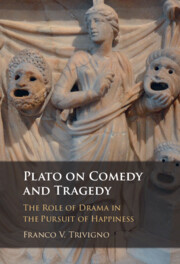
For Plato, tragedy and comedy are meaningful generic forms with proto-philosophical content concerning the moral character of their protagonists. He operates with a distinction between actual drama, the comedy and tragedy of the fourth and fifth centuries BCE, and ideal drama, the norm for what comedy and tragedy ought to be like. In this book Franco Trivigno reconstructs, on Plato's behalf, an original philosophical account of tragedy and comedy and illustrates the interpretive value of reading Plato's dialogues from this perspective. He offers detailed analyses of individual dialogues as instances of ideal comedy and tragedy, with attention to their structure and philosophical content; he also reconstructs Plato's ideals of comedy and tragedy by formulating definitions of each genre, specifying their norms, and showing how the two genres are related to each other. His book will be valuable for a range of readers interested in Plato and in Greek drama.
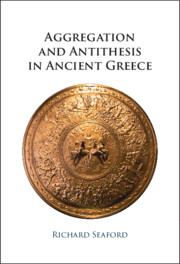
What is the relationship between forms of thought in literature, philosophy and visual art in ancient Greece, and how are these forms related to their socio-political and economic context? This is the question raised by Richard Seaford in his final book. His answer is framed in terms of the relationship between aggregation and antithesis. In Greece between the eight and fourth centuries BCE, Seaford traces a progressive and complex shift from aggregation to antithesis in literature, philosophy and visual art, and correlates this with the shift from a pre-monetary and pre-polis society to a monetised polis. In the Platonic metaphysics of being, he identifies a further move, the negation of antithesis, which he links with the non-circulating possession of money. In this characteristically ambitious and challenging study, Richard Seaford extends his socio-economic analysis of Greek culture to visual art and includes contrasts with Near Eastern society and art.
This Element offers the first comprehensive study of Hegel's views on European colonialism. In surprisingly detailed discussions scattered throughout much of his mature oeuvre, Hegel offers assessments that legitimise colonialism in the Americas, the enslavement of Africans, and British rule in India. The Element reconstructs these discussions as being held together by a systematic account of colonialism as racial domination, underpinned by central elements of his philosophy and situated within long-overlooked contexts, including Hegel's engagement with British abolitionism and Scottish four-stages theories of social development. Challenging prevailing approaches in scholarship, James and Knappik show that Hegel's accounts of issues like freedom, personhood and the dialectic of lordship and bondage are deeply entangled with his disturbing views on colonialism, slavery, and race. Lastly, they address Hegel's ambivalent legacy, examining how British Idealists and others adopted his pro-colonial ideas, while thinkers like C. L. R. James and Angela Davis transformed them for anti-colonial purposes. This title is also available as open access on Cambridge Core.
This chapter focuses on the domain of the vegetative soul that represents some of the simplest activities that distinguish the organic from the inorganic. It examines the central vegetative system consisting of the liver, the veins and their supporting organs, as well as the vegetative capacities present in all the tissues that are subservient to this system. The chapter not only discusses the relationship between the central parts and capacities in all of the body, but also examines the ways in which these capacities manifest themselves, arguing they represent Galen’s attempts to grapple with the notion of basic vitality. On some occasions, Galen also calls them ‘demiurgic’, implying a creative capacity. A discussion of how he engages with the pre-existing philosophical tradition and the notion of a biological demiurge helps to delineate the scope of these capacities.
The final chapter entitled Conclusions contains a summary of the findings of the study, explaining the key motivations and claims behind the Galenic understanding of bodily unity.
This chapter looks at the ways in which Galen posits the theoretical unity among the discrete physiological system, especially with a reference to tripartition. Unlike Platonic, the tripartition that is motivated by psychological conflict, Galen’s tripartition of physiological domains shows the three domains to be highly cooperative and co-dependent on each other. The respective material fluxes they control are together necessary for continued functioning. The chapter looks at Galen’s adoption of the popular philosophical idea that identity persists because of the form, and at his analysis of different causes, strongly influenced by the ideas of his contemporary Middle Platonists. While more popular analyses of causes explain that the body is unified in its design, it is the notion of cohesive cause, the chapter argues, that accounts for unified physiological functioning.
Galen employs several different taxonomies of body parts, dividing the body up in various ways. This chapter looks at some of the more prominent ones, especially those that either define parthood or shed light on Galen’s theorization of parthood in other ways. The central question guiding this discussion arises from claims about (in)expendability of various parts: why is it the case that, according to him, the loss of a bone leads to a complete loss of activity the bone supports (voluntary motion in a limb), but the loss of the stomach does not lead to the loss of the activity of nutrition. One of the key preoccupations emerging from various ways in which Galen differentiates bodily parts is the proper activity of parts, which shape his understanding of the role of parts and their significance relative to each other. The final sections of the chapter sketch out the difference between normative and functional understandings of a parthood.
This chapter opens with the discussion of vital unity, a problem at the intersection of medicine and philosophy. Broadly speaking, medicine is concerned with the preservation of a living whole, but for many ancient thinkers, like Galen, the practice of medicine was informed by a highly theoretical understanding of the relationship between the parts and the whole. The first section of the Introduction sets out the key preoccupation of the study: Galen’s understanding of the role that different body parts and systems have in maintaining the functioning of the living whole. Subsequent sections contextualise Galen’s work within the phusiologia tradition, as well the debate between empiricism and rationalism, and briefly outline key classifications to be discussed in later chapters, before turning to the content of individual chapters, situating the present study within the existing scholarship and, finally, briefly explaining how this work approaches the much-debated problem of the substance of the soul.