To save content items to your account,
please confirm that you agree to abide by our usage policies.
If this is the first time you use this feature, you will be asked to authorise Cambridge Core to connect with your account.
Find out more about saving content to .
To save content items to your Kindle, first ensure no-reply@cambridge.org
is added to your Approved Personal Document E-mail List under your Personal Document Settings
on the Manage Your Content and Devices page of your Amazon account. Then enter the ‘name’ part
of your Kindle email address below.
Find out more about saving to your Kindle.
Note you can select to save to either the @free.kindle.com or @kindle.com variations.
‘@free.kindle.com’ emails are free but can only be saved to your device when it is connected to wi-fi.
‘@kindle.com’ emails can be delivered even when you are not connected to wi-fi, but note that service fees apply.
This book speaks to all those with an interest in the question of the human in its relation to the non-human. More specifically, it illustrates how the ancient world mobilized concepts of ‘the animal’ and ‘animality’ to conceive of the human in a variety of ways. To this end, it offers ten essayistic interventions into ways of ‘thinking the human’ that reach from antiquity to the present in the ultimate aim to challenge our understanding of who we really are.
This chapter explores meat-eating as an important way by which humans define themselves and explores it as part of a broader ‘anthropology’ of food and eating. It tells the story of a boastful consumption of a wild boar at a (fictional) Roman dinner party to show that in the ancient world (as in the modern), what you eat is who you are.
This chapter illustrates the power of the animal story to challenge anthropocentric positions and ideas of human exceptionalism. It centres upon the famous story of Androclus and the lion (as told by Gellius and other ancient and modern authors) to show that anthropomorphizing is not merely a tool of human appropriation of the animal; it can also bring out real sympathies and correspondences between human and non-human creatures. With its particular focus on the capacity to experience pain as a shared feature of humans and animals, the story driving this chapter anticipates modern attempts to bring questions of sentience and suffering into the picture and to reimagine justice as extending beyond the human.
This chapter revolves around the famous story of how the Greeks managed to get into the city of Troy concealed in a gigantic wooden horse – and thus won a long and drawn-out war. The chapter follows this story and dismantles the odd human/animal hybrid at its core in the ultimate aim to explore how notions of animality define the human at war. Moving away from the ‘othering’ at work in the previous chapter, this one illustrates an area of existence in which analogies between human and animal prevail. Fighting emerges as an area of life in which our animal side comes to the fore.
This chapter introduces the human as a question. It revolves around the figure of the Theban Sphinx and her interaction with Oedipus and traces her presence from the ancient world into the works of Sigmund Freud. The chapter invokes the Sphinx as a presence that both prompts and challenges the way we think the human. Oedipus’ troubled humanity stands at the intersection between his success in solving the Sphinx’s riddle and his apparent failure to understand how her words apply to his own existence. As such, the Sphinx’ intervention at Thebes exposes a deep-seated vulnerability at the core of the human condition – a vulnerability springing from the fact that while the riddle can be solved with the powers of reasoning, the human as a riddle remains enigmatic and beyond the application of logos.
This chapter offers an investigation of what Socrates may have meant when, in his infamous appearance before a jury at Athens in 399 BCE, he referred to himself as a myōps – typically translated as a gadfly. The chapter illustrates that the natural world does not just serve to naturalize (and thus normalize) collective political systems that are already firmly in place. As in the case of Socrates, it can also serve as a potent strategy to seek to naturalize (and thus normalize) the individual political stance outside of the collective. The chapter shows that, by carving out a space for dissent, Socrates defined a form of citizenship that resonates far beyond the ancient world. It, for example, helps to explain the ambivalence surrounding modern dissenting voices (such as those of Julian Assange, Michael Moore, and Edward Snowden). The chapter ultimately traces the buzzing of the Socratic gadfly into Hannah Arendt’s political philosophy and illustrates the important tole that this peculiar ancient creature plays in her critique of the perils of modernity.
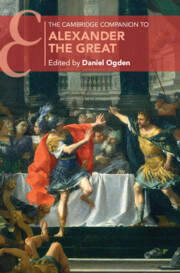
Has any ancient figure captivated the imagination of people over the centuries so much as Alexander the Great? In less than a decade he created an empire stretching across much of the Near East as far as India, which led to Greek culture becoming dominant in much of this region for a millennium. Here, an international team of experts clearly explains the life and career of one of the most significant figures in world history. They introduce key themes of his campaign as well as describing aspects of his court and government and exploring the very different natures of his engagements with the various peoples he encountered and their responses to him. The reader is also introduced to the key sources, including the more important fragmentary historians, especially Ptolemy, Aristobulus and Clitarchus, with their different perspectives. The book closes by considering how Alexander's image was manipulated in antiquity itself.
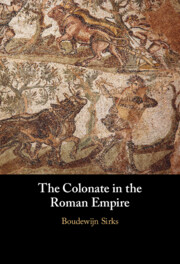
The fourth and fifth centuries AD gave rise to a particular phenomenon in the Roman Empire: the colonate. The colonate involved the fiscal regulation of a relationship of surety between landowners and farmers in the later Roman Empire and played a major role in agrarian and social relations, with implications for these farmers' freedom of movement and transmission of status. This study provides a clear and comprehensive reassessment of the legal aspects of the phenomenon, embedding them as far as possible in their social and economic contexts. As well as taking the innovative approach of working retrogradely, or backwards through time, the volume provides a thorough assessment of two critical sources, the Theodosian and Justinian Codes, and will therefore be an invaluable resource for students and scholars of Roman law and the agricultural and social history of late antiquity.
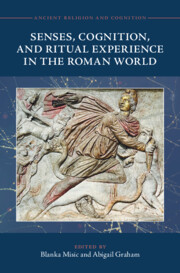
How do the senses shape the way we perceive, understand, and remember ritual experiences? This book applies cognitive and sensory approaches to Roman rituals, reconnecting readers with religious experiences as members of an embodied audience. These approaches allow us to move beyond the literate elites to examine broader audiences of diverse individuals, who experienced rituals as participants and/or performers. Case studies of ritual experiences from a variety of places, spaces, and contexts across the Roman world, including polytheistic and Christian rituals, state rituals, private rituals, performances, and processions, demonstrate the dynamic and broad-scale application that cognitive approaches offer for ancient religion, paving the way for future interdisciplinary engagement. This title is part of the Flip it Open Programme and may also be available Open Access. Check our website Cambridge Core for details.
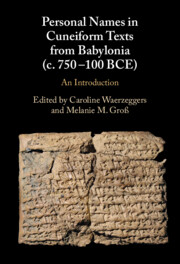
Personal names provide fascinating testimony to Babylonia's multi-ethnic society. This volume offers a practical introduction to the repertoire of personal names recorded in cuneiform texts from Babylonia in the first millennium BCE. In this period, individuals moved freely as well as involuntarily across the ancient Middle East, leaving traces of their presence in the archives of institutions and private persons in southern Mesopotamia. The multilingual nature of this name material poses challenges for students and researchers who want to access these data as part of their exploration of the social history of the region in the period. This volume offers guidelines and tools that will help readers navigate this difficult material. The title is also available Open Access on Cambridge Core.
A look at Spartan commemoration in the Peloponnesian War, focusing on Brasidas and the rhetoric of liberation. Brasidas was a new kind of Spartan that put freedom in the forefront, which led to Brasidas receiving more lavish commemoration but also drew Sparta into more wars.