To save content items to your account,
please confirm that you agree to abide by our usage policies.
If this is the first time you use this feature, you will be asked to authorise Cambridge Core to connect with your account.
Find out more about saving content to .
To save content items to your Kindle, first ensure no-reply@cambridge.org
is added to your Approved Personal Document E-mail List under your Personal Document Settings
on the Manage Your Content and Devices page of your Amazon account. Then enter the ‘name’ part
of your Kindle email address below.
Find out more about saving to your Kindle.
Note you can select to save to either the @free.kindle.com or @kindle.com variations.
‘@free.kindle.com’ emails are free but can only be saved to your device when it is connected to wi-fi.
‘@kindle.com’ emails can be delivered even when you are not connected to wi-fi, but note that service fees apply.
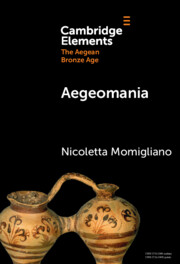
This Element provides an overview of Aegeomania: the fascination, sometimes bordering on the obsession, with the Aegean Bronze Age, which manifests itself in the uses of Aegean Bronze Age material culture to create something new in literature, the visual and performing arts, and many other cultural practices. It discusses the role that Aegeomania can play in our understanding of the Aegean Bronze Age and illustrates this with examples from the 1870s to the present, which include, among many others, poems by Emma Lazarus, Salvatore Quasimodo, and Giorgos Seferis; novels by Kristmann Gudmundsson, Mary Renault, Don DeLillo, Zeruya Shalev, and Sally Rooney; Freudian psychoanalysis; sculptures by Henry Moore and Pablo Picasso; music by Harrison Birtwistle and the rock band Giant Squid; films by Robert Wise and Wolfang Petersen; elegant textiles and garments created by Josef Frank and Karl Lagerfeld. This title is also available as Open Access on Cambridge Core.
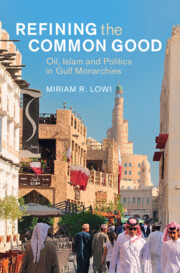
How has Islam as a set of beliefs and practices shaped the allocation of oil revenues in Arab Gulf monarchies? In turn, how has oil wealth impacted the role of Islamic doctrine in politics? Refining the Common Good explores the relationship between Islamic norms and the circulation of oil wealth in Gulf monarchies. The study demonstrates how both oil (revenues) and Islam (as doctrine) are manipulated as tools of state power, and how religious norms are refined for the sake of achieving narrow secular interests. Miriam R. Lowi examines different institutionalized practices financed by hydrocarbon revenues and sanctioned, either implicitly or explicitly, by Islam, and uses evidence from Kuwait, Qatar, Oman and Saudi Arabia to show how these practices are infused with political purpose. The dynamic relationship between oil wealth and Islamic doctrine is exploited to contribute to the management and control of society, and the consolidation of dynastic autocracy.
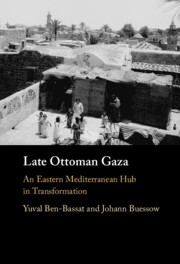
In contemporary public discourse, Gaza tends to be characterized solely as a theatre of the ongoing conflict between Israel and the Palestinians. However, little is known about Gaza's society, politics, economy, and culture during the Ottoman era. Drawing on a range of previously untapped local and imperial sources, Yuval Ben-Bassat and Johann Buessow explore the city's history from the mid-nineteenth century through WWI. They show that Gaza's historical importance extends far beyond the territory of the 'strip' since the city was an important hub for people, goods, and ideas in the Eastern Mediterranean from Antiquity until the twentieth century. Using new digital methodologies, Ben-Bassat and Buessow introduce readers to the world of Gazans from various walks of life, from the traditional Muslim elites to the commoners and minority communities of Christians and Jews. In so doing, they tell the lively story of this significant but frequently misunderstood city.
In March 2022, a couple of months after Kais Saied’s coup, I met Samia Driss, a leader of Ennahda in France whose trajectory we have followed throughout the preceding pages. I met her at the Place de la République in the centre of Paris, where many demonstrations took place during Ben Ali’s regime and where a new protest to oppose Kais Saied’s ascent to power was about to happen after several that had taken place over the previous months. Indeed, on 25 July 2021, the highly symbolic date of the proclamation of the Tunisian Republic, President Saied announced a state of emergency in Tunisia, suspended the Assembly and dismissed the prime minister. He then placed all powers under his control, with some initial popular support. Exactly a year later, he organised a constitutional referendum to replace the January 2014 Constitution.
Tunisian leftists and Islamists were active in fighting Ben Ali’s authoritarian regime, but several of them were also at the forefront of organisations that were concerned with immigrant politics. These were as much related to the French Muslim field as they were to the working and living conditions of immigrants and the fight for social and political equality. Chapter 5 therefore explores the articulation between different types of engagement, as well as the continuity, complementarity and simultaneity of activism in the fields of immigrant and homeland politics. The chapter also looks at the tensions and dissonances that resulted from those two faces of activism. The comparison between Tunisian leftists and Islamists shows how various activists found themselves facing different rules in the field of immigrant politics and how they negotiated these rules in the face of the unequal accumulation of material and symbolic resources. The chapter shows how new perspectives should be considered in order to fully understand Tunisian politics in France, and how ideological and class dimensions sometimes superseded the pro- or anti-regime cleavages.
Chapter 3 explores how the host state (France) and the home state (Tunisia) influenced the possibilities, nature and forms of pro- and anti-regime activism. It shows how the trans-state space of mobilisation should be understood in the light of the diverse and dynamic opportunities and constraints it offered. It first examines the ways in which the Tunisian system of control – the politics of encadrement – worked from afar, and shows how this system was characterised by a dialectic of assistance and surveillance. Through social and cultural encadrement, as well as surveillance, propaganda and a pervasive sense of threat, the Tunisian party-state succeeded in constraining Tunisian anti-regime mobilisation while simultaneously facing difficulties in encouraging support and pro-regime action in France. The chapter also looks at the ways in which the French authorities managed the different groups, from a diplomatic approach towards Ben Ali’s party-state to a securitised approach towards Islamists and a tendency towards indifference to the leftist movements.
Chapter 1 introduces the theoretical and empirical background to the study of long-distance Tunisian activism as well as the guiding questions on which the book rests: What were the conditions that enabled Tunisian politics in France? How do we explain what it meant to oppose or support an authoritarian regime from afar in terms of reconfiguring this activism in a migratory context? The chapter begins by discussing the choice to examine the Tunisian case in France and situates the study as part of the broader political, economic and migratory relationships between the two countries. The chapter then presents the theoretical framework underlying that universe of political practice, namely ‘the trans-state space of mobilisation’, which I locate at the intersection of scholarship on North African politics, social movements and diaspora politics. It concludes by outlining the issues involved in undertaking fieldwork in the wake of the 2011 Revolution and introduces the material on which this book draws.
Chapter 6 focusses on the different forms of cross-ideological alliances between Islamist and leftist movements that were made to oppose the authoritarian regime. Far from romanticising those experiences into the clichéd concept of good opponents all coming together to fight the authoritarian regime, the chapter demonstrates instead how building cross-ideological alliances provoked ruptures and crystallised dissension within the constellations of actors themselves. It also shows how specific organisations and actors, mobilised on several scenes, came to play different roles in those alliances. The chapter goes on to demonstrate how each constellation of actors also maintained its own spaces of sociability and its own networks. Long-distance activism entailed other forms of activities that were turned towards group members in order to maintain activist groups despite their members’ new political lives in exile. Both Islamists and leftists worked to preserve their communities and to ensure the continuity of activism, albeit in different ways.
Chapter 4 explores the nature of anti-Ben Ali politics from afar. It focusses on the field of homeland politics by investigating the modalities, frames and repertoires of action used by activists who fought the authoritarian regime. The chapter highlights the ambivalent logic underlying the use of human rights, which became the main frame of contention for the various actors. For pro-regime actors, the human rights frame was paradoxically a way of legitimising the regime abroad; for Islamists, the activation of a discourse on human rights appeared as a way of circumventing the distrust to which they were habitually subjected in France; and for leftists, human rights stood as a rallying point, because fighting the Ben Ali regime during this period meant embracing the Islamists as a matter of necessity, as they were main victims of repression. The chapter goes on to investigate two further lines of cleavage that are crucial to the full understanding of long-distance Tunisian opposition politics. These lines offer a framework that determined means of action in terms of relationships with the Islamists and the degree of rupture with the Tunisian authoritarian regime.
This concluding chapter looks back at the main findings that emerged from this research and shows how they explain the transformation of long-distance Tunisian politics in the aftermath of the 2011 Revolution. It asks how the anti- and pro-regime struggles evolved following the demise of the central purpose of these struggles and the movements they inspired, and looks at the ways in which boundaries were redefined through different fields of action and the growth of new divisions. The emergence of new actors, the political reconversion of those who had shifted to Tunisian-centred politics, new rules of the game and the various possibilities of return to Tunisia each played a role in redefining the modalities of long-distance Tunisian politics. However, decades of activism had regulated the practice of activists from afar and reinforced the informal rules of the trans-state space of mobilisation. The 2011 Revolution simultaneously represented a decisive rupture and a continuity, reshaping and continuing to reshape the dynamics of the trans-state space of mobilisation.
This article examines the complex relationship between Sufism, secularity, and psychiatry through Refik Halid Karay’s 1956 novel, Kadınlar Tekkesi (Women’s Lodge). The article argues that Kadınlar Tekkesi recontextualizes Sufism by medicalizing and pathologizing it through psychiatry and psychopathology. This analysis draws upon discourse analysis and Michel Foucault’s exploration of abnormality and power dynamics. The article contends that this approach diverges from previous anti-Sufi agendas of Turkish novels, which were primarily motivated by religious and moralistic criticisms. The article argues that the application of psychiatric terminology to Sufism suggests a shift in Turkish secularism’s attitude toward Sufism, which transitions from dismissing Sufism as obsolete to engaging with it systematically through scientific study. Informed by modern scientific rationality, this shift signifies a redefined interaction between knowledge and power and the gendered aspects of the medicalization process. The article underscores that interactions between the discourses of secularism, Sufism, and psychopathology suggest a new regime of truth based on secular and scientific thought, while implicitly supported by orthodox Islamic principles.
Chapter 2 redraws the genealogies and characteristics of the different players involved in long-distance Tunisian activism. These various constellations of actors were pro-regime, Islamist, leftist and trans-ideological, and they created political parties, associations or other movements within which to conduct their politics in the trans-state space of mobilisation. This space represented a political and relational battleground on which the position of each actor played a role. The chapter shows how Tunisian activists were able to politically survive despite distance from the homeland, and the extent to which they were able to adapt to new configurations to continue their activism. The organisation of long-distance Tunisian politics assumed a specific and complex configuration in the French environment, so it cannot be considered as a simple replication of Tunisian politics.