To save content items to your account,
please confirm that you agree to abide by our usage policies.
If this is the first time you use this feature, you will be asked to authorise Cambridge Core to connect with your account.
Find out more about saving content to .
To save content items to your Kindle, first ensure no-reply@cambridge.org
is added to your Approved Personal Document E-mail List under your Personal Document Settings
on the Manage Your Content and Devices page of your Amazon account. Then enter the ‘name’ part
of your Kindle email address below.
Find out more about saving to your Kindle.
Note you can select to save to either the @free.kindle.com or @kindle.com variations.
‘@free.kindle.com’ emails are free but can only be saved to your device when it is connected to wi-fi.
‘@kindle.com’ emails can be delivered even when you are not connected to wi-fi, but note that service fees apply.
Older than the pyramids, Sumerian was used in ancient Mesopotamia (Southern Iraq). It is probably the world's first written language, and survives on clay tablets in the cuneiform script, dating from c.3000 BCE to the beginning of the Common Era. It abounds in simple inscriptions, ideal for beginners, but also boasts a wealth of more advanced writings, such as fascinating mythological poetry. This comprehensive textbook equips students to read the full range of texts – including the special variety of the language known as Emesal. Drawing on the authors' experience in the classroom, it uses intuitive terminology and also makes extensive use of diagrams, which unravel the language's structures in an easy-to-learn way. The examples and readings are all taken from original sources. The learning journey is further supported by exercises (with key), a full sign list and glossary, and online recordings with 'approximate pronunciations'.
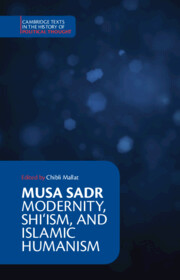
Musa Sadr was a leading force in Lebanese politics from the early 1960s until his disappearance in Libya in 1978. Like now, this was a time of turmoil, violence, and change in the Middle East. Sadr has been portrayed as primarily a charismatic man of action whose inspirational qualities led Lebanon's Shia Muslims to the centre of the political stage. This book also reflects his position as a thinker whose actions were firmly rooted in universal ethical and religious values, and for whom Islam was social philosophy as well as faith. With twelve texts taken from lectures or talks given by Sadr between 1966-1977, an introduction, and a chronology of Sadr's life, the book situates Sadr within currents of humanist intellectual thought. Detailed contextualising footnotes accompany the translations, highlighting the enduring relevance and topicality of Sadr's ideas.
Unlike conventional narratives of 'state failure' and its conceptual avatars, the volume analyses the remains of states whose populations had been torn apart by prolonged and violent conflicts and whose rulers lost the monopoly over the means of coercion and the capacity to implement public policies. Focusing on Lebanon since the civil war of the 1970s and 80s, Syria since the repression of the 'Arab spring' in 2011, and Iraq since the 1991 and 2003 wars, it provides a systematic explanation of the continuous, if precarious, survival of these states which draws on international recognition, access to resources, institutional arrangements, and societal ties alongside societal cleavages. In the process, States under Stress defends a definition of the state based on claims to statehood.
There is overwhelming evidence that the impacts of climate change are gender-differentiated and that women are the most negatively affected. Drawing on interviews with nearly 100 female activists and politicians from Algeria, Egypt, Iraq, Jordan, Lebanon, Mauritania, Morocco, Tunisia and Palestine, Lise Storm explores the implications of unequal female political representation for the climate crisis. Storm considers the voices of the women who are, or have been, involved in politics at the highest level. These women have experience with running for election, gender quotas, party politics, portfolio allocation, policy making, agenda setting and other such political dynamics and processes relating to power. This study sheds light on women's agency in climate debates and the impacts of the dynamics surrounding political representation. It adds new perspectives to the backgrounds of female MPs and activists and the drivers of their success – factors which influence how the global climate crisis is tackled locally in the region.
While Muhammad Baqir al-Sadr has often been portrayed as a fundamentalist or sectarian Islamist, this study repositions the scholar as a revolutionary Shi'i modernist and a critical figure in global intellectual history. Drawing on a range of previously neglected primary sources, Rachel Kantz Feder explores how Sadr synthesized Islamic tradition with Marxist thought, Arab modernism, and global leftist critiques to articulate a distinct vision of religious, political, and cultural renewal. Set against the backdrop of mid-twentieth-century Iraq, the book situates Sadr within broader Arab and Islamic debates on modernity, nationalism, and state-building. It demonstrates how Sadr challenged both secular ideologies and clerical conservatism to promote popular sovereignty, social justice, and individual agency within an Islamic framework. Offering fresh insights into Islamic reform, Shi'i thought, and Cold War-era Arab intellectual history, this is an essential work for scholars and students of Islamic studies, Middle East history, political theology, and religious modernism.
The Gulf region is a distinct sub-system of the wider Middle East, including the resource-rich states of Saudi Arabia, Bahrain, UAE, Qatar, Oman, Kuwait and Iran, and commands enduring relevance within the international system. This is the first textbook to provide a focused, comprehensive introduction to Gulf politics, specifically tailored for undergraduate students and newcomers to the subject. It explores the region's political landscape, covering key topics such as state formation, oil and rentierism, regime types, religion and politics, foreign policy and migration. Blending historical context with contemporary analysis, chapters by leading scholars examine the role of oil wealth, tribal structures, regional integration and merchant elites in state-building, as well as the region's strategic importance in global politics. An ideal core text for university courses on the Gulf and GCC, An Introduction to Gulf Politics is essential for understanding the complexities of power, governance and influence in one of the world's most dynamic regions.
After the 1952 revolution, the Egyptian state became an ideological project promoted by national cultural and media institutions. Focusing particularly on the years under the leadership of Gamal Abdel Nasser (1954–1970), Chihab El Khachab uses official written and visual sources produced by different governmental departments to show how low- and mid-ranking bureaucrats represented and embodied the Egyptian state through a praxis of 'achievement' (ingāz, pl. ingazāt). This study demonstrates how a successful anti-colonial nationalist movement built its own state apparatus. El Khachab argues that the state's 'achievements' are neither the tangible outcome of governmental work nor the self-evident metrics needed to evaluate national progress, but an ideological category deployed by bureaucrats. Conceiving achievements in this way allows us to understand how everyday bureaucratic work represents and embodies 'the state', and why this idea remains an important force in contemporary Egypt.
In a region known for its export of oil, Monarchies of Extraction explores how the Gulf states are simultaneously defined by the importation of food. Charting the economics and politics of the Gulf through an examination of its food system, Christian Henderson demonstrates how these states constitute a distinct social metabolism. Starting with the pre-oil phase, this book examines the politics of agrarian change in the Gulf. In the contemporary period, Henderson considers the way that the Gulf states represent 'inverted farms', where the import of prodigious quantities of agricultural commodities has enabled these economies to overcome their lack of arable land. As a result of this trade, states such as the UAE and Saudi Arabia have developed their own agribusiness sectors. Henderson further shows how food and consumption in the Gulf states constitute political questions of diet, sustainability, and boycott.
Aurangzeb 'Alamgir (r. 1658–1707) was the last of the so-called 'great' Mughal emperors. He remains a controversial historical figure: castigated for religious intolerance and placed at the centre of a narrative of Mughal decline by some; considered a great Muslim hero by others. In this richly researched exploration of Aurangzeb 'Alamgir's life and times, Munis D. Faruqui contests such simplistic understandings to unearth a more nuanced picture of the emperor and his reign. Drawing on a large and varied archive, Faruqui provides new insights into the emperor's rise to power, his administrative and religious policies, and the role of the imperial eunuchate and harem. By unpicking the complex dynamics of a long reign, from Aurangzeb 'Alamgir's accession to the last weeks of his life and his eighteenth-century memorialisation, this remarkable new history cuts through the many myths that have obscured the extraordinary life story of Emperor Aurangzeb 'Alamgir.
In the wake of Iran's revolution in 1978–79, a fundamentalist Islamic theocracy took control of the country. These dramatic changes impacted all sectors of society including a vast array of diverse peoples and cultures. In this book, Lois Beck provides an anthropological and historical account of Iran's many minorities. She focuses on the aftermath of the revolution, declaration of an Islamic republic, and Iraq-Iran war. Drawing on six decades of anthropological research, Beck provides frameworks for understanding how each of Iran's linguistic, religious, ethnic, ethno-national, and tribal minorities fashioned unique identities. These identities stem from factors relating to history, location, socioeconomic patterns, and sociocultural traits. They reflect the people's interactions with Iran's rulers and governments as they changed over time. A modern nation-state cannot be fully understood without knowing the extent of its reach in the peripheries and border regions and among its diverse peoples. This landmark study challenges existing scholarly accounts by offering broad and detailed perspectives on Iran's many distinct languages, religions, ethnicities, ethno-nations, and tribes.
Why does the state matter to its people? How do people know and experience the state? And how did the state come to be both desired and dreaded by its subjects? This study offers a historically grounded social theoretical account of state consolidation in Iraq, from the foundation of the country as a League of Nations British Mandate in 1921 through to the post-2003 era. Through analysis of key historical episodes of state consolidation (and fragmentation) during the past century, Nida Alahmad argues that consolidation rests on two sequential and interdependent factors. First, domination: the state's capacity to dominate land and population. Second, legitimation: whereby the state is accepted and expected by the population to be the final arbitrator of collective life based on common principles. Moving between intellectual traditions and disciplines, Alahmad demonstrates that a theorization of state consolidation is a theorization of the modern state.
When ancient Persian conquerors created a vast empire from the Mediterranean to the Indus, encompassing many peoples speaking many different languages, they triggered demographic changes that caused their own language to be transformed. Persian grammar has ever since borne testimony to the social history of the ancient Persian Empire. This study of the early evolution of the Persian language bridges ancient history and new linguistics. Written for historians, philologists, linguists, and classical scholars, as well as those interested specifically in Persian and Iranian studies, it explains the correlation between the character of a language's grammar and the history of its speakers. It paves the way for new investigations into linguistic history, a field complimentary with but distinct from historical linguistics. This title is also available as Open Access on Cambridge Core.
The presence of Shiʿite communities in Western Europe dates to the late nineteenth century, with Britain as the primary destination for immigration, as well as notable communities developing in Belgium, France, Germany, Ireland, the Netherlands and Scandinavia. Exploring selected encounters of Twelver Shiʿite Muslims with the European West, this study examines local and transnational religious organization to assess socio-political integration. Its central thesis defines European Shiʿism through peripheral engagement and religious retention. Building on a range of language sources, interviews with Shiʿite spokesmen and fieldwork in Iran, Britain, the Netherlands, and Germany, Matthijs van den Bos identifies European Shiʿism with a religious mode of engagement involving hierarchization of collective self and other identities. Shiʿite parties with greater distance to high politico-religious authorities abroad are seen more likely to engage in cultural exchange with their European milieu. On one side stand ethnically varied Shiʿite organizations with limited engagement of others in Europe. The other shows civic outreach, ritual transformation, and integrationist theology.
Examining sectarian divergence in the early modern Middle East, this study provides a fresh perspective on the Sunni–Shi'i division. Drawing on Ottoman Turkish, Persian, and European sources, Ayşe Baltacıoğlu-Brammer explores the paradox of an Ottoman state that combined rigid ideological discourses with pragmatic governance. Through an analysis of key figures, events, periods, and policies, Boundaries of Belonging reveals how political, economic, and religious forces intersected, challenging simplistic sectarian binaries. Baltacıoğlu-Brammer provides a comprehensive historical account of Ottoman governance during the long sixteenth century, focusing on its relationship with non-Sunni Muslim subjects, particularly the Qizilbash. As both the founders of the Safavid Empire and the largest Shiʿi-affiliated group within the Ottoman realm, the Qizilbash occupied a crucial yet often misunderstood position. Boundaries of Belonging examines their role within the empire, challenging the notion that they were merely persecuted outsiders by highlighting their agency in shaping imperial policies, negotiating their status, and influencing the Ottoman–Safavid rivalry in Anatolia, Kurdistan, and Iraq, and western Iran.
The Great Palace of Constantinople was the heart of Byzantium for almost a thousand years, serving as both a political and architectural model for Christendom and the Islamic world. Despite its historical significance, reconstructing its layout remains challenging due to the scarce amount of archaeological evidence. This Element synthesises the historical and topographical evolution of the palace, examining its architectural typologies and the role of ritual and artistic objects in representing imperial power. It also addresses key historiographical issues, such as the identification and dating of the Peristyle of the Mosaics, as well as its role in imperial ceremonies. The research is based on textual sources, archaeology, and graphic documentation, culminating in a virtual reconstruction through 3D imaging. By integrating these methodologies, this Element aims to offer a comprehensive understanding of the Great Palace, its influence, and its role as a central stage for Byzantine ceremonial and ideological expression.
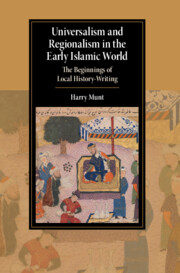
What was the role of local history-writing in the early Islamic World, and why was it such a popular way of thinking about the past? In this innovative study, Harry Munt explores this understudied phenomenon. Examining primary sources in both Arabic and Persian, Munt argues that local history-writing must be situated within its appropriate historical contexts to explain why it was such a popular way of thinking about the past, more popular than most other contemporary forms of history-writing. The period until the end of the eleventh century CE saw many significant developments in ideas about community, about elite groups and about social authority. This study demonstrates how local history-writing played a key role in these developments, forming part of the way that Muslim scholars negotiated the dialogues between more universalist and more particularist approaches to the understanding of communities. Munt further demonstrates that local historians were participating in debates that ranged into disciplines far beyond history-writing.
In the wake of the 2011 uprising in Syria, a number of Syrian intellectuals were forced into exile. Many of these intellectuals played a crucial role in mobilising people in the early days of the movement, but once in exile an irreconcilable tension emerged between their revolutionary narratives and the violent reality on the ground. Zeina Al Azmeh explores this tension, shedding light on whether and how exile influenced narratives, strategies, and political agency. Drawing on extensive ethnographic fieldwork and interviews in Paris and Berlin, Al Azmeh examines how writers and artists work to reconcile revolutionary ideals with the realities of war and displacement. Bringing together insights from cultural sociology, postcolonial thought, and migration studies, Syrian Intellectuals in Exile provides new analytical tools for understanding the intersection of intellectual work and social movements. This study blends empirical research with personal narratives, offering a timely reflection on exile, memory, and the limits of intellectual activism.
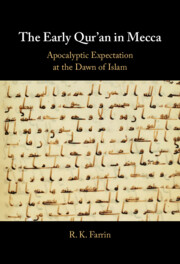
In this study, R. K. Farrin offers a fresh perspective on the emergence of Islam by tracing the structural and thematic development of the Qur'an in Mecca. He analyzes the form and content of the Qur'an at its earliest stage (ca. 609–14 CE), when it grew from a few verses to a scriptural corpus. From quantitative and literary evidence, Farrin argues that a Qur'anic nucleus – carrying a particularly urgent message – most likely formed during this period, to which units were then added as revelation continued in Mecca and Medina (ca. 615–32 CE). His study also situates the emerging Qur'an in the context of late antique Arabia, where monotheism's spread was still resisted by resident pagans. It also draws connections to contemporary Jewish and Christian ideas, especially regarding the anticipated Last Day. Significantly, Farrin's study peels back layers of Islamic history to consider the Qur'an and the environment in which it was first being recited.