To save content items to your account,
please confirm that you agree to abide by our usage policies.
If this is the first time you use this feature, you will be asked to authorise Cambridge Core to connect with your account.
Find out more about saving content to .
To save content items to your Kindle, first ensure no-reply@cambridge.org
is added to your Approved Personal Document E-mail List under your Personal Document Settings
on the Manage Your Content and Devices page of your Amazon account. Then enter the ‘name’ part
of your Kindle email address below.
Find out more about saving to your Kindle.
Note you can select to save to either the @free.kindle.com or @kindle.com variations.
‘@free.kindle.com’ emails are free but can only be saved to your device when it is connected to wi-fi.
‘@kindle.com’ emails can be delivered even when you are not connected to wi-fi, but note that service fees apply.
How an ancient object, artefact or commodity has moved over vast distances from one region to another, crossed major seas or travelled by land over extensive territories, has occupied and intrigued scholars in many disciplines over the years (Sabloff and Lamberg-Karlovsky 1975; Kristiansen et al. 2018). This subject becomes even more intriguing knowing that no textual evidence can give us a hint or a glimpse how this was organized. Since the beginning of modern humans in the Palaeolithic, migration and mobility have driven demographic expansion and the movement of material culture. At the same time, social interaction and intermarriage between groups constituted a basic institutional pattern among modern humans to prevent inbreeding, as demonstrated by ancient DNA (Sikora et al. 2017). New genetic evidence provides insights into patterns of human mobility and genetic admixture. However, the onset of trade and exchange as an institutionalized activity is still not well understood. The challenge increases once we move back in time before any written sources can inform us. How did pre-modern/pre-state societies organize themselves to engage in long-distance exchange? How did such societies communicate? How did such societies foster conditions and/or social institutions that facilitated long-distance exchange? Can the rise of social complexity be connected to long-distance exchange? Exactly how far did traders, raiders and visitors travel in prehistory and how were there distant exchanges organized? All of these questions can be boiled down to two basic questions: when and under what circumstances did trade become institutionalized in pre-state societies, and what forms did such institutionalization take?
This chapter will explore aspects of the Lapita culture of the Western Pacific, the culture of the initial colonizers of ‘Remote Oceania’, the area beyond the main Solomons chain around 3000 BP (Figure 9.1). The Lapita culture appears earliest in identifiable form in the Bismarck Archipelago off New Guinea a century or two earlier but derives in large part from the strand of the Island Southeast Asian Neolithic traceable to Taiwan around 5500 BP and beyond to southern China. There is evidence for Lapita long-distance interactions across some of the greatest distances found in Neolithic societies worldwide. The question must be posed, however, as to whether this represents exchange, particularly of prestige goods, or whether it signals some other form of interaction?
Archaeological discussions commonly link the trade and exchange of precious metals, shells, feathers, and other exotics to the demands of a prestige-goods economy (e.g., Friedman and Rowlands 1978; Earle 1987: 294–297; Hayden 1998; Kristiansen and Larsson 2005; Earle and Spriggs 2015). These claims are sometimes challenged, both at a general (Barrett 2012) and specific level (Kienlin 2015), but attempts to investigate them run into serious difficulties because so many dimensions of prehistoric prestige economies are archaeologically invisible. Some of the goods traded and transacted in these economies are durable enough to survive in the material record, but others are not, and much about the political, social, religious, and aesthetic contexts that gave them social force and meaning were insubstantial or transient and are now beyond recovery.
Classic Maya hieroglyphic writing displays a coherence across time and space that points to intensive, sustained communication among scribes about what they were writing and how. Yet we know little about what scribal transmission looked like on the ground or what knowledge scribes were conveying among themselves. This article examines the monumental hieroglyphic corpora from two communities, at Copan in western Honduras and at Palenque in Chiapas, Mexico, to illustrate local processes of innovation and exchange that shaped participation in regional transmission. I argue that distinct ‘cultures of creativity’ developed at Copan and Palenque from local elites’ varying understanding of their position in the Maya world and the nature of hieroglyphic inventions. These case studies attest to the multi-faceted nature of scribal production and exchange within a hieroglyphic tradition that remained largely coherent despite never being centrally administered. In addition, the study's palaeographic methods suggest possibilities for tracing dynamics of cultural innovation and transmission in the ancient past at multiple scales of society.
In this paper, we discuss the occurrence of lions, bears and leopards in south Levantine archaeological assemblages between the last glacial maximum (c. 25,000 years ago) and the Iron Age (c. 2500 years ago). We argue that the occurrence of these large carnivores constitutes a significant long-term cultural feature that begins with the first settled hunter-gatherer communities of the Natufian culture. Importantly, we show that carnivoran species representation in the archaeological record shifts through time, with leopards common during the Neolithic and lions and bears during the Bronze and Iron ages. These shifts, we suggest, are best understood as reflecting the interplay between costly signalling and symbolism as they interacted through processes of increasing socio-political complexity.
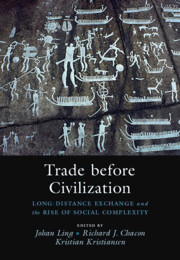
Trade before Civilization explores the role that long-distance exchange played in the establishment and/or maintenance of social complexity, and its role in the transformation of societies from egalitarian to non-egalitarian. Bringing together research by an international and methodologically diverse team of scholars, it analyses the relationship between long-distance trade and the rise of inequality. The volume illustrates how elites used exotic prestige goods to enhance and maintain their elevated social positions in society. Global in scope, it offers case studies of early societies and sites in Europe, Asia, Oceania, North America, and Mesoamerica. Deploying a range of inter-disciplinary and cutting-edge theoretical approaches from a cross-cultural framework, the volume offers new insights and enhances our understanding of socio-political evolution. It will appeal to archaeologists, cultural anthropologists, conflict theorists, and ethnohistorians, as well as economists seeking to understand the nexus between imported luxury items and cultural evolution.
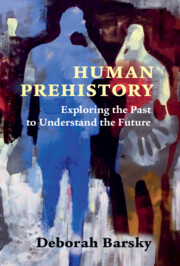
This book provides a concise overview of human prehistory. It shows how an understanding of the distant past offers new perspectives on present-day challenges facing our species - and how we can build a sustainable future for all life on planet Earth. Deborah Barsky tells a fascinating story of the long-term evolution of human culture and provides up-to-date examples from the archaeological record to illustrate the different phases of human history. Barsky also presents a refreshing and original analysis about issues plaguing modern globalized society, such as racism, institutionalized religion, the digital revolution, human migrations, terrorism, and war. Written in an accessible and engaging style, Human Prehistory is aimed at an introductory-level audience. Students will acquire a comprehensive understanding of the interdisciplinary, scientific study of human prehistory, as well as the theoretical interpretations of human evolutionary processes that are used in contemporary archaeological practice. Definitions, tables, and illustrations accompany the text.
Chapter 5 introduces the reader to the remarkable world of the Neandertal, discussing some of the most controversial issues relating to this species of Homo: its emergence, lifeways and ultimate extinction. It introduces cutting-edge ideas about how the probable encounters between Neandertals and anatomically modern humans, also present in the same timeframe and territories, might have been.
Chapter 3 discusses bipedalism and stone toolmaking, considered the two first major milestones in the so-called "hominization process." The hominin record is succinctly explained with an overview of the contexts in which the first bipedal ancestors developed in Africa with a discussion of how and why first technologies might have emerged.
Chapter 1 introduces some of the basic notions of human prehistory, defining evolutionary theory, culture and the historical aspects of archeological consciousness. The chapter explains the Quaternary Period as the setting for the evolution of the genus Homo, ending with the Anthropocene, which is the first geological period to be defined on the basis of humanly induced modifications to the Earth’s ecosystems, affecting climate and geological strata.
Chapter 10 allows for reflection on the present condition of humanity from an evolutionary perspective. This unique, long-term viewpoint clearly shows how the invention and evolution of technology and its related, falsely created land-linked cultural affinities have finally led the human species to an angst-ridden condition of alienation from Nature.
The Introduction provides an overview of the book’s thirteen chapters, outlining its main goal: to explain the basic notions of prehistoric archeology and its important role in helping us to gain a better understanding of the modern-day human condition. The structure of the book is exposed in five main parts. The first part (Chapters 1 and 2) defines prehistoric archeology and the different fields of knowledge integrated into its multidisciplinary scope. The second part (Chapters 3 through 5) explores the evolutionary indicators of what it means to be human, providing a concise geographical and chronological framework using examples from the archeology. The third part (Chapters 6 and 7) focuses on the technosocial evolutionary processes leading up to Homo sapiens, the last surviving hominin on the planet. The fourth part (Chapters 8 through 12) applies the concepts explained in the previous chapters to consider how the most challenging issues facing modern humanity today are elucidated by viewing them through the lens of prehistoric archeology. The fifth and final part (Chapter 13) concludes the book with a lucid interpretation of the significant role played by prehistoric archeology and evolutionary theory in the modern world.
Chapter 8 examines how millennia of accrued technological know-how, experimentation and curiosity enabled humanity to develop the first metallurgy, exploring the founding of important trade networks. The key role of symbolic communication networking is discussed as an influencing factor in the emergence of writing as a breakthough that finally enabled ideas to transcend time.
Chapter 13 chapter synthesizes the reasoning developed throughout the book, discussing the important role played by human prehistory in understanding the challenges facing modern-day humans in a globalized world of rapidly developing technologies in an increasingly virtual existence.
Chapter 9 discusses climate change, past, present and future: What is the real role of humanity in global warming and how do actual climatic trends differ from those of the past? Using key archeological sites with long stratigraphic records assists in providing a better understanding these phenomena.