To save content items to your account,
please confirm that you agree to abide by our usage policies.
If this is the first time you use this feature, you will be asked to authorise Cambridge Core to connect with your account.
Find out more about saving content to .
To save content items to your Kindle, first ensure no-reply@cambridge.org
is added to your Approved Personal Document E-mail List under your Personal Document Settings
on the Manage Your Content and Devices page of your Amazon account. Then enter the ‘name’ part
of your Kindle email address below.
Find out more about saving to your Kindle.
Note you can select to save to either the @free.kindle.com or @kindle.com variations.
‘@free.kindle.com’ emails are free but can only be saved to your device when it is connected to wi-fi.
‘@kindle.com’ emails can be delivered even when you are not connected to wi-fi, but note that service fees apply.
Ocean radiocarbon (14C) is a proxy for air-sea exchange, vertical and horizontal mixing, and water mass identification. Here, we present five pre- to post-bomb coral Δ14C records from West Flower Garden Bank and Santiaguillo reefs in the Gulf of Mexico, Boca de Medio, and Isla Tortuga near the Cariaco Basin north of Venezuela. To assess basin-wide Δ14C variability, we compiled the Atlantic Ocean reef-building surface coral Δ14C records (24 corals and 28 data sets in total) with these new records. Cumulatively, the Δ14C records, on their independent age models, reveal the onset of post-bomb Δ14C trends in 1958 ±1 to 2 years. A general decrease in maximum Δ14C values occurs with decreasing latitude reflecting the balance between air-sea gas exchange and surface water residence time, vertical mixing, and horizontal advection. A slightly larger atmospheric imprint in the northern sites and relatively greater vertical mixing and/or advection of low-14C waters influence the southern Caribbean and eastern Atlantic sites. The eastern Atlantic sites, due to upwelling, have the lowest post-bomb Δ14C values. Equatorial currents from the eastern Atlantic transport low Δ14C water towards the western South Atlantic and southern Caribbean sites. Decadal Δ14C averages for the pre-bomb interval (1750–1949) for the low latitude western Atlantic are relatively constant within analytical (3–5‰) and chronological uncertainties (∼1–2 years) due to mixing and air-sea exchange. The compiled Δ14C records provide updated regional marine Δ14C values for marine reservoir corrections.
The Cunene region of southern Angola, especially the area around Xangongo, hosts a large number of African baobabs, including several superlative specimens. Our research reports the investigation of the three biggest specimens from Xangongo Grove, named XG-1 (11 stems; circumference 26.34 m), XG-2 (5 stems; 22.70 m) and XG-3 (9 stems; 27.73 m), and of the largest baobab from Xangongo town, named XT-1 (7 stems; 21.02 m). Several wood samples were collected from these four baobabs mainly as cores from trunks and/or primary branches and then radiocarbon-dated by AMS. The two oldest samples were extracted from two primary branches of baobab XG-1. These have practically identical radiocarbon dates of 1822 ± 19 BP and 1822 ± 10 BP, which correspond to identical calibrated ages of 1785 ± 15 and 1785 ± 10 calendar years. The calculated age of baobab XG-1 is 2100 ± 50 years. Thus, XG-1, which is called by the locals “The biggest baobab of Africa”, becomes the oldest living African baobab with accurate dating results. The results indicate ages of 1100 years for baobab XG-2, 850 years for baobab XG-3 and 550 years for baobab XT-1.
We report a set of radiocarbon dating of prehistoric settlements located on the paleolake Baruun Khuree shores in the Gobi-Altai area, southern Mongolia. The obtained series of 11 AMS 14C measurements on charcoal and other charred plant macro-remains can be associated with one of the earliest episodes of the Holocene highly mobile desert-adapted hunter-gatherers activities from the Gobi desert (ca. 11,250–10,500 cal BP). Exploiting a wide range of environments, including dune fields, they are characterized by pottery usage and microblade core technology with wedge-shaped cores as well as osteological materials. These preliminary results are part of a project analyzing the nature of long-lasting prehistoric occupation around Tsakhiurtyn Hundi (Eng. Flint Valley)—one of the most extensive early prehistoric sites of Central Asia owing its name to the presence of abundant flint outcrops, lithic workshops and their innumerable flint artifacts.
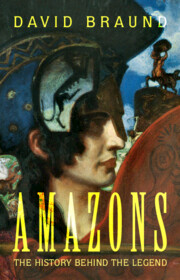
The idea of the Amazons is one of the most romantic and resonant in all antiquity. Greeks were fascinated by images and tales of these fierce female fighters. At Troy, Achilles' duel with Penthesilea was a clash of superman and superwoman. Achilles won the fight, but the queen's dying beauty had torn into his soul. This vibrant new book offers the first complete picture of the reality behind the legends. It shows there was much more to the Amazons than a race of implacable warrior women. David Braund casts the Amazons in a new light: as figures of potent agency, founders of cities, guileful and clever as well as physically impressive and sexually alluring to men. Black Sea mythologies become key to unlocking the Amazons' mystery. Investigating legend through history, literature, and archaeology, the author uncovers a truth as surprising and evocative as any fiction told through story or myth.
The archaeological settlements of the Early Neolithic Urfa region in Türkiye have garnered academic and public interest since the 1990s due to their large-scale stone architecture and rich iconography, particularly featuring phallic imagery. While mainstream narratives suggest a male-centred society in the region, feminist and queer theory approach such interpretations with a critical eye. By challenging traditional ‘male-centred society’ narratives through the lens of queer and feminist theories, this study offers a critique of existing methodologies that fail to historicize archaeological data. By recontextualizing the phallic iconography through the lens of sexuality, this study proposes a new interpretation: the phallus was not a symbol of male power, but an agent facilitating spiritual transcendence, enabling ecstatic experiences and serving as a conduit between the material and spiritual realms.
Within this paper, glocalization is presented to explain the heterogeneity of the Uruk Expansion/Phenomenon, a process which saw extensive interactions and cultural integration across Mesopotamia during the fourth millennium bce, characterized by the spread of southern Mesopotamian material culture and cultural practices. Through close examination of archaeological data from the Adhaim-Sirwan Drainage Basin, southern Iraqi Kurdistan, a region which is emerging as a focus of intense culture-contact during the Uruk Phenomenon, I contend that a glocalized perspective of this phenomenon better illuminates its regional nuances and complexities, as well as the interactions between local and Uruk communities within the Adhaim-Sirwan. By employing a glocalizing framework, this paper demonstrates that cultural interactions led to varied adaptations of the Uruk Phenomenon and illustrates the dynamic interplay between global influences and local responses. Ultimately, this paper advocates for a nuanced understanding of the Uruk Phenomenon, highlighting its regional variability and the importance of local agency in shaping cultural outcomes, thereby framing it as a distinctly glocalized process rather than an expression of globalization.
Migration is an established topic in archaeology, approached by researchers in multiple ways. We argue, however, that new ways of thinking are needed to understand migration in new ways in relation to new results coming from ancient DNA studies and other archaeometric analysis. We apply a transdisciplinary approach and engage with (critical) migration studies, critical heritage studies and archaeology to unwrap essential theoretical aspects of migration. Based on our results, we propose a conceptual/theoretical framework as our contribution to migration studies in archaeology.
The Late Neolithic and Early Bronze Age (c. 2900–1600 bc) of Central Europe are characterized by burial practices that strongly differentiate between men and women through body placement and orientation in the grave, as well as through grave goods. The osteological sex estimation of the individuals from the cemeteries of Franzhausen I and Gemeinlebarn F corresponds to the gender expressed in the funerary practice in 98 per cent of cases. In this study, we investigate the remaining minority by applying ultra-high-performance liquid chromatography–high-resolution mass spectrometry (UHPLC-HRMS) to identify sex-specific peptides in the dental enamel of 34 individuals, for which the published osteological sex estimation did not fit the gendered burial practice. The results reveal sex estimation and transcription errors, demonstrating that the chromosomal sex of the individuals usually aligns with the gendered burial treatment. We found burials with internally inconsistent gendered patterns (‘mixed-message burials’), but there is no evidence to suggest that a biologically male individual was deliberately buried as a woman or a biologically female individual was buried as a man.
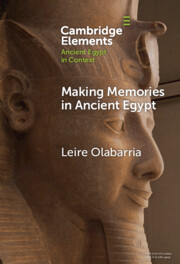
Memory is a fascinating way to approach modern and ancient cultures, as it raises questions about what, why, and how individuals and groups remember. Egyptology has had a major impact on the development of memory studies, with Jan Assmann's notion of cultural memory becoming a widespread model within the humanities. Despite this outstanding contribution of Egyptology to memory studies, remarkably few recent works on ancient Egypt deal with memory from a theoretical and methodological point of view. This Element provides a general introduction to memory, followed by a discussion of the role of materiality and performativity in the process of remembering. A case study from Middle Kingdom Abydos illustrates how memory can be embodied in the monumental record of ancient Egypt. The purpose of this Element is to present an up-to-date introduction to memory studies in Egyptology and to invite the reader to rethink how and why memory matters.
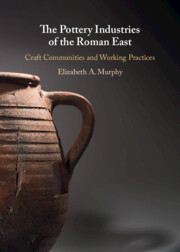
What was the social experience of work in the ancient world? In this study, Elizabeth Murphy approaches the topic through the lens offered by a particular set of workers, the potters and ceramicists in the eastern provinces of the Roman Empire. Her research exploits the rich and growing dataset of workshops and production evidence from the Roman East and raises awareness of the unique features of this particular craft in this region over several centuries. Highlighting the multi-faceted working experience of professionals through a theoretically-informed framework, Murphy reconstructs the complex lives of people in the past, and demonstrates the importance of studying work and labor as central topics in social and cultural histories. Her research draws from the fields of archaeology, social history and anthropology, and applies current social theories --- communities of practice, technological choices, chaîne opératoire, cultural hybridity, taskscapes – to interpret and offer new insights into the archaeological remains of workshops and ceramics.
Research published in the last decade, which has provided data from both technological and morphometrical analyses of lithic points from southeastern and southern Brazil and Uruguay, suggests that there is much more cultural diversity among hunter-gatherers during the Early to Mid-Holocene than previously suggested by the Umbu Tradition model. Some of these studies have suggested new archaeological cultures and new definitions of lithic industries. In this article we present new data on another lithic assemblage that we associate with the Garivaldinense lithic industry and is found at the Pedro Fridolino Schmitz site. We also present, for the first time, the definition of two new types of lithic bifacial stemmed points. Our data suggest a low-density occupation of the site from the Middle to Late Holocene (8000–1000 BP) and some variability within the Garivaldinense industry throughout time and space.
This article presents a case of osteomyelitis variolosa from a skeleton excavated in the Western Cemetery at Cirencester (Corinium) in Britain, dated to the 3rd or 4th c. CE. This osteological condition is caused by the variola virus, the causative agent of smallpox, and is found in some individuals who have survived a childhood smallpox infection, the condition manifesting many years later. The significance of this discovery is that it indicates that smallpox had been introduced into the Roman world, and to Britain in particular, by the late 3rd or 4th c. CE. Rather than postulating a separate and unrecorded introduction of smallpox into the Roman empire, we suggest that this discovery strengthens the case for seeing the 2nd-c. Antonine Plague as an early form of smallpox.
Emerging from a shift in the relationship between archaeology and museums, the ‘Making the Museum’ project investigates the makers of the archaeological and ethnographic collections of the Pitt Rivers Museum in Oxford, positioning archaeological theory and method as essential tools for uncovering the ‘hidden histories’ of these makers.
This article reports from an interdisciplinary, archaeological and philosophical research project developing and using an analogue model in archaeological research. With prominent uses outside of archaeology, analogue models can offer a unique participatory perspective to prehistoric processes. As such the paper contributes to recent discussions in this journal and elsewhere on the role of games, play and gamification in archaeological research, teaching and cultural heritage. Our analogue model critically discusses cultural-evolution-based models of selected European Neolithic and Bronze Age models and develops a perspective based on the life history and the Capability Approaches. In times of climate and war stress, our model can offer a hopeful perspective of the human past, present and future without compromising on scientific insights.
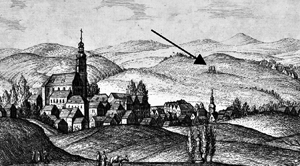
Historic sites of lawful execution are now largely consigned to archival records, including hand-drawn maps. Using these records to identify potential locations, this project deploys non-invasive geophysical surveys and targeted excavation to uncover execution sites and historic gallows in Silesia.
This Element focusses on the emergence of Aegean Prehistory as a discipline, starting with the first recorded encounters with prehistoric monuments and artefacts and ending with the decipherment of Linear B in 1952. It broadens the history of Aegean Bronze Age archaeology as told in popular accounts as a series of excavations of great men, particularly Heinrich Schliemann at Troy and Mycenae and Sir Arthur Evans at Knossos. Though their work is of fundamental importance for the discipline, here it is placed within wider political, institutional and intellectual frameworks. This Element also provides an overview of the work of many other archaeologists across the Aegean and the regional and historical context in which they operated. It provides a brief but comprehensive history of the formative stages of the study of Aegean Prehistory.
A total of 2848 denarii from the Nietulisko Małe Hoard, one of the largest hoards of Roman coins found in Poland, were digitised and documented using reflectance transformation imaging, highlighting the potential for this technology in numismatic research.
On the upper reaches of the Tigris and Euphrates, archaeologists encounter evidence that challenges conventional understandings of early state formation as a transition from ‘small-scale, egalitarian’ to ‘large-scale, stratified’ societies. One such location is the Early Bronze Age cemetery of Başur Höyük, which presents evidence of grand funerary rituals—including ‘retainer burials’ and spectacular deposits of metallic wealth—in an otherwise small-scale, egalitarian setting. A further, puzzling feature of this cemetery is the preponderance of teenagers in the richest tombs. Here we describe the combined results of archaeological and anthropological analysis at Başur Höyük, including ancient DNA, and consider the challenges they pose to traditional accounts of early state formation.