To save content items to your account,
please confirm that you agree to abide by our usage policies.
If this is the first time you use this feature, you will be asked to authorise Cambridge Core to connect with your account.
Find out more about saving content to .
To save content items to your Kindle, first ensure no-reply@cambridge.org
is added to your Approved Personal Document E-mail List under your Personal Document Settings
on the Manage Your Content and Devices page of your Amazon account. Then enter the ‘name’ part
of your Kindle email address below.
Find out more about saving to your Kindle.
Note you can select to save to either the @free.kindle.com or @kindle.com variations.
‘@free.kindle.com’ emails are free but can only be saved to your device when it is connected to wi-fi.
‘@kindle.com’ emails can be delivered even when you are not connected to wi-fi, but note that service fees apply.
By the mid-1200s, a traveler across the Plains would have encountered a wide array of communities and lifeways. In the far southwest, scattered households of small-scale farmers with strong ties to the southern part of the American Southwest lived in much of the Pecos Valley, while similar communities with closer connections to the Taos area lived to the north of them, perhaps into Colorado. People who made brownware pottery like that in the southern Southwest also occupied the grasslands from the Pecos across the southern Llano Estacado and may still have had settlements in the eastern Texas Panhandle and to the edge of central Texas, where they perhaps lacked maize horticulture but retained southwestern ceramic and other traditions. In Texas, these eastern groups would have met aceramic, probably seasonally settled, generalist hunter-gatherers. From Oklahoma to North Dakota, farmers dominated much of the eastern two-thirds or so of the region, living in fairly small communities in more southern areas and in substantial towns with hundreds of inhabitants in the north. All of these farmers grew maize and other cultigens, although they varied widely in their emphasis on this and there were persistent enclaves of communities (in areas like southeastern Kansas and the eastern part of the Dakotas) who knew and interacted with them but whose ways of life had changed relatively little since Late Woodland times. Much of the Western Plains of Colorado and Wyoming seems to have been substantially depopulated at this time, but farmers certainly reached out to the west in ways that we still do not fully understand. And industrial bison hunters filled the grasslands to the north and northwest, as they had for centuries.
I began this volume by noting the disconnect between widespread and long-standing views of the indigenous people and environment of the Great Plains and the reality of the character and history of that region. Mounted bison hunters like the ones we often visualize did live on the grasslands, but they existed for little more than a century and a half and many of the most famous groups who lived this way migrated to the Plains during the Colonial Era. Focusing on them neglects not only the farmers who dominated the Plains for a millennium but also the diversity of hunter-gatherer ways of life that people have lived there for perhaps 15,000 years or more. Like human history throughout North America, human history on the Plains is not a story of an unchanging way of life fixed for centuries in the forms that Euroamericans encountered; it is a story of constant change and interaction between human beings and the region’s potentials and limits. It is also a story that is difficult to understand without thinking about how Plains people reached out beyond the grasslands, establishing social and economic connections that spanned much of North America.
As the next three chapters discuss, communities of maize farmers appeared in a limited area at the northeastern edge of the grasslands during the 10th century and over a much larger area in the following centuries. This shift had implications for virtually every aspect of the lives the people in these communities and their neighbors lived, as did similar shifts throughout the world. This chapter presents a background to these changes on the Great Plains. Chapters 8 through 10 examine the archaeology of Plains farmers and their hunter-gatherer neighbors from AD 950 to AD 1500 more concretely with this background in mind.
This article discusses the aggregation and dispersion of the Chulmun hunter-gatherers (c. 8000–1500 bce) in prehistoric Korea. The following observations are made from settlement datasets. First, large numbers of houses do not necessarily imply aggregation, as they can be palimpsests of dwelling structures from different phases. Second, aggregation settlements were segmented and contained multiple discrete subunits. Individual residential clusters typically had fewer than 60 inhabitants. Third, there are some indications of social hierarchy in nucleated settlements such as Unseo-dong. Fourth, despite some evidence of emergent elites and social differentiation, social complexity did not intensify over the long run. Levelling mechanisms (e.g. group fission) were in operation and they suppressed the institutionalization of social hierarchy.
Decapitation was an integral part of the complex ritual practices recorded in the palaeographic and archaeological records at the Late Shang (c. 1250–1050 bce) site of Yinxu in Henan Province, China. Although representations of decapitation are often found in societies where the act was carried out, no clear evidence exists for Yinxu, where only a small number of human depictions have been uncovered to date. In this article, I use archaeological data from sacrificial contexts and material culture uncovered during excavations over the past 90 years to investigate the human head as Late Shang elite visual culture. I argue that the dramatic increase in decapitation at Yinxu necessitated the development of a ritually informed process for handling these remains that transformed them into elite objects, while simultaneously pacifying their potentially dangerous post-mortem agency. This research contributes to global comparative studies on the materiality of the human head.
The primitive race of Soay sheep from the St Kilda archipelago in northwest Scotland has played an important role in narratives of the history of domestic sheep. The Soays, apparently a ‘Bronze Age’ race of sheep, were probably confined to the precipitous isle of Soay as soon as ‘Iron Age’ sheep were introduced to Hirta, St Kilda's main island, owing to the competitive edge of the ferocious Soay rams over the new arrivals. In the 1880s, Pitt-Rivers, following his archaeozoological interests, was the first to keep Soays in his park, their epic journey from the edge of the Atlantic to southern England enabled by his acquaintance with their owner. In the early twentieth century, Soays featured in animal bone reports for archaeological sites, were kept in parks and involved in breeding experiments, particularly around Horsham, Sussex (where their owner lived), and in Edinburgh. The transfer of 107 Soays to Hirta in 1934 and 1935, after humans had evacuated St Kilda, was a remarkable feat, enabling the important long-running Soay Sheep Project. The historical exploitation of ‘feral’ Soay sheep by the islanders of St Kilda has significant cultural ramifications.
Medicinal practices were critical in ancient societies, yet we have limited insight into these practices outside references found in ancient texts. Meanwhile, historic and ethnographic resources have documented how a number of plants, from across the landscape, are assembled into pharmacopoeias and transformed into materia medica. These documentary resources attest to diverse healthcare practices that incorporate botanical elements, while residues in the archaeological record (seeds, phytoliths and starch grains) point to a variety of activities, some of them therapeutic in nature. Focusing on four pre-Hispanic communities in northwestern Honduras, I draw upon ethnobotanical and ethnobiological knowledge to infer medical practices potentially represented by ancient plant residues. Comparing these findings with prior investigations, I address the limits of dividing taxa into mutually exclusive categories such as ‘food’, ‘fuel’ and ‘medicine’. I consider the importance of apothecary craft in past lifeways, as well as the persistence of many traditions in contemporary medical practice.
The interpretation of Late Iron Age burial mounds often focuses exclusively on the discovered contents, the social identity or role of the interred and the economic and political implications that can be extracted. This article considers the mound itself as a basis for archaeological interpretation, and attempts to place substantial late Iron Age burial mounds within the landscape they are made of. Within these burial mounds internal references to time, place and the transformations and imbued associations within the earth-sourced materials are purposeful and significant. This is illustrated via comparable examples from southern Norway, and to add contrast, cases from the Viking Age Isle of Man will be explored. This article will outline why the selected mounds should be seen as closely related to each other in the references they contain, and how the materials used can be seen as a purposeful link to the land itself.
Recovering the agency, skill and innovation of archaeological field assistants from historical encounters is essential to interrogating processes of knowledge production, but is often hampered by access to appropriate archival sources and methods. We detail a field project from early twentieth-century Basutoland (modern-day Lesotho) that is unique both for its aim to salvage details of rock-art production as a dying craft and for its archive chronicling the project's intellectual journey from experiment to draft manuscripts to published work over more than three decades. We argue that critical historiographic attention to this archive offers a guide for examining the intimate dynamics of fieldwork and the effects of these micropolitics on the archaeological canon. We demonstrate how sustained attention to long processes of knowledge production can pinpoint multiple instances in which the usability of field assistants’ scientific knowledge is qualified, validated, or rejected, and in this case how an African assistant is transformed into an ethnographic interlocutor. For rock-art studies especially, this represents a need for interrogating the epistemic cultures—not just the content—of foundational historical data.
In this study, we outline a maritime perspective on interaction in the Late Bronze/early Iron Age Mediterranean. In response to what has elsewhere been termed the ‘maximalist’ approach, which foregrounds direct, long-distance trading connections between distant Mediterranean regions as a key feature of Late Bronze Age exchange systems, we propose a more nuanced, ‘minimalist’ and argue that notions of contact, connectivity and mobility need to be carefully distinguished if we wish to discuss both the material and social dimensions of maritime mobility. In particular, we critique the prominently proposed, allegedly direct trade route between Sardinia and Cyprus. The network we suggest hinges on multiply connected nodes, where a variety of social actors take part in the creation and maintenance of maritime connections. By unpacking several such nodes between Sardinia and Cyprus, we demonstrate that simply asserting the dominance of Sardinian, Cypriot or Aegean mariners falls short of the complex archaeological evidence and eschews possible social interpretations. In conclusion, we submit that maritime connectivity is an inherently social activity, and that a culturally diverse prehistoric Mediterranean was connected by multiple interlocking and overlapping networks.
Studies into the presence and absence of post-European contact rock art within Indigenous communities are particularly relevant to questions of colonial impact and influence. However, it is the presence of post-contact motifs and introduced subject matter that typically takes precedence in these studies. In this paper, we focus on the absence of post-contact paintings of European ships in Torres Strait (northeastern Australia) rock art. This absence is curious, given that Torres Strait peoples first encountered European ships over 400 years ago, yet the only paintings of watercraft are of their own double outrigger canoes. Furthermore, ethnographic information suggests many painted canoes were spirit canoes used by spirits of the dead, and European mariners were considered spirits of the dead who travelled in ‘ghost ships’. Despite apparent epistemological and ontological congruence between Islander and Kaurareg canoes and European ships, we argue the latter were conceptually and metaphysically different to spirit canoes and thus fell outside of the representational (rock art) genre of watercraft that was limited to spirit canoes. The lack of Torres Strait post-contact rock art reveals that reasons for the inclusion of introduced subject matter in post-contact rock art are likely to extend beyond simple exposure to, and familiarity with, so-called new subject matter.
This paper proposes a novel procedural framework for the archaeological study of the long-term transformation of religious practices by heuristically defining the religious in terms of their functional-effective elements. Thus, religious activities constitute a distinct communicative domain that responds to and processes the uncertainties and risks of the world. Drawing on this re-definition, this paper proposes a procedure comprising the following units of investigation: (A) what uncertainties and risks of the world were generated in and differentiated by a certain social formation; (B) how were they responded to and processed; and (C) how is the mode of the responding and processing changed as social formations are transformed? The applicability of this procedure is examined through a case study from the pre- and proto-historic periods of the Japanese archipelago. It is hoped that the framework reintroduces causally explanatory, comparative and long-term perspectives to the archaeological study of religious practices.
Dental modification represents one interesting aspect of corporeal adornment in human history that directly reflects personal social identity. Tooth filing choices distinguished certain individuals at the urban, Maya political capital of Mayapan from 1150 to 1450 ad, along with cranial modification, nose and ear piercings, tattoos and body paint. Here we examine how filing teeth, considered a beautification practice for women at Spanish Contact in the sixteenth century, is distributed across a skeletal sample of males, females, elites and commoners in this city. We evaluate the normative claim of the Colonial period and determine that while predominantly females filed their teeth, most women chose not to. Sculptural art further reveals that male personages associated with the city's feathered serpent priesthood exhibited filed teeth, and we explore the symbolic meaning of filed tooth shape. Assessing the practice in terms of associated archaeological contexts, chronology and bone chemistry reveals that it did not correlate with social class, dietary differences, or birthplace. Residents of Mayapan, a densely inhabited, multi-ethnic city of 20,000, engaged with multiple material expressions of belonging to intersecting imagined communities that crosscut competing influences of polity, city, hometown and family scale identity. Tooth filing reflects identities at the individual or family scale.
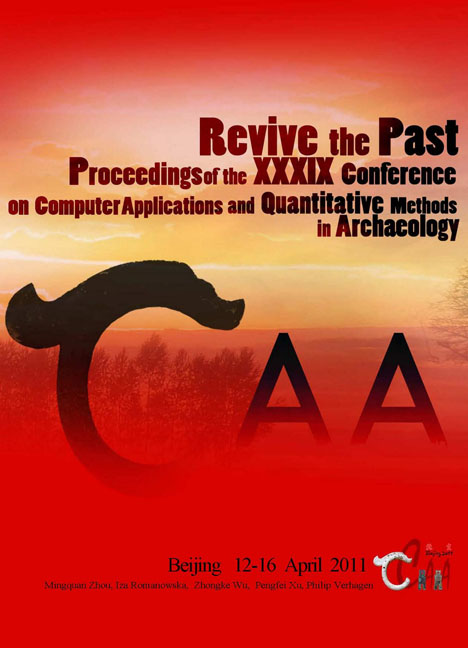
The present volume consists of the peer-reviewed papers presented at the CAA2011 conference held in Beijing, China between April 12 and 16, 2011. The theme of this conference was -Revive the Past, which means retrieving our history and using it to help create a new civilization. It was a great honour to organize the conference where over 130 researchers made presentations; ten keynote speeches were given; and sixteen sessions covered a wide variety of topics: data acquisition and recording, conceptual modelling, data analysis, data management, digging with words, 3D models, visualizing heritage sites, digital spaces for archaeology, geophysics, GIS, graphics in archaeology, visualisation in archaeology, semantic technologies, spatial prediction, visualization and exhibition, and 3D object reconstruction. In addition, student papers and posters were presented.