Everyday Occupation

-
Select format
-
- Publisher:
- Cambridge University Press
- Publication date:
- 27 November 2025
- 11 December 2025
- ISBN:
- 9781009600705
- 9781009600682
- 9781009600668
- Creative Commons:
-
This content is Open Access and distributed under the terms of the Creative Commons Attribution licence CC-BY-NC-ND 4.0.


https://creativecommons.org/creativelicenses - Dimensions:
- (229 x 152 mm)
- Weight & Pages:
- 0.617kg, 312 Pages
- Dimensions:
- (229 x 152 mm)
- Weight & Pages:
- 0.454kg, 312 Pages
Open AccessYou have digital access to this book
Show more authors 
You have digital access to this book
Book description
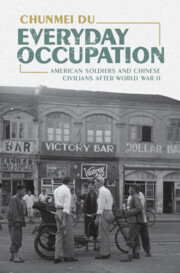
'In this rich history of everyday encounters between US soldiers and Chinese civilians, Chunmei Du explores their entangled relations from the end of World War II to the founding of the People's Republic of China. Drawing upon official, popular and personal accounts from both countries, Du examines the sensorial, material, and symbolic exchanges that took place between GIs and ordinary Chinese people-stall vendors, pedestrians, rickshaw pullers, 'Jeep girls,' and suspected thieves. Through the conceptual lens of the everyday, this book reveals how interactions such as traffic accidents, sexual relations, theft, and black-market dealings, impacted larger political dynamics during this pivotal era. Du shows how mundane struggles made imperialism and sovereignty tangible, fueling anti-American sentiment. Meanwhile, these encounters fostered informal diplomacy, shaping identities and forging new bonds that left a lasting imprint on both countries. This title is also available as Open Access on Cambridge Core.'
Reviews
‘This sophisticated book connects everyday offenses and geopolitics into a broad historical argument about the limits of ideology, policy, and propaganda to grasp popular outrage. The Jeep transitioned from a symbol of Allied victory to a representation of American imperialism in postwar China when the U.S. military occupation of North China let loose soldiers who bullied, raped, disregarded traffic signs and offended ordinary people. Reconstructing a complex history of the U.S. Marine III Amphibian Corps (IIIAC)’s fifty-thousand-man force sent to help end the Japanese occupation, Du creates a detailed account for another explanation for how the U.S. ‘lost’ the People’s Republic of China. Deftly wrapping macro-politics (the rise of the U.S. Empire and Cold War) around a regional struggle to capture the Chinese state, this book clarifies how it is still possible to write about the people as a motive force. Beneath abstraction, Du argues, is the terrain of everyday experience where we decide to act or not.’
Tani Barlow - Rice University
‘Compelling, affective, and marvellously delightful to read, Everyday Occupation ingeniously places the postwar US occupation of China under a microscope and reveals a rich texture of sociocultural reality in a volatile historical era. This is microhistory at its best.’
Yunte Huang - University of California, Santa Barbara
‘A remarkable study of the Chinese response to US soldiers who lingered too long in their country after 1945. With research both broad and deep, Chunmei Du demonstrates that the everyday sociologies of encounter - involving all the senses and including speeding Jeeps, American sexual misconduct, and ‘halt or shoot’ orders that resulted in the deaths of scores of Chinese - had direct, and devastating, impacts on China-US relations.’
Andrew Rotter - Colgate University
‘This well documented study of Sino-American encounters over women, food, and material objects foregrounds young American soldiers as accidental emissaries of a postwar global empire of liberal democracy. A multifaceted analysis made possible only by time, Du compellingly delineates the original dilemmas that structured the forgotten beginning of contemporary Chinese anti-Americanism.’
Wen-hsin Yeh - University of California, Berkeley
Contents
Contents
-
Everyday Occupation
pp i-ii -
-
- You have access
- Open access
- HTML
- Export citation
-
-
Everyday Occupation - Title page
pp iii-iii - American Soldiers and Chinese Civilians after World War II
-
-
- You have access
- Open access
- HTML
- Export citation
-
-
Copyright page
pp iv-iv -
-
- You have access
- Open access
- HTML
- Export citation
-
-
Dedication
pp v-vi -
-
- You have access
- Open access
- HTML
- Export citation
-
-
Contents
pp vii-vii -
-
- You have access
- Open access
- HTML
- Export citation
-
-
Maps
pp viii-viii -
-
- You have access
- Open access
- HTML
- Export citation
-
-
Figures
pp ix-xi -
-
- You have access
- Open access
- HTML
- Export citation
-
-
Acknowledgments
pp xii-xiv -
-
- You have access
- Open access
- HTML
- Export citation
-
-
Additional material
pp xv-xvi -
-
- You have access
- Open access
- HTML
- Export citation
-
-
Transliterations and Citation Practices
pp xvii-xviii -
-
- You have access
- Open access
- HTML
- Export citation
-
-
Introduction
pp 1-20 - Everyday Encounter
-
-
- You have access
- Open access
- HTML
- Export citation
-
-
1 - Occupying China
pp 21-58 - Mission Impossible
-
-
- You have access
- Open access
- HTML
- Export citation
-
-
2 - Sensory Contact
pp 59-93 - Life in the Orient
-
-
- You have access
- Open access
- HTML
- Export citation
-
-
3 - Embodied Vehicles
pp 94-123 - Jeep and GIs
-
-
- You have access
- Open access
- HTML
- Export citation
-
-
4 - Intimate Relations
pp 124-153 - Jeep Girls and Gendered Nationalism
-
-
- You have access
- Open access
- HTML
- Export citation
-
-
5 - Entangled Goods
pp 154-195 - American Charms and Harms
-
-
- You have access
- Open access
- HTML
- Export citation
-
-
Epilogue
pp 196-212 - Revisiting the Lost Era
-
-
- You have access
- Open access
- HTML
- Export citation
-
-
Notes
pp 213-264 -
-
- You have access
- Open access
- HTML
- Export citation
-
-
Bibliography
pp 265-286 -
-
- You have access
- Open access
- HTML
- Export citation
-
-
Index
pp 287-292 -
-
- You have access
- Open access
- HTML
- Export citation
-
Metrics
Altmetric attention score
Full text views
Full text views helpTotal number of HTML views: 0
Total number of PDF views: 0 *
 Loading metrics...
* Views captured on Cambridge Core between #date#. This data will be updated every 24 hours.
Usage data cannot currently be displayed.
Accessibility standard: WCAG 2.1 AA
Why this information is here
This section outlines the accessibility features of this content - including support for screen readers, full keyboard navigation and high-contrast display options. This may not be relevant for you.
Accessibility Information
The PDF of this book complies with version 2.1 of the Web Content Accessibility Guidelines (WCAG), covering newer accessibility requirements and improved user experiences and achieves the intermediate (AA) level of WCAG compliance, covering a wider range of accessibility requirements.
Content Navigation
Table of contents navigation
Allows you to navigate directly to chapters, sections, or non‐text items through a linked table of contents, reducing the need for extensive scrolling.
Index navigation
Provides an interactive index, letting you go straight to where a term or subject appears in the text without manual searching.
Reading Order and Textual Equivalents
Single logical reading order
You will encounter all content (including footnotes, captions, etc.) in a clear, sequential flow, making it easier to follow with assistive tools like screen readers.
Short alternative textual descriptions
You get concise descriptions (for images, charts, or media clips), ensuring you do not miss crucial information when visual or audio elements are not accessible.
Visual Accessibility
Use of colour is not sole means of conveying information
You will still understand key ideas or prompts without relying solely on colour, which is especially helpful if you have colour vision deficiencies.
Structural and Technical Features
ARIA roles provided
You gain clarity from ARIA (Accessible Rich Internet Applications) roles and attributes, as they help assistive technologies interpret how each part of the content functions.