To save content items to your account,
please confirm that you agree to abide by our usage policies.
If this is the first time you use this feature, you will be asked to authorise Cambridge Core to connect with your account.
Find out more about saving content to .
To save content items to your Kindle, first ensure no-reply@cambridge.org
is added to your Approved Personal Document E-mail List under your Personal Document Settings
on the Manage Your Content and Devices page of your Amazon account. Then enter the ‘name’ part
of your Kindle email address below.
Find out more about saving to your Kindle.
Note you can select to save to either the @free.kindle.com or @kindle.com variations.
‘@free.kindle.com’ emails are free but can only be saved to your device when it is connected to wi-fi.
‘@kindle.com’ emails can be delivered even when you are not connected to wi-fi, but note that service fees apply.
Geopolitical tensions escalated between the USSR and the Republic of China over control of the Chinese Eastern Railway during the late 1920s, resulting in a brief war in which several thousand people were killed. Given the violence in Manchuria in the months preceding direct military engagement, it is surprising that Soviet authorities sent an opera tour to the zone of conflict. This article examines the two seasons spent by visiting Soviet opera vocalists at the Railway Assembly Hall (Zhelsob) from September 1927 to February 1929, attending to the staging, reception and political goals of the tour. I argue that the opera stage in the city of Harbin transformed into a temporary zone of informal extraterritoriality, where unpredictable collaborations transpired between ideological enemies on either side of the military clash. The Soviet opera tour to Manchuria prompts us to reconsider the agency and intentionality of musicians in armed conflict.
This article sheds light on the understudied significance of Islam, Communism, and global politics in defining what constituted an acceptable “religion” (shūkyō 宗教) in wartime Japan. An analysis of the Japanese Imperial Diet’s debates on the place of Islam in the Religious Organizations Law of 1939, which defined state-sanctioned religious organizations, reveals that Muslim attention from around the world, international politics, the global spread of Communism, and the relatively short history of Islam in Japan, affected politicians’ decision not to mention Islam as a religious organization in the law. While previous literature on the Religious Organizations Law has not adequately addressed the significance of international and non-Euro-American transnational influences, this article argues that lawmakers viewed the power of transnational Muslim and Communist networks as crucial when defining both officially acceptable “religion” and the Shrine (jinja 神社), or Shrine Shinto, as the national core to be protected under this law. The debates surrounding Islam offer fertile ground for examining the significance of global affairs in determining acceptable forms of “religion” in Japan, as well as the broader implications of what Japanese state officials called “religion” and “thought” (shisō 思想) in wartime Japanese and world politics.
Chapter 4 adds another intellectual dimension and genealogy to Nkrumah’s political-economic philosophy by arguing that he was aware of Lenin’s state capitalist ideas and that the Ghanaian economy existed and functioned within this state capitalist, mixed economic framework. Moreover, this chapter examines how people within and outside Ghana understood the duality of Ghana’s socialist and capitalist economy – its socialist state capitalist project – and its applicability to Ghana’s conditions and the postcolonial world. It demonstrates that the Ghanaian political economy under Nkrumah combining socialist and capitalist development paths was not a contradictory Marxian policy but was embedded within Black Marxist understandings of Lenin’s state capitalist ideas. In so doing, Socialist De-Colony merges the nonoverlapping intellectual and geographic spaces of Paul Gilroy’s “Black Atlantic” and Cedric Robinson’s “Black Marxism” with Maxim Matusevich’s “Africa and the Iron Curtain.” It shows how the cultural and intellectual interchange of ideas between and amongst Black thinkers moved beyond the Atlantic circuit and were simultaneously heavily mediated and impacted by ideas from the East.
The two crises in this chapter share three main characteristics. They involve territorial (border) conflict that relates to the independence of Ukraine (or, relatedly, the breakup of the Soviet Union), feature an East–West tension, and (as of this writing) do not escalate to a war among the major states. In 2014, after Ukraine attempted to move closer to Europe (i.e., it contemplated an EU agreement and the pro-Russian government fell), Putin annexed Crimea to secure the long-held naval base there. Although done forcefully, there were no military fatalities. In 2022, amidst a fear that Ukraine was again moving closer to Europe (i.e., it looked to be closer to joining NATO and its government became less pro-Russian), Russia invaded Ukraine. It failed to take Kyiv, even though it heavily bombed Ukraine. Russia then withdrew to the east, where a majority of Russian speakers had sought to separate from Ukraine. The United States and the European Union gave weapons and aid that expanded as the war continued. Deaths mounted on both sides. The Russians successfully created a land bridge from the Donbas to Crimea. After his election, Trump attempted to negotiate a settlement that would end the war.
Chapter 2 interrogates the development schemes between Ghana and the Soviet Union – notably the Cotton Textile Factory and the Soviet Geological Survey Team. These engagements were supposed to embody Ghana’s new postcolonial socialist modernity and highlight the benefits, opportunities, and possibilities of Soviet partnership. It demonstrates how pro-Soviet and Eastern bloc stories in the Ghanaian press were not simply intended to offer hagiographic praise or to support Nkrumah’s commitment to geopolitical nonalignment. Instead, they were part of a concentrated movement to dismantle and deconstruct the myth of Western scientific and cultural superiority and anti-Soviet bias, which were introduced and reinforced by Western colonial education and rule. In addition, Chapter 2 focuses on the relationships, expertise, livelihoods, and contestations of the technicians, bureaucrats, and local Ghanaian actors who were essential to overseeing the actual success of Ghana-Soviet relations in tangible ways for the Ghanaian people. It demonstrates how everyday Ghanaians employed Ghana–Soviet spaces to demand rights and protections against ethnic-discrimination and favoritism, and to make citizenship claims.
This chapter recounts the major events from Operation Barbarossa, the codename for the invasion of the Soviet Union beginning on 22 June 1941. It looks briefly at the German operational planning and then the invasion itself. It considers how German operations sought to implement the strategic plan to defeat the Soviet Union in a summer campaign. Much of the discussion focuses on the panzer groups in the battles of Minsk, Smolensk, Kiev, and Moscow. It looks at the problems they encountered as well as the strategic disagreements in the German High Command. Key personalities like Franz Halder, Heinz Guderian, Hermann Hoth, Fedor von Bock, as well as Adolf Hitler are discussed. The final section discusses the Soviet winter offensive, which began in December 1941, and the subsequent German retreat from Moscow.
This chapter argues that Soviet crimes at times of war were both widespread and complex in their origin, goals, logic, and trajectory. It distinguishes and explains several forms of Soviet criminality during its defensive war against Germany in 1941–1945: crimes against humanity and war crimes, both perpetrated by agents of the state and often in accordance with explicitly formulated state policy; troop crimes, not guided by state policy but often understood to be in its fulfilment by the perpetrators; and a variety of violent and criminal behaviour emanating from small group bonding, both within the military and outside of it. The chapter explains their origins and charts the reasons why there was so much silence about the criminality of the Soviet war effort after victory.
Chapter 1 examines the fragility and unenviability of Black independence. It shows how Black Marxists and anticolonial figures navigated and negotiated Soviet and communist linkages from the 1940s to the 1960s against attempts by white Western imperial and colonial powers to weaponize the term “communism” to suffocate anticolonial movements and suspend Black independence. Once independent, the chapter shows that the Ghanaian government’s wariness of hastily establishing relations with the Soviet government arose not only from Western pressure but from genuine fears of swapping one set of white colonizers for another. The chapter then questions the totalizing analytical purchase of using the Cold War paradigm to understand the relationship between Black African nations and white empires – whether capitalist or communist – during the 20th century. It posits that a framework highly attentive to race and racism in international relations and diplomatic history must also be employed to understand the diplomatic actions of African states during this period. By so doing, Chapter 1 follows other pioneering works to argue that Ghanaians and the early African states had agency and dictated the paces and contours of their relationship with the USSR and other white imperial states.
Led by the charismatic Kwame Nkrumah, Ghana won its political independence from the United Kingdom in 1957. It precipitated both the dying spiral of colonialism across the African continent and the world's first Black socialist state. Utilising materials from Ghanaian, Russian, English, and American archives, Nana Osei-Opare offers a provocative and new reading of this defining moment in world history through the eyes of workers, writers, students, technical-experts, ministers, and diplomats. Osei-Opare shows how race and Ghana-Soviet spaces influenced, enabled, and disrupted Ghana's transformational socialist, Cold War, and decolonization projects to achieve Black freedom. This title is also available as open access on Cambridge Core.
By analyzing articles published in the official publication of the Latvian SSR Union of Writers, this article examines how Latgalian identity and culture were constructed by the Soviet Latvian intelligentsia before, during, and after the 1958 Latgale Culture Week in Riga. Interwar-era narratives that had identified Latgale as the Latvian internal Other were endemic to the center-periphery relations in Soviet Latvia during the Khrushchev Thaw. Consequently, politicized representations of Latgale in the late 1950s deferred to the same discursive frames that had contributed to the formation of Latvian national imaginaries of Latgale as underdeveloped, backward, and fundamentally Other. By situating the Culture Week in a colonial setting and critically examining the historical entanglement of Latgale in multiple structures of power – Soviet and Latvian – this article shows that performances of Latgalian identity during the Culture Week became a tool for both nationally minded members of the Latvian Communist Party (LCP) and Russophile Soviet state-builders to consolidate power and project an image of national unity at a time of growing political strife in the LCP.
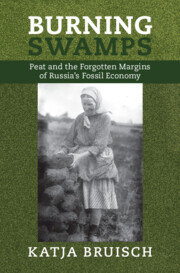
Why do peat and peatlands matter in modern Russian history? The introduction highlights peatlands as a prominent feature of Russia’s physical environment and reflects on their forgotten role as providers of fuel in the nineteenth and twentieth centuries. It discusses the invisibility of peat and peatlands in most existing historical narratives of the fossil fuel age and identifies peat as a lens to reflect upon Russia’s place within global histories of economic growth and associated resource-use. Situating the book at the intersection of modern Russian, energy, and environmental history, the introduction underscores why the planetary predicament makes the seemingly marginal history of peat extraction a topic of global significance.
This groundbreaking environmental history recounts the story of Russia's fossil economy from its margins. Unpacking the forgotten history of how peat fuelled manufacturing industries and power plants in late Imperial and Soviet Russia, Katja Bruisch provides a corrective to more familiar historical narratives dominated by coal, oil, and gas. Attentive to the intertwined histories of matter and labor during a century of industrial peat extraction, she offers a fresh perspective on the modern Russian economy that moves beyond the socialism/capitalism binary. By identifying peat extraction in modern Russia as a crucial chapter in the degradation of the world's peatlands, Bruisch makes a compelling case for paying attention to seemingly marginal places, people, and resources as we tell the histories of the planetary emergency.
Physical education in the Soviet Union, initially focused on health and military readiness, shifted toward producing athletes for international competitions by the early 1950s, peaking in the 1970s/1980s. This shift led to increased investment in sport psychology. To analyze this history, particularly the use of sports to promote communist values, and challenge other political systems, I synthesized peer-reviewed articles using keywords like "Soviet Union," "sport(s) psychology," and "Puni." As social scientists, we decided to analyze this specific history with an emphasis on psychological theories to better understand how the Soviet Union’s communist ideology impacted scientific study within the Soviet Union and sports competition abroad. Thus, I explored the life of the most prominent sports psychologist in the Soviet Union, Avksenty Cezarevich Puni, and his theory of Psychological Preparation for Competition (PPC), which serves as an example of the Soviet Union’s approach to applied sports. Additionally, I examined how Soviet Olympic successes spurred investment in sports and sport psychology, reflecting efforts to compete with the West and asserting the superiority of communism.
The ideology of Marxism–Leninism seemingly contradicts competition, yet competition was prevalent in former communist countries to foster productivity and economic growth. The Stakhanovite movement, originating in the Soviet Union, incentivized laborers to excel as an economic propaganda tool, while also honoring them as socialist heroes but also penalizing dissent as a political propaganda tool. Competition extended to managers of state-owned enterprises (SOEs) vying for government resources. Consumer competition arose from pervasive shortages, driving black market economies. Underground enterprises, which were protected from competition, resisted economic reform from a planned economic system to a more market-oriented system to maintain their privileged status. Post-World War II, some SOEs adopted market-based approaches, competing domestically and globally. This chapter argues that such forms of competition emerge when humans struggle for survival amid perceived inequalities in the existing system, prompting them to seek opportunities and thrive.
In the late nineteenth century, the orally transmitted Armenian legend about the folk hero David of Sassoun seemed doomed to oblivion when Ottoman Armenian clergyman Karekin Srvandzdiants published a tiny booklet containing the story that he had learned by chance. Srvandzdiants noted that he would be happy if the story could reach twenty people. Decades later, this hitherto little-known folk legend would be read, and its main heroes celebrated by tens of millions of citizens of the Soviet Union. Scores of variants of the epic were collected from all over the newly established Soviet Armenia; some of the most revered Soviet poets and linguists produced a collated text of the epic and translated it into dozens of languages. More importantly, David of Sassoun and other heroes of the epic cycle came to symbolize the newly forged Soviet Armenian national character in a vast totalitarian empire whose guiding ideology was inimical to various aspects of Armenian traditions. In this article, I examine the underlying messages of the epic, discuss how Soviet policies helped the epic captivate a large audience in a short period, and analyze the political calculations and ideological justifications behind the promotion of the epic.
This chapter examines how the War Department approached planning for the postwar world. It specifically focuses on the future of Soviet-American relations and how that relationship impacted preparations for the defeat and eventual occupation of the Axis powers. The War Department often adopted ambiguous and confusing stances toward the Soviet Union when it came to postwar planning issues. Stimson, his senior advisers, and Marshall primarily felt a durable postwar peace required a cooperative Washington–Moscow relationship while Army planners and mid-level War Department officials expressed strong concerns about Soviet behavior in Eastern Europe and what that meant for the future. Given Army planners’ central role in the strategic planning and policy process, these divisions helped blur and muddle Washington’s broader Russia policy and helped reinforce American hawks’ views that the future Soviet–American relationship would be dominated by conflict and superpower rivalry. The hawks’ increasingly strong beliefs made confrontational US policies more likely and helped construct the foundations for the pugnacious atmosphere in the developing superpower relationship and the Cold War.
O’Casey was a great writer of war, and he wrote a great deal during the Second World War when he lived in England, although much of this work has failed to find a place in the theatrical repertoire. This chapter focuses on the two wartime plays set during the war: the comic Purple Dust (1940), about two Englishmen moving to Ireland to escape the conflict; and the tragic Oak Leaves and Lavender (1946), set during the Battle of Britain. This chapter shows how the geopolitics of the Second World War, combined with O’Casey’s complex political affiliations and a heightened anxiety about Irish masculinity, placed O’Casey in a position from which he found it difficult to speak.
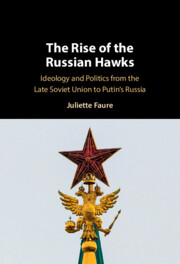
Studying the interplay between ideology and politics in Russian governance, from the former USSR to contemporary Russia, this book examines why, despite the prohibition of state ideology in the 1993 Russian Constitution, Russian hawks endured beyond the 1991 regime change and have risen to political prominence as the chief ideologues of Russia's confrontation against the West. Departing from realist and constructivist explanations of foreign policy focused on Vladimir Putin, Juliette Faure highlights the influence of elite groups with diverse strategic cultures and reveals how, even under authoritarian rule, a competitive space exists where rival elites contest their visions of national interests. Demonstrating the regime's strategic use of ideological ambiguity to maintain policy flexibility, Faure offers a fresh lens on the domestic factors that have played into the Russian regime's decision to wage war against Ukraine and their implications for international security, regional stability and the global balance of power.
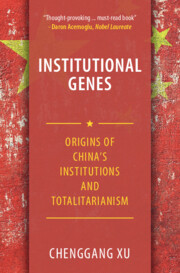
This book explores the origins and evolution of China's institutions and communist totalitarianism in general. Contemporary China's fundamental institution is communist totalitarianism. Introducing the concept of “institutional genes” (IGs), the book examines how the IGs institutional genes of Soviet Russia merged with those of the Chinese imperial system, creating a durable totalitarian regime with Chinese characteristics – Regionally Administered Totalitarianism. Institutional Genes are fundamental institutional elements that self-replicate and guide institutional changes and are empirically identifiable. By analyzing the origins and evolution of IGs institutional genes in communist totalitarianism from Europe and Russia, as well as those from the Chinese Empire, the Chinese Communist Revolution, the Great Leap Forward, the Cultural Revolution, and post-Mao reforms, the book elucidates the rise and progression of communist totalitarianism in China. The ascent of communist China echoes Mises' warning that efforts to halt totalitarianism have failed. Reversing this trend necessitates a thorough understanding of totalitarianism.
Chapter 2 demonstrates that Russian modernist conservatism was first formed in the late Soviet Union as an attempt to confront the convergence horizon predicted by Western liberal modernization theories. From 1970 to 1985, theorizers of modernist conservatism aimed to reenchant Soviet modernity through the deconfliction of the relationship between technological modernity and spirituality. As they viewed it, this new ideological language should serve to reinvigorate the Soviet state ideology and maintain it as an alternative to the Western model of modernity. The chapter shows that, in contrast to the description of the Soviet state ideology as a rigid monolith, modernist conservatism’s ideas were selectively dispersed in official sites of ideology production such as the Komsomol.