To save content items to your account,
please confirm that you agree to abide by our usage policies.
If this is the first time you use this feature, you will be asked to authorise Cambridge Core to connect with your account.
Find out more about saving content to .
To save content items to your Kindle, first ensure no-reply@cambridge.org
is added to your Approved Personal Document E-mail List under your Personal Document Settings
on the Manage Your Content and Devices page of your Amazon account. Then enter the ‘name’ part
of your Kindle email address below.
Find out more about saving to your Kindle.
Note you can select to save to either the @free.kindle.com or @kindle.com variations.
‘@free.kindle.com’ emails are free but can only be saved to your device when it is connected to wi-fi.
‘@kindle.com’ emails can be delivered even when you are not connected to wi-fi, but note that service fees apply.
The militarisation of the Syrian uprising began a few months after the March protests of Dar‘a in the Syrian south. On 25 April 2011 government forces besieged Dar‘a and attacked protestors in response to mounting non-violent mobilisation. Following that, government forces perpetrated numerous massacres against unarmed civilians. For example, on 3 May 2013, the town of al-Bayda in the province of Tartus off the Mediterranean coast witnessed brutal massacres and summary executions of unarmed civilians by government forces, pro-government paramilitary groups and local mobs. After brief clashes between government forces and armed opposition groups in the nearby coastal town of Baniyas in the morning, armed opposition groups withdrew, and the village of al-Bayda saw government forces making their way in by 1pm. Until four o’clock in the afternoon, pro-government forces repeatedly entered specific complexes of homes of select families in the area, ‘separated men from women, rounded-up the men in one spot, and executed them by shooting them at close range’. As a Human Rights Watch investigation reveals, the violence of the day was targeted, and the indiscriminate killings of the day were not random. Although the men and women were separated, the report documents at least twenty-three women and fourteen children, including infants, killed on the day. In addition to killing 167 individuals, pro-government forces burned the bodies of the deceased and some perpetrators recorded the violence as it unfolded and uploaded the footage to YouTube. Mass looting and burning of properties ensued, before armed forces withdrew from the area on Saturday at 5pm.
Mass violence, such as the massacre in al-Bayda, has broad spatial attendance beyond the targeted unarmed civilians, as it encourages retribution from opponents and hastens polarisation more broadly. As Salwa Ismail notes, in August 2013, when opposition groups, including Suqur al-‘Iz and al-Farouq Battalion, launched an attack on Latakia countryside, their massacres reflect a mimetic reproduction of the violence witnessed in al-Bayda. Ismail argues that this ‘modus operandi of the actors produces the regime and the armed opposition as fetishes of each other’. What is significant here is the capacity of mass violence to bring civilians (loyalists, oppositionists and the silent majority – ramadiyyin) alike, into a spiralling polarisation. Ismail also notes that such dynamics render narratives of victimisation interchangeable and contested even where the identity of perpetrators is evident – pro-government or anti-government alike.
Things standing thus unknown, shall I leave behind me!
If thou didst ever hold me in thy heart
Absent thee from felicity awhile
And in this harsh world draw thy breath in pain
To tell my story.
Hamlet, Hamlet, V.ii.328–33
As Hamlet dies, hermeneutical concerns are on his mind, as they have been throughout the play. Hamlet fears that he will be misunderstood. Not even death offers him release from the unknowing that shadows Hamlet's characters as they are carried forward, seemingly inescapably, to their tragic ends. Theirs is, indeed, a ‘harsh world’. Moreover, as suggested by Shakespeare's foregrounding of his characters’ interpretive predicaments, it is a harsh world that brings out the hermeneutic nature of their being in it. Hans-Georg Gadamer's influential thesis about modern human subjectivity rings true, it seems, of Hamlet. For Gadamer, understanding is both intrinsic to human being and always interpretive. As such, individuals’ mode of experiencing all things – other people, one's situatedness in history, one's own existence and the world – ‘constitute[s] a truly hermeneutic universe’.
Pairing Hamlet with this hermeneutic framing of subjectivity points to a preoccupation within the ever-expanding hermeneutical situation of the play's afterlife. Since the late eighteenth century, the task of unearthing the self signified by Shakespeare's characters, especially his protagonist, has occupied a sizeable portion of the vast field of Hamlet criticism. Hamlet has come to represent the liberal humanist self, or the socially delineated self, or the secular (or else the spiritual) self, and more. Other writers have summarised the mountain of now-familiar, conflicting arguments about selfhood (both early modern and modern) that invoke Shakespeare's hero.
The meaning of ‘belonging’ – i.e., the element of tradition in our historical-hermeneutical activity – is fulfilled in the commonality of fundamental, enabling prejudices.
Hans-Georg Gadamer, Truth and Method
You, in the first place, touch upon justification by faith, the first and keenest subject of controversy between us. […] you very maliciously stir up prejudice against us, alleging that by attributing everything to faith, we leave no room for works.
Jean Calvin, ‘Calvin's reply to Sadoleto’, 1539
Wherever we have religious differences, the problem of prejudice, it seems, rears its head. In the later years of the 1530s, Protestant Geneva was in the midst of much turmoil, due in large part to the conflict that arose between the civil authorities and Calvin and his fellow Reformer Guillaume Farel. Cardinal Jacopo Sadoleto (then Bishop of Carpentras in southern France) saw the in-fighting as an opportunity to weaken Protestantism's grip on Geneva. In March 1539, Sadoleto wrote to the city's magistrates and citizens, seeking to persuade them to return to Rome. At the time, Calvin was living in Strasbourg, having been expelled from Geneva (along with Farel) almost a year earlier. Nevertheless, the powers that be decided that Calvin was the person most able to respond to Sadoleto. He did, after some persuasion.
Calvin identifies ‘the first and keenest subject of controversy’ between himself and Sadoleto as justification by faith, the critical issue which had impelled Luther's full-blooded challenge of the church that had, until then, been his haven. In his letter to the Genevans, Sadoleto paints the Reformers as ‘inventors of novelties’ on the pressing question of how a person is justified before God and thus attains eternal salvation. That is, if the Fall ruptured the divine-human relationship, by what mechanism can fallen human beings once more know and be known by God? Reflective of Rome's theological position, the Bishop contends that divine grace, Christ's crucifixion specifically, is the basis of ‘the first access which we have to God; but it is not enough’. One must also contribute a pious mind and a willingness to do ‘whatever is agreeable’ to God. In contrast, according to Sadoleto, the Reformers’ doctrine of faith alone promoted ‘a mere credulity and confidence in God’ that excluded ‘charity and the other duties of a Christian mind’.
Be ye merciful. Judge not, and ye shall not be judged. Condemn not, and ye shall not be condemned. Forgive, and ye shall be forgiven. Give, and it shall be given unto you; good measure, and pressed down, and shaken together, and running over, shall men give into your bosoms. For with the same measure that ye mete withal, shall other men mete to you again. And he put forward a similitude unto them. Can the blind lead the blind? […] Why seest thou a mote in thy brother's eye, and considerest not the beam that is in thine own eye? […] First thou hypocrite, cast out the beam out of thine own eye, and then shalt thou see perfectly to pull out the mote that is in thy brother's eye.
Luke 6: 36–42Fourth Sunday after Trinity gospel reading, The Book of Common Prayer 1559
This self-overcoming of justice: one knows the beautiful name it has given itself – mercy; it goes without saying that mercy remains the privilege of the most powerful man, or better, his – beyond the law.
Friedrich Nietzsche, On the Genealogy of Morals
For centuries, Measure for Measure has provoked spirited responses around the tensions which Nietzsche strikingly, provocatively captures. As Nietzsche sees it, when justice overcomes, when it surpasses itself as mercy, it becomes something sublime. Yet, there is a catch. Mercy sounds beautiful, but it is also the prerogative of those in authority. It is the ‘powerful’ who have the capacity and the utility for benevolence, for action ‘beyond the law’. Does the granting of mercy ultimately elide, or does it satisfy, the claims of justice? Can it simultaneously do both? Moreover, if mercy is given by the ‘powerful’, does this act divest its recipients of their own agency? Measure immerses its audience in these dilemmas as it sets forth the seemingly enigmatic, and complex, interconnections of justice, law, human agency and action, and the ideas behind the word which Shakespeare uses more times in this play than any other: mercy.
Picture Macbeth alone on stage, staring intently into empty space. ‘Is this a dagger which I see before me?’ he asks, grasping decisively at the air. On one hand, this is a quintessentially theatrical question. At once an object and a vector, the dagger describes the possibility of knowledge (‘Is this a dagger’) in specifically visual and spatial terms (‘which I see before me’). At the same time, Macbeth is posing a quintessentially philosophical question, one that assumes knowledge to be both conditional and experiential, and that probes the relationship between certainty and perception as well as intention and action. It is from this shared ground of art and inquiry, of theatre and theory, that this series advances its basic premise: Shakespeare is philosophical.
It seems like a simple enough claim. But what does it mean exactly, beyond the parameters of this specific moment in Macbeth? Does it mean that Shakespeare had something we could think of as his own philosophy? Does it mean that he was influenced by particular philosophical schools, texts and thinkers? Does it mean, conversely, that modern philosophers have been influenced by him, that Shakespeare's plays and poems have been, and continue to be, resources for philosophical thought and speculation?
The answer is yes all around. These are all useful ways of conceiving a philosophical Shakespeare and all point to lines of inquiry that this series welcomes. But Shakespeare is philosophical in a much more fundamental way as well. Shakespeare is philosophical because the plays and poems actively create new worlds of knowledge and new scenes of ethical encounter. They ask big questions, make bold arguments and develop new vocabularies in order to think what might otherwise be unthinkable. Through both their scenarios and their imagery, the plays and poems engage the qualities of consciousness, the consequences of human action, the phenomenology of motive and attention, the conditions of personhood and the relationship among different orders of reality and experience. This is writing and dramaturgy, moreover, that consistently experiments with a broad range of conceptual crossings, between love and subjectivity, nature and politics, and temporality and form.
Turkish Politics and ‘The People’ enhances our understanding of ‘the popular’ in the study of politics through a critical examination of the uses and constructions of ‘the people’ from the establishment of the Turkish Republic in 1923, to the present. It proposes ways of reading the insertion and operationalisation of the notion of ‘the people’ as a concept, a political subject, the object of policy and politics over the past century. It assesses the ways ‘the people’ have been shaped by the history of the republic, and, in turn, have informed ways of visualising society, the country’s political culture, institutional architecture and framed the parameters and repertoires of political action. Drawing on extensive archival research and contributions from historical sociology and social movement research, Spyros A. Sofos enriches the ways of approaching the ‘popular’ by proposing ways of integrating identity, discourse, strategy, organisation and leadership in the articulation of ‘the people’ in political discourse and action.
The Edinburgh Companion to the Essay distinguishes itself by the wide range and scope of its themes, voices and approaches. Thirty-five leading essayists, literary critics and writing instructors explore the essay from multiple perspectives, including its theories, forms and histories as well as its cultural, political and pedagogical contexts. In particular, the volume extends the theory of the essay by addressing topics such as the construction of an essayistic self and the political dimensions of essaying. It further explores the relationship between the essay and other forms, such as philosophical writing, the column, science writing, the novel, the lyric and the advert as well as the essay in digital spaces.
Though modernism's emergence in an environment of techno-cultural acceleration has long been recognized, recent scholarship has deepened and challenged our understanding of the connections between twentieth-century cultural production and its technological interlocutors. In twenty-eight chapters by leading academics, The Edinburgh Companion to Modernism and Technology re-examines the machines and media that functioned as modernism's contexts and competitors. Grounded in an interdisciplinary approach informed by the theoretical and socio-historical frames of current teaching and research on modernism and technology, this research volume makes a crucial and timely intervention in the field of modernist studies. The scholarly contributions on machines that govern transport, production, and public utilities, on media and communication technologies, on the intersections of technology with the human body, and on the technological systems of the early twentieth-century capture the contemporary state of modernist technology studies and chart the future directions of this vibrant area.
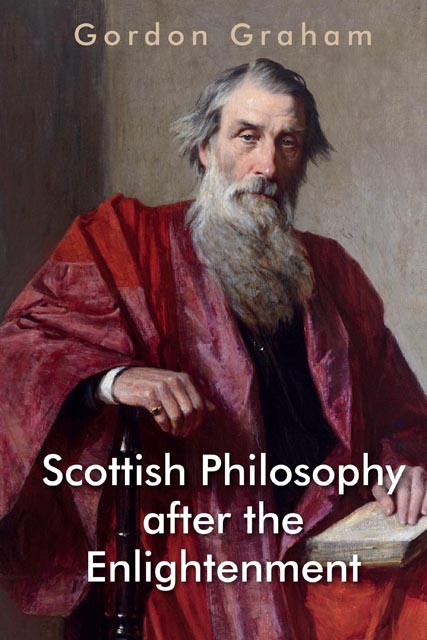
Beginning with Sir William Hamilton's revitalisation of philosophy in Scotland in the 1830s, Gordon Graham takes up the theme of George Davie's The Democratic Intellect and explores a century of debates surrounding the identity and continuity of the Scottish philosophical tradition.
Gordon Graham identifies a host of once-prominent but now neglected thinkers - such as Alexander Bain, J. F. Ferrier, Thomas Carlyle, Alexander Campbell Fraser, John Tulloch, Henry Jones, Henry Calderwood, David Ritchie and Andrew Seth Pringle-Pattison - whose reactions to Hume and Reid stimulated new currents of ideas. Graham concludes by considering the relation between the Scottish philosophical tradition and the twentieth-century philosopher John Macmurray.
This book examines the poetry of Hart Crane and his circle within transnational modernist periodical culture. It reappraises Crane's poetry and reception and introduces several lost works by the poet, including critical prose, reviews and 'Nopal', a poem written in Mexico. Through its exploration of Crane's close engagement with periodical culture, it provides a rich and detailed panorama of twentieth-century literary and artistic communities. In particular, this monograph offers a vivid portrait of forgotten periodicals and their artistic communities, examines the periodical contexts in which modernist poetry fused material and aesthetic experimentation and explores Crane's important and neglected influence on modern and contemporary poetry.