To save content items to your account,
please confirm that you agree to abide by our usage policies.
If this is the first time you use this feature, you will be asked to authorise Cambridge Core to connect with your account.
Find out more about saving content to .
To save content items to your Kindle, first ensure no-reply@cambridge.org
is added to your Approved Personal Document E-mail List under your Personal Document Settings
on the Manage Your Content and Devices page of your Amazon account. Then enter the ‘name’ part
of your Kindle email address below.
Find out more about saving to your Kindle.
Note you can select to save to either the @free.kindle.com or @kindle.com variations.
‘@free.kindle.com’ emails are free but can only be saved to your device when it is connected to wi-fi.
‘@kindle.com’ emails can be delivered even when you are not connected to wi-fi, but note that service fees apply.
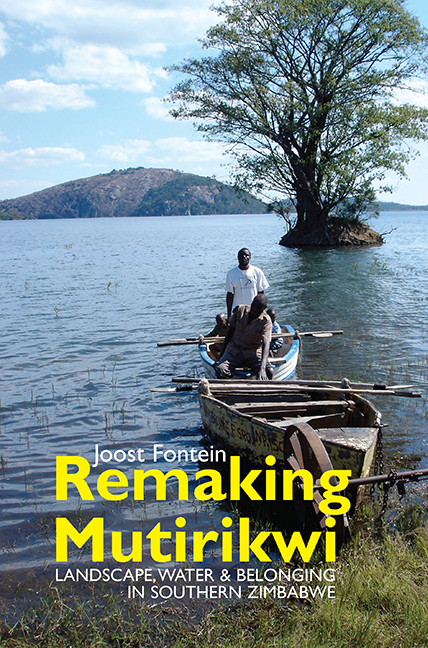
The Mutirikwi river was dammed in the early 1960s to make Zimbabwe's second largest lake. This was a key moment in the Europeanisation of Mutirikwi's landscapes, which had begun with colonial land appropriations in the 1890s. But African landscapes were not obliterated by the dam. They remained active and affective. At independence in 1980, local clans reasserted ancestral land claims in a wave ofsquatting around Lake Mutirikwi. They were soon evicted as the new government asserted control over the remaking of Mutirikwi's landscapes. Amid fast-track land reform in the 2000s, the same people returned again to reclaim the land. Many returned to the graves and ruins of past lives forged in the very substance of the soil, and even incoming war veterans and new farmers appealed to autochthonous knowledge to make safe their resettlements. This book explores those reoccupations and the complex contests over landscape, water and belonging they provoked. The 2000s may have heralded a long-delayed re-Africanisation of Lake Mutirikwi, but just as African presence had survived the dam, so white presence remains active and affective through Rhodesian-era discourses, place-names and the materialities of ruined farms, contour ridging and old irrigation schemes. Through lenses focused on the political materialities of water and land, this book reveals how the remaking of Mutirikwi's landscapes has always been deeply entangled with changing strategies of colonial and postcolonial statecraft. It highlights how the traces of different pasts intertwine in contemporary politics through the active, enduring yet emergent, forms and substances of landscape.
Joost Fontein is Director of the British Institute in Eastern Africa and Lecturer in Social Anthropology at the University of Edinburgh.
Published in association with the British Institute in Eastern Africa.
Enlightenment thinking - the drive for order, organisation and rationality - was an underlying motive force in England's eighteenth century, influencing middle class thinking with regard to the running and improvement of business. In the same way, it shaped their choice of leisure activities. As many turned their backs on blood sports, they found that music, conversation and cards embodied rational enjoyment and exercise of human intellect and ability.For the middle classes, card play made use of skills they had in hand and could be justified on the basis of teaching the young their numbers and the importance of accounting for money lost and won. The careful score-keeping, the accounting for sums won and lost, and the order and discipline of these players' favourite card games echoed and suited their tidy lives. As important participants in polite society on the strength of their new wealth and their increasing social prominence, the middle classes embraced the agreeable pastimes of gentility while rejecting its dangerous extremes. Card play became a means of forming and reinforcing social and commercial bonds within complex webs of family and business circles. As they tugged the fashionable activity of gaming onto their own playing-field from the high-risk arena of the aristocracy, the middle classes were imposing order on disorder, subjecting a reckless activity to new restraints. Drawing on the personal papers of the commercial and professional classes of eighteenth-century England, 'A Sixpence at Whist' tells the stories of these men and women at play.Janet E. Mullin is Lecturer in History at St. Thomas University and the University of New Brunswick, both in Fredericton, N.B., Canada.
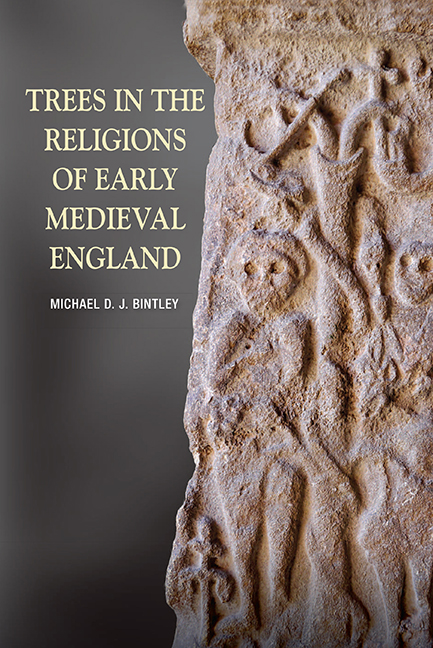
Trees were of considerable importance in Anglo-Saxon religion, both Christian and pre-Christian. This book considers various ways in which trees featured in both, and how they helped to mediate the transition between the two. It argues that trees retained certain symbolic characteristics in Anglo-Saxon belief because of their importance to both heathens and Christians, notably the life-sustaining abundance of the earth. Archaeological, historical and textual evidence is used to present a comprehensive picture. Michael D.J. Bintley is Senior Lecturer in Medieval English Literature at Christ Church University, Canterbury.
To the cultures of medieval northwestern Europe, the changing of the seasons was a material and economic reality that strongly informed the labour, travel and ritual calendars. However, while there has been much research into the interplay between society and its physical surroundings as reflected in medieval literature, the seasonal aspect of this dynamic has hitherto been neglected. This book analyses the narrative and psychological functions of seasonal settings in the literatures of medieval England and Iceland from the eighth to the fourteenth century, from Beowulf to Sir Gawain and the Green Knight. Dealing with both the material realities and the figurative functions of the seasonal cycle, it interprets seasonal spaces in myth and literature as conventionalised environments, where society deals with outside threats and powers which manifest themselves in marginal landscapes. Informing its literary investigations with relevant concerns from economic history, patristic doctine and decision theory, this book offers a comprehensive new look at the pyschology of landscape and season in medieval literature; it also brings out beliefs concerning the seasons and their connections with the supernatural. P. S. Langeslag is a lecturer of Medieval English Studies at the University of Göttingen, Germany.
Recent decades have seen a wave of land law reforms across Africa, in the context of a "land rush" and land-grabbing. But how has this been enacted on the ground and, in particular, how have women experienced this? This book seeks to re-orientate current debates on women's land rights towards a focus on the law in action. Drawing on the author's ethnographic research in the Arusha region of Tanzania, it explores how the country's land law reforms have impacted on women's legal claims to land. Centring on cases involving women litigants, the book considers the extent to which women are realising their interests in land through land courts and follows the progression of women's claims to land - from their social origins through processes of dispute resolution to judgment. Dancer's work explores three central issues. First, it considers the nature of women's claims to land in Tanzanian family contexts, the value of land in an era of land reform and the 'land rush' across Africa, and the extent to which the social issues raised are addressed by Tanzania's current laws and legal system. Secondly, it examines how agency and power relations between social and legal actors engaged in legal processes affect women's access to justice and the progression of claims. Thirdly, it explores Tanzanian concepts of justice and rights and how women's claims have been judged by land courtsin practice.
Helen Dancer is a lecturer in Law at the University of Brighton. She practised as a barrister in England specialising in family legal aid cases prior to training as a legal anthropologist. She is also a consultant for Future Agricultures at IDS, University of Sussex. Her areas of research interest include law and development, gender and land, and human rights and legal pluralism.
This book starts with an extraordinary event and document. The event is the trial and execution for infanticide of a puritan minister, John Barker, along with his wife's niece and their maid, in Northampton in 1637; the document, what appears to be a virtual transcript of Barker's last speech on the gallows. His downfall soon became polemical fodder in scribal publications, with Puritans circulating defences of Barker and anti-Calvinists producing a Laudian condemnation of the minister.
Scandal and Religious Identity in Early Stuart England uses Barker's crime and fate as a window on the religious world of early modern England. It is based upon an extraordinary deposit of manuscript and printed sources, all produced between 1637 and 1640 by people living in close proximityto one another and all of whom knew one another, either as friends or more often as enemies. Marshalling evidence from public polemical sources and from almost entirely private ones - a diary, private letters and a spiritual autobiography - the book is able to examine the same events and persons, and beliefs and practices, from multiple perspectives: the micro and the macro, the personal and thepolitical, and the affective and the doctrinal. Throughout, we meet a range of very different people putting various bodies of religious theory into practice, connecting the most local and particularof events and rivalries to the great issues of the day and responding, in certain cases, to the promptings of the Holy Spirit and the temptations of the devil. This approach enables a whole series of generalisations to be explored: about the relation between politics and religion, devotion and polemic, puritans and their enemies, local and national affairs; between rumour, manuscript and print; and, finally, about gender hierarchy and the social roles of men and women. The result is an extraordinarily detailed and intimate portrait of the religio-political scene in an English county on the eve of civil war.
PETER LAKE is Distinguished University Professor of early modern English history at Vanderbilt. He is the author of several studies of English religion, culture and politics in the Elizabethan and early Stuart periods.
ISAAC STEPHENS is Assistant Professor of History at Saginaw Valley State University and has published on early modern marriage, religion, and life-writing.
In the last decade, cuts have been made to foreign-language programs in the United States across all levels of education, German programs among them. Despite this, enrollments in German programs have increased modestly. The importance of Germany and its language on the world stage is undeniable: it has demonstrated its strength as a major world economic power, and Germany continues to invest heavily throughout the world.Inspired by the leadership of Helene Zimmer-Loew, longtime Executive Director of the American Association of Teachers of German, the contributors to this volume examine the factors shaping German-language study in the new millennium. They highlight how innovative curricular design, creative applied research, inspirational leadership, inventive professional development, and entrepreneurial approaches have allowed Germany to weather many of its challenges.This volume will be of interest to scholars, teachers, and students of German who are committed to invigorating its study in the United States.
Contributors: Teresa R. Bell, Regina Braker, Kurt Buhanan and Glenn S. Levine, Albrecht Classen, Kathleen Condray, Rachel J. Halverson, Martin Kagel and William Collins Donahue, Lynn Marie Kutch, Aleidine J. Moeller and Sheri Hurlbut, Traci S. O'Brien, Lynne Tatlock, Frank Trommler, Gregory H. Wolf.
Rachel J. Halverson is Marianna Merritt and Donald S. Matteson Distinguished Professor in Foreign Languages and Cultures at Washington State University. Carol Anne Costabile-Heming is Professor of German in the Department of World Languages, Literatures, and Cultures at the University of North Texas.
An engaging window into a century of musical life, as seen in the history of the Pro Arte String Quartet, first organized in 1912 and still performing today.
Transnationalism has become a key term in debates in the social sciences and humanities, reflecting concern with today's unprecedented flows of commodities, fashions, ideas, and people across national borders. Forced and unforced mobility, intensified cross-border economic activity due to globalization, and the rise of trans- and supranational organizations are just some of the ways in which we now live both within, across, and beyond national borders.Literature has always been a means of border crossing and transgression - whether by tracing physical movement, reflecting processes of cultural transfer, traveling through space and time, or mapping imaginary realms. It is also becoming more and more a 'moving medium' that creates a transnational space by circulating around the world, both reflecting on the reality of transnationalism and participating in it. This volume refines our understanding of transnationalism both as a contemporary reality and as a concept and an analytical tool. Engaging with the work of such writers as Christian Kracht, Ilija Trojanow, Julya Rabinowich, Charlotte Roche, Helene Hegemann, Antje Rávic Strubel, Juli Zeh, Friedrich Dürrenmatt, and Wolfgang Herrndorf, it builds on the excellent work that has been done in recent years on 'minority' writers; German-language literature, globalization, and 'world literature'; and gender and sexuality in relation to the 'nation.'Contributors: Hester Baer, Anke S. Biendarra, Claudia Breger, Katharina Gerstenberger, Elisabeth Herrmann, Christina Kraenzle, Maria Mayr, Tanja Nusser, Lars Richter,Carrie Smith-Prei, Faye Stewart, Stuart Taberner.Elisabeth Herrmann is Associate Professor of German at Stockholm University. Carrie Smith-Prei is Associate Professor of German at the University of Alberta. Stuart Taberner is Professor of Contemporary German Literature, Culture and Society at the University of Leeds and is a Research Associate in the Department of Afrikaans and Dutch; German and French at the University of the Free State, South Africa.
The essays in The Utopia of Terror provide new perspectives on the relationship between the politics of construction and destruction in the wartime Independent State of Croatia (1941-1945) ruled by the fascist Ustasha movement. Bringing together established historians of the Ustasha regime and an emerging generation of younger historians, The Utopia of Terror explores various aspectsof everyday life and death in the Ustasha state that until now have received peripheral attention from historians. The contributors argue for a more complex consideration of the relationship of massterror and utopianism in which the two are seen as part of the same process rather than as discrete phenomena. They aim to bring new perspectives, generate original thinking, and provide enhanced understanding of both the Ustasha regime's attempts to remake Croatian society and its campaign to destroy unwanted populations.
Renaissance Papers collects the best scholarly essays submitted each year to the Southeastern Renaissance Conference. The 2014 volume opens and closes with essays on historically based explorations of identity: the first on the circle of Jane Scroop in Skelton's Philip Sparrow, and the last on dogs and horses as symbols of national identity in early modern England. The heart of thisyear's journal is English drama, especially Jonson and Marlowe: there are essays on Puritan logic in Jonson's Bartholomew Fair; grotesque sex in Jonson's Volpone; the role of anti-Catholicism in the creation of Marlowe's Dr. Faustus; and the relationship between puppetry and the Faust legend. Marlowe and Jonson also surface in two reconsiderations of their non-dramatic works;first an essay on Ovidian resonances in Marlowe's Hero and Leander, and second a reflection on Spenserian echoes in Jonson's Epode. The next essay shifts to the poetics of religious literature, arguing for clothing as an important metaphor for renewal in Herbert's The Temple, and the penultimate essay addresses imaginative resources in the Martin Marprelate pamphlets.
Contributors: William Coulter, Philip Goldfarb, Chris Hill, Joanna Kucinski, Pamela Macfie, Sara Mayo, Barry Shelton, Emily Stockard, Lisa Ulevich, Emma Annette Wilson.
The journal is edited by Jim Pearce of North Carolina Central University and Ward Risvold of the University of Georgia.
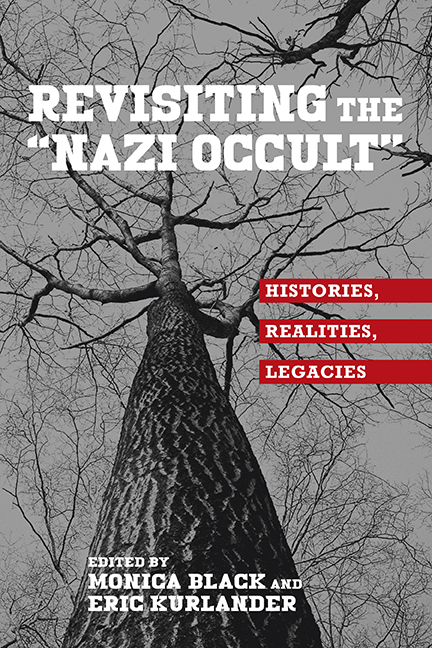
Scholars have debated the role of the occult in Nazism since it first appeared on the German political landscape in the 1920s. After 1945, a consensus held that occultism - an ostensibly anti-modern, irrational blend of pseudo-religious and -scientific practices and ideas - had directly facilitated Nazism's rise. More recently, scholarly debate has denied the occult a role in shaping the Third Reich, emphasizing the Nazis' hostility to esoteric religion and alternative forms of knowledge. Bringing together cutting-edge scholarship on the topic, this volume calls for a fundamental reappraisal of these positions. The book is divided into three chronological sections. The first, on the period 1890 to 1933, looks at the esoteric philosophies and occult movements that influenced both the leaders of the Nazi movement and ordinary Germans who became its adherents. The second, on the Third Reich in power, explores how the occult and alternative religious belief informed Nazism as an ideological, political, and cultural system. The third looks at Nazism's occult legacies. In emphasizing both continuities and disjunctures, this book promises to re-open and re-energize debate on the occult roots and legacies of Nazism, and with it our understanding of German cultural and intellectual history over the past century.
Contributors: Monica Black; Jeff Hayton; Oded Heilbronner; Eric Kurlander; Fabian Link and J. Laurence Hare; Anna Lux; Perry Myers; John Ondrovcik; Michael E. O'Sullivan; Jared Poley; Uwe Schellinger, Andreas Anton, and Michael T. Schetsche; Peter Staudenmaier.
Monica Black is Associate Professor and Associate Head of the Department of History at the University of Tennessee, Knoxville. Eric Kurlander is Professor of Modern European History at Stetson University.
Millions of former German soldiers (known as Heimkehrer, literally "homecomers," or returnees) returned from captivity as prisoners of war at the end of the Second World War, an experience that had profound effects on German society and touched almost every German family. Based on extensive archival research and oral history interviews, this book provides the first comprehensive analysis ofthe history of the German returnees, explored as a history of memory, both during Germany's division and after unification. At its core lies the question of how the experiences of war captivity were transformed into individual and collective memories. The book argues that memory of the experience of captivity and return is complex and multilayered and has been shaped by postwar political and social frameworks. Christiane Wienand is a Research Fellow on the AHRC-funded research project "Reverberations of War: Communities of Experience and Identification in Germany and Europe since 1945." She holds a PhD in History from University College London.