To save content items to your account,
please confirm that you agree to abide by our usage policies.
If this is the first time you use this feature, you will be asked to authorise Cambridge Core to connect with your account.
Find out more about saving content to .
To save content items to your Kindle, first ensure no-reply@cambridge.org
is added to your Approved Personal Document E-mail List under your Personal Document Settings
on the Manage Your Content and Devices page of your Amazon account. Then enter the ‘name’ part
of your Kindle email address below.
Find out more about saving to your Kindle.
Note you can select to save to either the @free.kindle.com or @kindle.com variations.
‘@free.kindle.com’ emails are free but can only be saved to your device when it is connected to wi-fi.
‘@kindle.com’ emails can be delivered even when you are not connected to wi-fi, but note that service fees apply.
Against the backdrop of worsening tensions across the Taiwan Strait, this Element analyzes the positions and policies vis-à-vis Taiwan of six major democratic US treaty allies-Japan, Australia, South Korea, the United Kingdom, France, Germany-and the European Union. Historically and today, these US partners have exercised far greater agency supporting Taiwan's international space and cross-Strait stability-in key instances even blazing early trails Washington would later follow-than the overwhelmingly US-centric academic and policy discourse generally suggests. Decades ago, each crafted an intentionally ambiguous official position regarding Taiwan's status that effectively granted subsequent political leaders considerable flexibility to operationalize their government's 'One China' policy and officially 'unofficial' relationship with Taiwan. Today, intensifying cross-Strait frictions ensure that US allies' policy choices will remain critical factors affecting the status quo's sustainability and democratic Taiwan's continued viability as an autonomous international actor. This title is also available as Open Access on Cambridge Core.
While the concept of economic nationalism is frequently deployed it is often poorly defined, posited as the cause of protectionism in some cases while providing a rationale for liberalization in others. This Element provides a more rigorous articulation by analyzing variation in foreign investment regulation in postwar Brazil and India. Conventional approaches cite India's leftist “socialism” and Brazil's right-wing authoritarianism to explain why India resisted foreign direct investment (FDI) while Brazil welcomed foreign firms. However, this ignores puzzling industry-level variation: India restricted FDI in auto manufacturing but allowed multinationals in oil, while Brazil welcomed foreign auto companies but prohibited FDI in oil. This variation is inadequately explained by pluralist theories, structural-material approaches, or constructivist ideas. This Element argues that FDI policies were shaped by contrasting colonial experiences that generated distinct economic nationalisms and patterns of industrialization in both countries. This title is also available as Open Access on Cambridge Core.
According to Kant, citizenship amounts to freedom (Freiheit), equality (Gleichheit), and civil self-sufficiency (Selbständigkeit). This Element provides a unifying interpretation of these three elements. Vrousalis argues that Kant affirms the idea of interdependent independence: in the just society, citizens have independent use of their interdependent rightful powers. Kant therefore thinks of the modern state as a system of cooperative production, in which reciprocal entitlements to one another's labour carry a justificatory burden. The empirical form of that ideal is a republic of economically independent commodity producers. It follows that citizenship and poverty, for Kant, are inextricably connected. Vrousalis explains how Kant's arguments anticipate Hegel's discussion of the division of labour, Marx's account of alienated labour, and Rawls' defence of a well-ordered society. This title is also available as Open Access on Cambridge Core.
Transparency has become a ubiquitous presence in seemingly every sphere of social, economic, and political life. Yet, for all the claims that transparency works, little attention has been paid to how it works – even when it fails to achieve its goals. Instead of assuming that transparency is itself transparent, this book questions the technological practices, material qualities, and institutional standards producing transparency in extractive, commodity trading, and agricultural sites. Furthermore, it asks: how is transparency certified and standardized? How is it regimented by 'ethical' and 'responsible' businesses, or valued by traders and investors, from auction rooms to sustainability reports? The contributions bring nuanced answers to these questions, approaching transparency through four key organizing concepts, namely disclosure, immediacy, trust, and truth. These are concepts that anchor the making of transparency across the lifespan of global commodities. This title is also available as Open Access on Cambridge Core.
This book offers a critical exploration of climate justice, bringing together diverse perspectives from a wide range of regions and disciplines including law, political science, anthropology, environmental sciences, and economics. It addresses the intersection of environmental, social, and economic issues, highlighting the profound inequalities amplified by the climate crisis. Through theoretical critiques and concrete case studies from different regions, it emphasizes how global politics shape local realities and showcases the voices of those resisting structural injustices. It not only deepens the understanding of climate justice but also proposes practical solutions and alternatives, making it a valuable resource for students, researchers, and practitioners in the fields of climate change, human rights, development, and social movements. With its interdisciplinary approach and global scope, this book will appeal to anyone seeking to engage critically and constructively with the most pressing issues of our time. This title is available as Open Access on Cambridge Core.
This Element explores the transformative impact of integrating service design principles into public management and administration, championing a user-centred approach and co-design methodology. By reviewing existing literature, the authors define the scope and applications of service design within public administration and present three empirical studies to evaluate its implementation in public services. These studies reveal a trend towards embracing co-design and digital technologies, advancing a citizen-centred strategy for public service design. This approach prioritizes value creation and responsiveness, highlighting the importance of involving users and providers in the development of services that meet changing needs and promote inclusion. Combining theoretical insights with practical solutions, the Element offers a comprehensive framework for public management research. It highlights the need for ongoing engagement and integration of user experiences, presenting an effective strategy to navigate the complexities of public service design. This title is also available as Open Access on Cambridge Core.
This Element examines China's embrace of green development on the global stage, or 'Chinese global environmentalism.' It traces Chinese global environmentalism's historical evolution and motivations and analyzes its deployment through the governance tools of green ideology, diplomacy, economic statecraft, and international development cooperation. It conceives of Chinese global environmentalism as a wide-ranging economic and political strategy used to unsettle traditional views of China and bolster the legitimacy of Chinese power at home and abroad. This Element argues that Chinese global environmentalism, while not without its fits and starts, is enabling China to make inroads internationally with implications for China's rise and the natural environment that are only beginning to be appreciated. This title is also available as Open Access on Cambridge Core.
In an era of constant policy growth (known as policy accumulation), effective policy implementation is a growing challenge for democratic governance across the globe. Triage Bureaucracy explores how government agencies handle expanding portfolios of rules, programs, and regulations using 'policy triage' – a set of strategies for balancing limited resources across increasing implementation demands. Drawing on case studies from six diverse European countries, the authors show how organizations' vulnerability to overburdening and their ability to compensate for overload determine why policy implementation succeeds in some cases while it fails in others. Triage Bureaucracy offers a deeper understanding of the organizational dynamics behind effective governance and, by placing bureaucratic actors at the center of the policy process, shows why policy growth often outpaces our ability to implement it – shedding light on the consequences of an ever expanding policy state. This title is also available as Open Access on Cambridge Core.
On the northern periphery of Nairobi, in southern Kiambu County, the city's expansion into a landscape of poor smallholders is bringing new opportunities, dilemmas, and conflicts. Drawing on extensive ethnographic fieldwork, Peter Lockwood examines how Kiambu's 'workers with patches of land' struggle to sustain their households as the skyrocketing price of land ratchets up gendered and generational tensions within families. The sale of ancestral land by senior men turns would-be inheritors, their young adult sons, into landless and land-poor paupers, heightening their exposure to economic precarity. Peasants to Paupers illuminates how these dynamics are lived at the site of kinship, how moral principles of patrilineal obligation and land retention fail in the face of market opportunity. Caught between joblessness, land poverty and the breakdown of kinship, the book shows how Kiambu's young men struggle to sustain hopes for middle-class lifestyles as the economic ground shifts beneath their feet.This title is also available as open access on Cambridge Core.
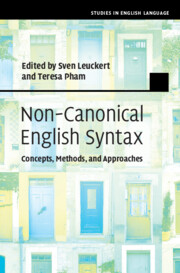
The term non-canonical syntax generally refers to deviations from 'typical' word order. These represent a fascinating phenomenon in natural language use. With contributions from a team of renowned scholars, this book presents a range of case-studies on non-canonical syntax across historical, register-based, and non-native varieties of English. Each chapter investigates a different non-canonical construction and assesses to what extent it can be called 'non-canonical' in a theory-based and frequency-based understanding of non-canonical syntax. A range of state-of-the-art methodologies are used, highlighting that an empirical approach to non-canonical syntactic constructions is particularly fruitful. An introduction, a synopsis, a terminological chapter, and three section introductions frame the case studies and present overviews of the theory behind non-canonical syntax and previous work, while also illustrating open questions and opportunities for future research. The volume is essential reading for advanced students of English grammar and researchers working on non-canonical syntax and syntactic variation. This title is also available as Open Access on Cambridge Core.
The objective of this work is to investigate the unexplored laminar-to-turbulent transition of a heated flat-plate boundary layer with a fluid at supercritical pressure. Two temperature ranges are considered: a subcritical case, where the fluid remains entirely in the liquid-like regime, and a transcritical case, where the pseudo-critical (Widom) line is crossed and pseudo-boiling occurs. Fully compressible direct numerical simulations are used to study (i) the linear and nonlinear instabilities, (ii) the breakdown to turbulence, and (iii) the fully developed turbulent boundary layer. In the transcritical regime, two-dimensional forcing generates not only a train of billow-like structures around the Widom line, resembling Kelvin–Helmholtz instability, but also near-wall travelling regions of flow reversal. These spanwise-oriented billows dominate the early nonlinear stage. When high-amplitude subharmonic three-dimensional forcing is applied, staggered $\Lambda$-vortices emerge more abruptly than in the subcritical case. However, unlike the classic H-type breakdown under zero pressure gradient observed in ideal-gas and subcritical regimes, the H-type breakdown is triggered by strong shear layers caused by flow reversals – similar to that observed in adverse pressure gradient boundary layers. Without oblique wave forcing, transition is only slightly delayed and follows a naturally selected fundamental breakdown (K-type) scenario. Hence in the transcritical regime, it is possible to trigger nonlinearities and achieve transition to turbulence relatively early using only a single two-dimensional wave that strongly amplifies background noise. In the fully turbulent region, we demonstrate that variable-property scaling accurately predicts turbulent skin-friction and heat-transfer coefficients.
In times of new geopolitical challenges, many states have revived the concept of total defence, in which all citizens contribute to national defence efforts. How authorities communicate the need of this new defence strategy and when such crisis communication leads to an increased defence willingness is an important research question. We hypothesise that individuals who feel a sense of empowerment or an increased risk of war when exposed to crisis communication are more willing to engage in the defence. To evaluate our hypotheses, we collected representative survey data from 2,068 Swedish respondents, at the same time as the Swedish Civil Contingencies Agency was distributing a new brochure on expectations on and advice for citizens in case of war. By analysing the responses of individuals who had read or not read the brochure, we gauge the impact of the crisis communication on defence willingness. The results show that individuals experiencing a higher sense of empowerment and perceiving a higher risk of war when having read the booklet were more willing to engage in total defence activities. This has important implications for our understanding of how specific types of crisis communication influence commitment and defence willingness in the population.
This study examines the impact of climate change, defined as long-term changes in temperature and precipitation patterns due to natural and human factors, on women's employment in Burkina Faso, highlighting labour market participation and gender disparities. Using a static computable general equilibrium model calibrated with a gender-specific social accounting matrix, it evaluates two climate scenarios: a 2.4°C temperature increase and a 7.5 per cent decrease in precipitation by 2050. The results indicate that these climate shocks significantly reduce women's employment opportunities. The supply of paid labour for women may decrease by 3.9 per cent, with skilled women experiencing greater job losses than their unskilled counterparts. In rural areas, the domestic workload could increase by up to 0.28 per cent, further limiting women's labour market participation. These changes reinforce gender inequalities and contribute to a decline in real GDP. To counter these effects, investments in climate-resilient agriculture, water and energy infrastructure, and women's entrepreneurship are essential. Gender-responsive policies are needed to promote inclusive economic growth and reduce employment disparities.
Narratives shape public perceptions and policymaking around emerging technologies like quantum technologies (QTs), yet what narratives develop across different societal domains remains underexplored. This study analyzes narratives about QTs in 36 government documents, 163 business reports, and 2023 media articles published over the past 23 years, using a mixed-methods approach that combines topic modeling with qualitative thematic analysis. We find that the dystopian or utopian extremes associated with technologies such as artificial intelligence are largely absent from discourse about QTs. Media coverage tends to cover a broad range of topics, while business and government narratives emphasize technical milestones, economic competitiveness, and national security, frequently at the expense of questions about ethics, equity, and accessibility. We discuss the implications of this focus, particularly the risk that an emphasis on zero-sum geopolitical competition could foster a more closed and fragmented innovation ecosystem.
We study how changes in a country’s administrative hierarchy affect development at the city level. We exploit the 1806 Napoleonic administrative reform implemented in the Kingdom of Naples as a historical experiment to assess whether district capitals endowed with supra-municipal administrative functions gained an urban development premium compared with non-capital cities. We find that district capitals recorded a population growth premium throughout the nineteenth century (1828–1911) and experienced higher industrialization both before and after the Italian unification (1861) compared with non-capital cities. We explain our results through mechanisms related to public goods provision and transport network accessibility.