Flip it Open aims to fund the open access publication of 128 titles through typical purchasing habits. Once titles meet a set amount of revenue, we have committed to make them freely available as open access books here on Cambridge Core and also as an affordable paperback. Just another way we're building an open future.
To save content items to your account,
please confirm that you agree to abide by our usage policies.
If this is the first time you use this feature, you will be asked to authorise Cambridge Core to connect with your account.
Find out more about saving content to .
To save content items to your Kindle, first ensure no-reply@cambridge.org
is added to your Approved Personal Document E-mail List under your Personal Document Settings
on the Manage Your Content and Devices page of your Amazon account. Then enter the ‘name’ part
of your Kindle email address below.
Find out more about saving to your Kindle.
Note you can select to save to either the @free.kindle.com or @kindle.com variations.
‘@free.kindle.com’ emails are free but can only be saved to your device when it is connected to wi-fi.
‘@kindle.com’ emails can be delivered even when you are not connected to wi-fi, but note that service fees apply.
Beginning in the late nineteenth century and lasting well into the Cold War, socialism represented the most powerful and sustained force of political and social dissent in Europe. Prior to the First World War, this dissent operated largely outside of the dominant order. Socialist political parties were excluded from participation in government and the industrial actions undertaken by labor unions were often met with violence and state repression. After the war, the socialist movement split into rival Social Democratic and Communist parties. The former entered government in many countries, while the latter contributed substantially to the political polarization that fed the emergence of authoritarian regimes across much of Europe.
This chapter maps secularism as a culture, using the example of Berlin. It takes the reader through all of the venues that provided materialist monism and establishes their relationship to the socialist milieu. It begins in Free Religion, and then analyzes the city’s chief popular scientific institutions. It looks in detail at the offerings of each to illuminate how monism was communicated. This chapter argues that despite political polarization among the secularist organizations, there was nonetheless a great deal of ideological and personnel coherence across the secularist spectrum
The concluding chapter takes stock of findings and trends in the field, identifies key challenges, and highlights directions and methods for research. It focuses on the imbalance between the three elements comprising the field of emotion regulation in parenting: how parents regulate their own emotions, how parents regulate their own emotions in the context of parenting, and how parents regulate the child’s emotions during parent–child interaction. The most documented of the three is the regulation of the child’s emotions by the parent and its effect on child development. The chapter highlights other shortcomings, such as the importance given to parent-driven effects over child-driven effects, the predominance of correlational studies, and a tendency to simplify by considering the relationships between emotion regulation, parenting, and child development as linear and homogeneous. This chapter proposes future directions focusing on content and methodological issues to overcome the current limitations. Although much work has been done at the intersection of emotion regulation and parenting, much remains to be done. The perspectives proposed should stimulate research in this area.
This chapter undertakes a collective biography of socialist intellectuals working in the Berlin Free Religious Congregation to explore the common sociological factors that contributed to this intellectual type.
The development of children’s emotions and emotion-related self-regulation are involved in many important developmental outcomes. The purpose of this review is to examine the ways that parents socialize their children’s experience and regulation of emotionality. We begin by presenting our theoretical model of parental socialization of emotions. Next, we review literature on three aspects of emotion-related socialization practices including (1) socializers’ reactions to children’s emotions, (2) socializers’ own expressions of emotions and regulation, and (3) socializers’ discussion of emotions. Complexities in these relations, such as potential bidirectional relations and moderators, are considered. Specifically, we discuss the role played by contextual factors such as culture/race, child characteristics, and global parenting behavior in the relation between emotion-related socialization behaviors and children’s emotion-related outcomes. We conclude with a review of intervention studies that sought to improve children’s emotional competence through changes in parenting behaviors and future directions for research.
Developmental theories propose that children learn emotion regulation through dynamic interactions with their parents over time. Emotion regulation is transmitted intergenerationally through environmental and genetic pathways, yet both parents and children evoke regulatory capacities from each other. Further, these interactive effects iterate on a micro -level day by day, as well as on a longer time scale, influenced by factors like parenting style and dyadic conflict. Thus, dyadic parent–child emotion regulation is a bidirectional developmental process requiring careful study design, measurement, and analysis. Yet there are fewer research studies on these dynamic processes than one would expect, perhaps due to the aforementioned complexity. In this chapter, we provide a brief theoretical background on interactive emotion regulation between parent–child dyads, review example studies that have addressed these processes, identify conceptual and methodological barriers to conducting this research, and provide resources for researchers. Finally, we highlight the Actor–Partner Interdependence Model to derive interactive and bidirectional inferences into parent–youth emotion regulation.
In the first book-length study of the whole lifespan in Old English verse, Harriet Soper reveals how poets depicted varied paths through life, including their staging of entanglements between human life courses and those of the nonhuman or more-than-human. While Old English poetry sometimes suggests that uniform patterns shape each life, paralleling patristic traditions of the ages of man, it also frequently disrupts a sense of steady linearity through the life course in striking ways, foregrounding moments of sudden upheaval over smooth continuity, contingency over predictability, and idiosyncrasy over regularity. Advancing new readings of a diverse range of Old English poems, Soper draws on an array of supporting contexts and theories to illuminate these texts, unearthing their complex and fascinating depictions of ageing through life. This title is part of the Flip it Open Programme and may also be available Open Access. Check our website Cambridge Core for details.
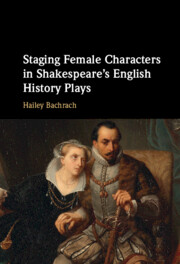
Hailey Bachrach reveals how Shakespeare used female characters in deliberate and consistent ways across his history plays. Illuminating these patterns, she helps us understand these characters not as incidental or marginal presences, but as a key lens through which to understand Shakespeare's process for transforming history into drama. Shakespeare uses female characters to draw deliberate attention to the blurry line between history and fiction onstage, bringing to life the constrained but complex position of women not only in the past itself, but as characters in depictions of said past. In Shakespeare's historical landscape, female characters represent the impossibility of fully recovering voices the record has excluded, and the empowering potential of standing outside history that Shakespeare can only envision by drawing upon the theatre's material conditions. This title is part of the Flip it Open Programme and may also be available Open Access. Check our website Cambridge Core for details.
This chapter gives an overview of the concepts of diversity, equity and inclusion in the context of Kazakhstan. It gives an exposition of developments regarding the process of implementing inclusive education in Kazakhstan. A historical policy context is mapped out. The chapter uses Ainscow’s lever of change approach to highlight how inclusion has evolved in aspects of conceptualisation, curriculum, policy development, teacher practices, beliefs and attitudes, schools, leadership, non-governmental organisations (NGOs) and communities. One of the lessons drawn from the review is that despite efforts and plans to make the system more equitable and inclusive, the conditions for inclusive education have not been met. There is a need to revise policies regarding student placement and practices in teaching and learning. While curriculum reforms were implemented, less effort seems to have been invested in preparation of pre-service teachers. The fact students with disabilities and special needs are integrated into the mainstream means more training for school leaders on managing inclusive schools is needed.