Flip it Open aims to fund the open access publication of 128 titles through typical purchasing habits. Once titles meet a set amount of revenue, we have committed to make them freely available as open access books here on Cambridge Core and also as an affordable paperback. Just another way we're building an open future.
To save content items to your account,
please confirm that you agree to abide by our usage policies.
If this is the first time you use this feature, you will be asked to authorise Cambridge Core to connect with your account.
Find out more about saving content to .
To save content items to your Kindle, first ensure no-reply@cambridge.org
is added to your Approved Personal Document E-mail List under your Personal Document Settings
on the Manage Your Content and Devices page of your Amazon account. Then enter the ‘name’ part
of your Kindle email address below.
Find out more about saving to your Kindle.
Note you can select to save to either the @free.kindle.com or @kindle.com variations.
‘@free.kindle.com’ emails are free but can only be saved to your device when it is connected to wi-fi.
‘@kindle.com’ emails can be delivered even when you are not connected to wi-fi, but note that service fees apply.
There are two human rights properties overshadowing academic discourse and policy documents in relation to automated systems and artificial intelligence which are operating in the digital realm. These properties are about the trust in artificial intelligence and automated systems, and secondly, of robustness. The latter appears in two aspects related to law governing the AI solutions and the AI itself. The degree of our trust in physical judges is related to our expectation that they are capable of distrusting the law. And our trust in automated systems and artificial intelligence is weaker because we assume that they completely trust the law. It could be said that we cannot find a better positivist than artificial intelligence. The moment artificial intelligence can independently exercise disavowal and intolerability formulas, that is, articulate a reasoned understanding that a specific legal norm or rule is profoundly unfair, then the non-coherence disappears. However, then we would no longer be dealing with artificial intelligence; perhaps we could term such a decision-maker an artificial brain.
The IBF is a quotient of the relative numerical value of two fundamental rights – the numerical value assigned as a result of input elements for the right to privacy divided by the numerical value assigned to the freedom of expression as a result of input elements. The input elements are internet vulnerability, degree of interference into privacy, the element of time, public interest, public figure, how the information was obtained and empathy. The Internet Balancing Formula is capable of maximising the element of transparency and minimising the element of arbitrariness in private online balancing. It is therefore a tool that brings optimised order to the online dimension of conflicting fundamental rights. The formula can claim correctness in a given time–space related context. It is a rational, mathematical and living instrument.
This chapter provides an overview of studies that call on the syntactic features of connectives as a means to disambiguate their function and meaning. These syntactic features cover the morphosyntactic nature of discourse connectives as well as their syntagmatic distribution. On the basis of existing lexicons of discourse connectives, we first give an overview of the morphosyntactic distribution of discourse connectives in several European and non-European languages. We then address a number of studies that focus on the (semi-automatic) identification and annotation of discourse connectives in context. This is of particular interest in the field of natural language processing, but also in the field of contrastive linguistics, where it has been shown that syntactic categories, including those underlying the description of discourse connective uses, are not always cross-linguistically valid. The final section is devoted to the relationship between the syntagmatic position of discourse connectives and their meaning, which has given rise to numerous studies at the grammar-discourse interface highlighting the fuzzy boundary between discourse connectives and discourse markers.
The non-reflective and simplistic application of the non-coherence assumption leads to an automatic statement that foreseeability transforms into non-foreseeability online. The proponent of simplicity could argue that when the offline human rights normative domain is by and large characterised by foreseeability, the online realm is characterised by the opposite, non-foreseeability. Yet there is no rule according to non-coherence theory saying that specific features characterising rights offline turn into the opposite online. Variance in features can produce a multitude of non-coherent images, exhibiting a weakening or strengthening of the features, but also turning them into the opposite. If foreseeability were to turn into its opposite upon transposition to the online domain, and such transformation could be validated, then this positions foreseeability exclusively in the offline rights domain. The consequences of such exclusivity would be in terms of valuability and usability. Foreseeability exists online in more extreme formats than offline, to a considerably higher and lower degree. Because of this particularity, the image of foreseeability online is unclear.
In this chapter, we first sketch a number of assumptions underlying diachronic research in order to understand how researchers sketch the emergence of discourse connectives (and discourse markers) in language. We then review the discussion about the theoretical framework underlying the diachronic evolution of discourse connectives, that is, in which conceptual terms this linguistic process is best accounted for, grammaticalization or pragmaticalization. We then turn to a general description of the evolution from clause combining strategies to coordinating and subordinating connectives. Different case studies are presented in order to illustrate typical and less typical cases of language change in the area of connectives: the semantic evolution from temporal meaning to concessive meaning of French cependant (‘yet’), the peculiar semantic evolution from cause to contrast of Italian però (‘but’) (5.3.2), and a diachronic account of the synchronic polysemy of French alors.
Susi offers a novel non-coherence theory of digital human rights to explain the change in meaning and scope of human rights rules, principles, ideas and concepts, and the interrelationships and related actors, when moving from the physical domain into the online domain. The transposition into the digital reality can alter the meaning of well-established offline human rights to a wider or narrower extent, impacting core concepts such as transparency, legal certainty and foreseeability. Susi analyses the 'loss in transposition' of some core features of the rights to privacy and freedom of expression. The non-coherence theory is used to explore key human rights theoretical concepts, such as the network society approach, the capabilities approach, transversality, and self-normativity, and it is also applied to e-state and artificial intelligence, challenging the idea of the sameness of rights. This title is part of the Flip it Open programme and may also be available Open Access. Check our website Cambridge Core for details.
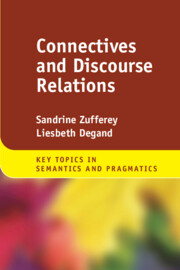
Illustrated with examples from a rich range of languages and genres, this book provides a state-of-the-art introduction to the meanings and functions of connectives, and the discourse relations they communicate. It begins with theoretical chapters that illustrate the many interfaces present in the study of connectives and discourse relations, using diachronic data to illustrate how connectives incorporate such a wide range of functions in synchronic language use. The second half of the book presents the rapidly growing body of studies that have used empirical data to assess theories of connectives and discourse relations, spanning fields as diverse as discourse processing, first and second language acquisition, and cross-linguistic studies. End-of-chapter discussion questions and lists of further readings are included, along with a comprehensive glossary of key terms. This title is part of the Flip it Open Programme and may also be available open access. Check our website Cambridge Core for details.
This chapter reads Wollstonecraft’s Vindication of the Rights of Men as staging not merely a political argument with Edmund Burke’s Reflections on the Revolution in France, but a political economic one. By exhuming the obscured economic substrata of Burke’s work, Wollstonecraft exposes the injustices of the socio-economic order which he sought to naturalise and attacks the economic order on which late eighteenth-century society was founded. Wollstonecraft shows how Burke weaponises ‘specious’ human feeling in defence of existing structures, and how he defends a political economy which subjugates human feeling to a defence of the status quo. In contrast, Wollstonecraft resists the separation of political economic concerns from questions of liberty, equality, and happiness. By insisting that sympathetic feeling for others should be used to reform human community and to motivate political actions to sustain human happiness, she asserts human feeling as an alternative ground of value.
This chapter explores how political economy was understood in Joseph Johnson’s periodical, the Analytical Review, by investigating which publications were listed under the heading of ‘political economy’, and how they were reviewed. It thereby illuminates how political economy was understood in Wollstonecraft’s intellectual milieu. Political economy emerges as a heterogeneous discourse where political and moral ideas mixed with the economic, and where discussions of human nature, and human motivation, as well as of civil society, were often prominent. Writings reviewed as ‘political economy’ in the Analytical Review reveal how the term was used by radical and progressive thinkers as a means for collecting a range of critical perspectives on contemporary society, as well as setting out possible means of improvement. In the eyes of the Analytical Review, political economy offered the prospect of enacting reforms which might increase the happiness of ordinary people, and a means of critiquing existing injustices.
This chapter addresses Wollstonecraft’s engagement with narratives of property and property society in Smith and Rousseau, as reflected in her A Short Residence in Sweden, Norway and Denmark (1796). In political economy’s imaginary, the figure of property encapsulates the ambivalences at the heart of late eighteenth-century modernity and poses questions of affective response and social relation which were fundamental to political economy’s account of social origin. Wollstonecraft’s attention to property of many kinds on her travels is read as an on-going critique of the contemporary political economic order, as well as attempts to imagine alternatives to it, such as the independent, comfortable existence suggested by the farmstead or cottage. Literary form emerges as a means through which questions of human personality and identity in commercial modernity might be framed, and as a means of insisting on ‘something’ more than the mediated social relations of market society’s ‘society of strangers’.
This chapter addresses Wollstonecraft’s Historical and Moral View of the Origin and Progress of the French Revolution (1794), the work in which she engages most explicitly with contemporary political economic thought. Noting that she gives particular prominence to the liberation of the grain trade in the early years of the Revolution, it explores how Wollstonecraft uses the issue to yoke commercial with political forms of liberty. The free circulation of grain was a totemic issue in Adam Smith’s new political economy of ‘natural liberty’, but it also pitted the market against traditional notions of ‘moral economy’. The chapter also explores Wollstonecraft’s links with Girondin politicians, including Jacques Pierre Brissot, and theirs with the Shelburne circle of the 1780s, and discusses the involvement of Americans Joel Barlow and Gilbert Imlay in provisioning the French Republic in the mid-1790s: activity which informed the hostility to commerce of Wollstonecraft’s later works.
This chapter opens with an account of the Bank Restriction Act (1797) as marking a crisis in the British credit system on which the economy depended. It reads Wollstonecraft’s unfinished novel, The Wrongs of Woman (1798), as investigating the gendered systems of affect, belief, and credit which underwrote both political economy and social relations. Against Adam Smith’s attempt to regulate potentially disruptive forms of affect, including credulity and sensibility, the ‘extreme credulity’ of Wollstonecraft’s protagonist, Maria, rewrites the usual story of irrational femininity as the binary other to masculine rationality. Demonstrating the mutual imbrication of financial and sexual economies in late eighteenth-century commercial society, Wollstonecraft attempts to mobilise an alternative economy of social feeling to reform a selfish, sexualised world of commerce based on self-interest, and to reformulate the relations between morality and commercial society – between affect and money – by asking what else might circulate to social advantage.