Flip it Open aims to fund the open access publication of 128 titles through typical purchasing habits. Once titles meet a set amount of revenue, we have committed to make them freely available as open access books here on Cambridge Core and also as an affordable paperback. Just another way we're building an open future.
To save content items to your account,
please confirm that you agree to abide by our usage policies.
If this is the first time you use this feature, you will be asked to authorise Cambridge Core to connect with your account.
Find out more about saving content to .
To save content items to your Kindle, first ensure no-reply@cambridge.org
is added to your Approved Personal Document E-mail List under your Personal Document Settings
on the Manage Your Content and Devices page of your Amazon account. Then enter the ‘name’ part
of your Kindle email address below.
Find out more about saving to your Kindle.
Note you can select to save to either the @free.kindle.com or @kindle.com variations.
‘@free.kindle.com’ emails are free but can only be saved to your device when it is connected to wi-fi.
‘@kindle.com’ emails can be delivered even when you are not connected to wi-fi, but note that service fees apply.
Aiming at reconstructing the prologue to On Nature, the first part of this chapter focuses on the collocation of the demonological fragments which, by expanding on Empedocles’ exile introduced in B 115, depict his katabasis into the realm of the dead. The narrative of this extraordinary journey serves Empedocles as authorial legitimation on matters beyond ordinary human knowledge. The second part of Chapter 2 reconstructs the rest of the proem by interweaving traditionally introductory themes, such as the dedication to Pausanias and the invocation to the Muse, with novel topics concerning the rejection of ritual sacrifice based on Empedocles’ concept of rebirth. The proem thus reconstructed presents a coherent programmatic structure and makes sense of several Empedoclean fragments that are essential for a comprehensive and impartial understanding of his thought. Moreover, by showing that religious concerns inform the entire introductory section, the new proem indicates that the concept of rebirth is central to Empedocles’ physical system and thus offers a new basis to rethink the interplay of myth, religion, and physics in his natural philosophy.
Chapter 5 locates the Younger Seneca and Lucan in a shared conversation about the long-term ramifications of sole rule. It opens with a reading of Seneca’s De Clementia, which is the first text to theorize the metaphors of the healer and head of state. Using both to construct a persuasive ideal of imperial interdependence, Seneca described a body politic whose health vacillates in proportion to the virtue of its princeps. The sick heads and overzealous surgeons that crop up in his other works, however, confirm the risks of such an arrangement. Lucan took this idea as his point of departure in the Bellum Civile, which responds to the imagistic framework of De Clementia through the characters of Sulla and Pompey. Portraying the former as a surgeon who makes excessive use of the scalpel and the latter as a head who suffers the mutiny of his limbs, he portrayed a body politic that was harmed but yet unable to survive without its rulers. He thereby conveyed the futility of politics in a society doomed to civil war.
In the Introduction I set out the main argument of the book, namely the demonstration that Empedocles’ doctrine of rebirth is not only a positive doctrine within On Nature, but is central to his physical system. Then, after briefly tracing the history of the reception of Empedocles’ thought up to the modern era and showing thereby the importance of this thinker in the history of ancient philosophy, I discuss the state of the art related to the book’s main argument. Building on Kahn’s fundamental reappraisal of Empedocles’ doctrinal unity, my book considers the Strasbourg papyrus as evidence for a new reconstruction of Empedocles’ physical poem and thus for a rethinking of his philosophy in terms of a unified system of thought. Therefore, by aiming to demonstrate the ways in which Empedocles’ physics integrates, on a textual and contextual basis, the details of his doctrine of rebirth, sometimes even giving the impression of being premised on it, it is argued that this study is also relevant to a reassessment of the nature and intent of ancient Greek philosophy in general.
Chapter 1 begins with the Fable of the Belly, a foundational myth of civic organization that Roman thinkers dated to the Conflict of the Orders. Naturalizing the hierarchical distribution of power between the senate and people, the fable identified concord as the basis of civic health. Late Republican thinkers used this metaphor to explain the problem of discord, which seemed akin to the splitting or doubling of the res publica. While writers like Cicero, Sallust, and Varro crafted such imagery to lament the loss of civic unity, Catiline used it to justify the acquisition of personal power. Describing the senate and people as separate bodies with little in common, he proposed reworking the Republican constitution to better reflect their divide. He then laid claim to the role of the caput populi, which confirmed his aspirations to tyranny. His conspiracy would be put down in a matter of months, but the language he used to articulate his ambitions proved more difficult to extinguish.
Chapter 4 identifies the Tiberian era as the moment when Roman writers started representing the establishment of the Principate as a civic rebirth. Benefiting from the hindsight granted by half a century of peace, Manilius, Velleius Paterculus, and Valerius Maximus constructed a triumphant narrative that equated the acquisition of a head of state with the end of civil war. Yet their imagery also betrayed growing concern over the succession, a weakness encoded in the fabric of the Principate’s Republican façade. This problem became acute with the violent assassination of Caligula, which exposed the vulnerability of a political community dependent on one man for its survival. Those writing under Claudius, including the Elder Seneca, Philo of Alexandria, and Curtius Rufus, consequently began returning to imagery of a sick, aged, and headless body politic. Their revival of this tradition confirmed that the Augustan restoration was not a permanent solution. With each transfer of power came a new head of state who could harm or heal the body under his care.
Chapter 3 focuses on δαίμων and its significance in Empedocles’ concept of rebirth. I show that the demonological fragments and the term δαίμων, in particular, emphasize Empedocles’ divine nature in contrast to the rest of humankind and cannot represent, as is generally believed, the place where his personal vicissitude becomes exemplary of every soul’s destiny, thus grounding his doctrine of rebirth. To define what Empedocles intended when he called himself a reincarnated δαίμων, I analyze Plato’s myths of the soul’s otherworldly journeys and some fragments attesting to Pythagoras’ demonology. While Plato, in his concept of rebirth, conceptualized the δαίμονες as deities who guide souls during and beyond this life, Pythagoras articulated the idea that a god could exceptionally undergo rebirths, but these are usually reserved for ordinary souls. Following Pythagoras and anticipating Plato, Empedocles constructs his demonology which is linked, but does not overlap, with his doctrine of rebirth. Finally, addressing the issue of the ‘physical’ δαίμων in B 59 I argue that δαίμων is a predicative notion which, in all Empedoclean occurrences, is still intimately connected to the traditional sense of ‘god’.
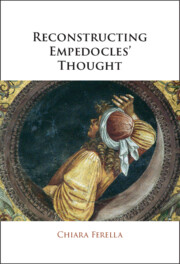
To understand Empedocles' thought, one must view his work as a unified whole of religion and physics. Only a few interpreters, however, recognise rebirth as a positive doctrine within Empedocles' physics and attempt to reconcile its details with the cosmological account. This study shows how rebirth underlies Empedocles' cosmic system, being a structuring principle of his physics. It reconstructs the proem to his physical poem and then shows that claims to disembodied existence, individual identity and personal survival of death(s) prove central to his physics; that knowledge of the cosmos is the path to escape rebirth; that purifications are essential to comprehending the world and changing one's being, and that the cosmic cycle, with its ethical import, is the ideal backdrop for Empedocles' doctrine of rebirth. This title is part of the Flip it Open Programme and may also be available Open Access. Check our website Cambridge Core for details.
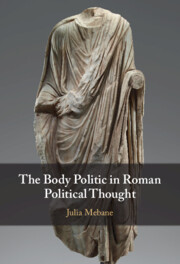
How did Roman writers use the metaphor of the body politic to respond to the downfall of the Republic? In this book, Julia Mebane begins with the Catilinarian Conspiracy in 63 BCE, when Cicero and Catiline proposed two rival models of statesmanship on the senate floor: the civic healer and the head of state. Over the next century, these two paradigms of authority were used to confront the establishment of sole rule in the Roman world. Tracing their Imperial afterlives allows us to see how Romans came to terms with autocracy without ever naming it as such. In identifying metaphor as an important avenue of political thought, the book makes a significant contribution to the history of ideas. This title is part of the Flip it Open Programme and may also be available Open Access. Check our website Cambridge Core for details.
This chapter discusses Darwin’s lifelong interest in unconscious agency and instinct. Darwin typically treats instinct as a rational action that has become habitual and thus heritable; instinct embodies a cognitive process that does not know itself as such. His discussion of instinct is thus connected to other moments in his work where he uses the term ‘unconscious’; his treatment of previous taxonomists of species as unconsciously providing evidence for species transmutation, and his discussion of unconscious selection as an analogy for the effect of aesthetic preference in sexual selection. Darwin’s unconscious anticipates Freud’s as the embodiment of human agency in biological history.