Flip it Open aims to fund the open access publication of 128 titles through typical purchasing habits. Once titles meet a set amount of revenue, we have committed to make them freely available as open access books here on Cambridge Core and also as an affordable paperback. Just another way we're building an open future.
To save content items to your account,
please confirm that you agree to abide by our usage policies.
If this is the first time you use this feature, you will be asked to authorise Cambridge Core to connect with your account.
Find out more about saving content to .
To save content items to your Kindle, first ensure no-reply@cambridge.org
is added to your Approved Personal Document E-mail List under your Personal Document Settings
on the Manage Your Content and Devices page of your Amazon account. Then enter the ‘name’ part
of your Kindle email address below.
Find out more about saving to your Kindle.
Note you can select to save to either the @free.kindle.com or @kindle.com variations.
‘@free.kindle.com’ emails are free but can only be saved to your device when it is connected to wi-fi.
‘@kindle.com’ emails can be delivered even when you are not connected to wi-fi, but note that service fees apply.
This chapter situates Percy Shelley’s Prometheus Unbound in the sociopolitical contexts of the Romantic “age of exile.” It argues that the drama centers on what Shelley calls “sad exile,” a phrase that deliberately toggles between the archaic and traditional meanings of “sad” as both sorrowful and steadfast. In the play, sad exile registers as an ambivalent process that neither ends nor anticipates a return to a former state or place. Rather, it becomes fundamental to maintaining the renovated society’s mutually determined livelihood. As an ongoing re-visionary and recalibrating condition, this method of self-inquiry and critical distancing permits the drama’s key transformation from complicity to collaboration.
This chapter identifies a strain of political, affective maladjustment it labels “Hopeless Romanticism,” of which Percy Bysshe Shelley is an exemplary case. It argues that hope plays a fundamental role in the progressivist refusal to abide by the terms of the status quo. Hopeless romantics hold on to visions of a better world in spite of the crushing realities that surround them. This chapter tracks how this affective mechanism manifests in a series of Shelleyan poems where hope leaps past probabilistic boundaries, even as the despair that is hope’s other side repeatedly intrudes. Hope’s structural investment in futurity has made it both a symptom of weakened individual agency and a social portent of political change.
This chapter explores the way in which Shelley’s verse speaks to, and influences, two kinds of texts: the treaties between the various Indigenous peoples of North America and European or settler governments, and Indigenous-authored poetry that interacts with these treaties. The chapter will begin by conceptualizing 1819 (an iconic year in Shelley studies) as a “treaty year,” one in which Shelley’s “England in 1819” and The Mask of Anarchy, despite their apparent focus on domestic politics, can be read alongside major global diplomatic events that occurred in settler-Indigenous relationships in North America. The chapter then turns to late nineteenth- and early twentieth-century Native American poets who used Shelley’s political poetry as a source for considering treaties and the disastrous consequences of colonization, including the Cherokee authors John Rollin Ridge and Too-qua-stee, James Roane Gregory (Yuchi and Muscogee/Creek), and Arsenius Chaleco (Yuma). Their different allusions to and adoptions of Shelley’s 1819 poems in their poems demonstrate that both “England in 1819” and The Mask of Anarchy were interpreted by Indigenous poets as highly relevant to their contemporary concerns about broken treaties. Finally, the chapter considers the ways in which Shelley’s more meditative poems, including “To a Skylark” and “Mont Blanc,” might also be drawn into a wider conversation about colonization, treaty-making, and Indigenous peoples.
Starting from the Solon-Croesus episode, this chapter argues that Herodotus’ inquiry establishes a horizon of expectation in which historical memory (through the narratives of Tellus and Cleobis and Biton) opens up a new space for philosophical knowledge. The second half of the chapter suggests that the Histories’ generic affiliation with history over philosophy is anachronistic in the fifth century BCE. It demonstrates that Herodotus was not interpreted as a historian in his own time and that "inquiry" and "love of wisdom" characterize the dynamic and highly experimental intellectual culture of this period.
The study of nature as an object of scientific interest matured through the investigations of Presocratic philosophers on the observable world. Herodotus is in dialogue with those expanding its domain into the spheres of natural science and the human. Physis embraces the interior and exterior regularities of subjects as diverse as landmasses, rivers, seas, elements, animals, and men. Unique to Herodotus, however, is the use of nature as a category of historical explanation; it is a standard of measurement that permits historical inference.
The assassination of the False Smerdis in Book 3 and the ensuing constitutional uncertainty offer Herodotus an inflection point to pause and consider the institution of monarchy in Persia in terms of its strengths and weaknesses. This chapter reexamines the speeches given by the conspirators in advance of the coup and its aftermath. In these episodes, Darius undermines a key nomos held by the Persians, their abhorrence of falsehood. Darius does so as a private citizen but given his subsequent rise to the throne, this invites comparison with the Great Kings. Darius’ disregard for nomos opens a philosophical debate on human motivation and self-interest. In a speech to the Persian conspirators, the future monarch defends "egoism," the philosophy that all action is performed to maximize the individual’s self-interest. This view is set alongside orations by the Persians Otanes and Prexaspes, exponents of cooperative action and altruism, respectively. The chapter argues that fifth-century intellectual culture engaged in a spirited interrogation of the individual in relation to self-interest, often in terms of the social contract. The clash between motivation on behalf of the one versus the many will illustrate the complex negotiation in Persia of ruler and ruled, self and society.
Percy Shelley has been a young man’s poet. Ever since Matthew Arnold dubbed his predecessor a “beautiful and ineffectual angel, beating in the void his luminous wings in vain,” poets and critics would pit Shelley’s youthful radicalism against their own grown-up poetics and politics. T. S. Eliot would, for example, rhapsodize about his teenage years misspent idolizing the Romantic poet just to articulate his newfound modernism. Two hundred years later, we might amend the cliché to say that Percy Shelley is a young woman’s poet. His is the social media–savvy voice of Alexandria Ocasio-Cortez, dreaming of a Green New Deal and the systematic dismantling of institutional inequities; Arnold’s the establishment voice of Nancy Pelosi, chastising the beat of ineffectual wings. Because of this generational reading of Shelley, his last unfinished poem, The Triumph of Life, frequently sounds like a pessimistic turn from Promethean idealism toward Byronic cynicism, like youthful radicalism disappointed by unfulfilled promises. This chapter argues instead that the poem’s embodied contingencies of age, debility, and disability shape rather than frustrate Shelley’s developing idealism.
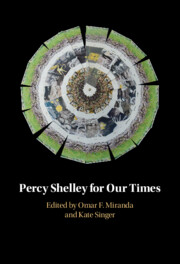
Two centuries after Percy Shelley's death, his writings continue to resonate in remarkable ways. Shelley addressed climate change, women's liberation, nonbinary gender, and political protest, while speaking to Indigenous, queer/trans, disabled, displaced, and working-class communities. He still inspires artists and social justice movements around the world today. Yet Percy Shelley for Our Times reveals an even more farsighted writer, one whose poetic methodology went beyond the didactic powers of prophetic art. Not historicist, presentist, or transhistorical, Shelley 'for our times' conceives worlds outside himself, his poetry, and his era, envisioning how audiences connect and collaborate across space and time. This collection revitalizes a writer once considered an adolescent of idealist protest, showing how his interwoven poetics of relationality continually revisits the meaning of community and the contemporary. This title is part of the Flip it Open programme and may also be available Open Access. Check our website Cambridge Core for details.
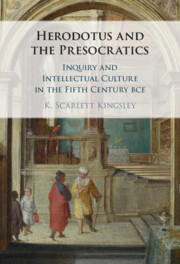
Herodotus' Histories was composed well before the genre of Greek historiography emerged as a distinct narrative enterprise. This book explores it within its fifth-century context alongside the extant fragments of Presocratic treatises as well as philosophizing tragedy and comedy. It argues for the Histories' competitive engagement with contemporary intellectual culture and demonstrates its ambition as an experimental prose work, tracing its responses to key debates on relativism, human nature, and epistemology. In addition to expanding the intellectual milieu of which the Histories is a part and restoring its place in Presocratic thought, K. Scarlett Kingsley elucidates fourth-century philosophy's subsequent engagement with the work. In doing so, she contributes to a revision of the sharp separation between the ancient genres of philosophy and history. This title is part of the Flip it Open Programme and may also be available Open Access. Check our website Cambridge Core for details.
Human rights online are distorted versions of human rights offline. This distortion appears in various formats and properties and will be the subject of the present monograph. The image of the non-coherence theory can be presented for the purposes of introduction through three non-legal lenses: Aristotelian logic, Plato’s myth of the cave, and Lewis Carroll’s Alice’s Adventures in Wonderland.
The first question to be asked is whether the division of rights into absolute and relative is retained in the digital domain. A positive reply shows an image where the basic human rights architecture has no variance, and such variance can appear in the scope of these two areas; in other words, whether the circle of absolute rights online is substantially wider or narrower than offline. This means that the notions of dignity, personal freedom and equality appear online undistorted in comparison with the offline domain. Yet doubts can be raised due to the relativisation of the core values thesis. There does not appear any non-coherence between the idea of dignity in online and offline spaces due to the absence of abstract definitions. Both domains rely on an intuitionistic justification of dignity. There may occur non-coherence regarding the absolute nature of dignity since the offline rights environment is multilayered, but it is not certain that the online environment is.
Mart Susi’s Internet Balancing Formula is completely different from the Weight Formula. It is not general but highly particular, and it is not abstract but highly concrete. And it must be particular and concrete. In offline balancing the substantive dimension can and must be delegated to argumentation. Here the Weight Formula is a form of legal argumentation. In contrast to this, rational online balancing is only possible on the basis of a solid substantive input. Precisely this Susi attempts to provide with his Internet Balancing Formula. The main critiques are related to the elements of internet vulnerability and the element of empathy.