A collection of out-of-copyright and rare books from the Cambridge University Library and other world-class institutions that have been digitally scanned, made available online, and reprinted in paperback.
To save content items to your account,
please confirm that you agree to abide by our usage policies.
If this is the first time you use this feature, you will be asked to authorise Cambridge Core to connect with your account.
Find out more about saving content to .
To save content items to your Kindle, first ensure no-reply@cambridge.org
is added to your Approved Personal Document E-mail List under your Personal Document Settings
on the Manage Your Content and Devices page of your Amazon account. Then enter the ‘name’ part
of your Kindle email address below.
Find out more about saving to your Kindle.
Note you can select to save to either the @free.kindle.com or @kindle.com variations.
‘@free.kindle.com’ emails are free but can only be saved to your device when it is connected to wi-fi.
‘@kindle.com’ emails can be delivered even when you are not connected to wi-fi, but note that service fees apply.
The Assyriologist and archaeologist Reginald Campbell Thompson (1876–1941) studied Hebrew at Cambridge and upon graduation moved into the department of Egyptian and Assyrian antiquities at the British Museum, where he developed remarkable skill in matching fragments of cuneiform tablets and transcribing their texts. He excavated at Nineveh and later produced a definitive edition of the trilingual inscription of Darius at Behistan in Iran. This 1915 work describes Thompson's life 'in the field' at various sites in Egypt, the Sudan and western Asia. The difficulties and dangers of travel, the encounters with local people, and the management of an excavation are all described with enthusiasm and in melodramatic terms. Thompson lovingly records the daily life and traditions of the pre-1914 Middle East, perhaps feeling that he was witnessing a world that would soon be radically changed by the war. His Semitic Magic (1908) is also reissued in this series.
William Marshall (1745–1818), from farming stock, became a farmer and then estate manager and land agent after several years spent conducting business in the West Indies. A pioneer of scientific methods of farming, he published widely on best practice, and was also known for his geographical surveys of agriculture. This two-volume 1789 work covers the county of Gloucestershire, but also includes dairy management in north Wiltshire and the orchards and fruit products of Herefordshire. A hands-on reporter, Marshall stayed in the vale of Gloucester to learn the art of cheese-making, and then spent a year in various locations studying local farming practice. Volume 2 covers the Cotswold Hills and the vale of Berkeley, with detailed descriptions of dairy farming in these areas. A section is devoted to Herefordshire, its orchards, and the manufacturing processes and marketing of its famous 'fruit liquors', cider and perry.
This nine-volume selection from the letters of Queen Victoria, with ancillary material, was commissioned by her son, Edward VII, and published between 1907 and 1932, with a gap of almost twenty years between the third and fourth volumes. The editors of the first three volumes, the poet and writer A. C. Benson (1862–1925) and the second Viscount Esher (1852–1930), administrator and courtier, decided that the plan for the selection of letters from the thousands available should be to publish 'such documents as would serve to bring out the development of the Queen's character and disposition, and to give typical instances of her methods in dealing with political and social matters'. Volume 1 contains introductory chapters about the Queen's early life, and letters to and from the young princess, continuing through her accession, coronation, courtship and marriage, and ending in 1843.
Well versed in oriental languages and antiquities, and possessed of an 'insatiable thirst for seeing new countries', Claudius James Rich (1786/7–1821), the East India Company's resident at Baghdad, set out for Kurdistan in 1820 despite his delicate health. Before he succumbed to cholera the following year, he had visited and described many historic locations in present-day Iraq and Iran. His written account has long stood as an important early record of the region's geography, culture and archaeology. This two-volume work was edited by his widow and published, with maps and other illustrations, in 1836. Rich's Narrative of a Journey to the Site of Babylon in 1811 (1839), including his two archaeological memoirs, is also reissued in this series. Volume 2, including descriptions of the site of ancient Nineveh, covers the return to Baghdad. Extracts from various letters give an account of Rich's journeys to Shiraz and Persepolis.
In this two-volume work, published in 1912, the Hungarian-born archaeologist Marc Aurel Stein (1862–1943) describes his second expedition to the deserts of Chinese Turkestan in 1906–8. (His account of his first expedition, Sand-Buried Ruins of Khotan (1903), is also reissued in this series.) Stein intended this account to be read by non-specialists, and, like his previous book, it is highly illustrated and full of interesting details about his journey and the people he met en route, as well as of the important archaeological discoveries which still link his name with the civilisation of this remote and dangerous area. In Volume 2, Stein describes the discovery of the caves near the great trading post of Dunhuang which contained - walled up and almost perfectly preserved - manuscripts, sculptures, silk cloths, and the Diamond Sutra, the earliest complete and dated example of a printed book, hidden by Buddhist monks nine hundred years previously.
The surgeon William Ainsworth (1807–96) acted as the geologist of the 1835 Euphrates Expedition, his account of which is also reissued in this series. Great interest was aroused by the scientific and archaeological findings of that journey, and a further expedition was funded, ostensibly to make contact with the Nestorian Christians of the region, but covertly to make further mineralogical investigations. Ainsworth was the leader of the expedition, and his two-volume account was published in 1842. Starting from Istanbul in 1839, Ainsworth took a route through Asia Minor, northern Syria, Kurdistan, Persia and Armenia, returning to Istanbul in 1840. The expedition was regarded as unsuccessful, as Ainsworth had massively overspent the budget originally allotted by the sponsors, and his secret activities were discovered by the Ottoman authorities, but the work remains a vivid account of the area. Volume 2 describes the journey through Armenia, and the return via Trebizond.
The astonishing creative genius of Franz Schubert (1797–1828) produced an extraordinary quantity of music: song cycles, symphonies, piano and chamber works – all now recognised as masterpieces. Such acclaim did not exist in the years immediately after his death, and it was only later, when the rediscovery of Schubert's music (led by George Grove) was gathering pace, that this work, the first full-length biography of the composer, appeared in 1865. Written by Heinrich Kreissle von Hellborn (1812–69), a Viennese lawyer and member of the city's Gesellschaft der Musikfreunde, the work incorporates reminiscences of Schubert's friends as collected by Ferdinand Luib for his prospective biography. This 1869 English translation by Arthur Duke Coleridge, founder of the Bach Choir, contains an appendix by Grove on Schubert's symphonies and his rediscovery in Vienna of several manuscripts as well as the partbooks for Rosamunde. Volume 1 charts Schubert's life up to the composition of Rosamunde in 1823.
In 1807, the Directors of the East India Company ordered a survey of the nine districts, covering 60,000 square miles and containing 15,000,000 British subjects, which formed the Eastern territories of British India. In this three-volume work, published in 1838, Irish civil servant and author Robert Montgomery Martin (1801–68) compiled and collated the original survey material at East India House to describe the geography, geology, meteorology, natural history, agriculture and manufactures, population, history, architecture, fine arts, religion and education of this huge area. Martin, the first colonial Treasurer of Hong Kong, founder of the East India Association, author of History of the British Colonies (1834–5), and later publisher of the Duke of Wellington's dispatches, carried out his work to alert the British public to the growing social and political problems he perceived in India. Volume 1 covers the districts of Behar (Patna City) and Shahabad.
Published in Copenhagen in 1879, this Cambridge edition is the third edition of Cicero's De Finibus by Johan Nicolai Madvig (1804–1886), first published in 1839. A Danish politician and leading classical scholar at the University of Copenhagen, Madvig was critical of what he considered careless German scholarship, and he sought a return to a truer manuscript tradition. His work focussed on Cicero and culminated in the first edition of De Finibus, which defined the standard for sound textual criticism. De Finibus Bonorum et Malorum (On the Ends of Good and Evil) is the most extensive of Cicero's works, in which he criticises three ancient philosophical schools of thought: Epicureanism, Stoicism, and the Platonism of the Academy of Antiochus. This third edition contains a revised preface outlining Madvig's method of ranking texts, and the five books of De Finibus.
The publication between 1887 and 1897 of these letters, which form part of the archive of the Dutch Church at Austin Friars in London, was a remarkable feat of bibliography. The archive had been deposited in 1866 with the Library Committee of the Corporation of the City of London, and in 1884 Jan Hendrick Hessels began to prepare them for the press. The letters, written in Dutch, French, English, Italian and Latin between 1524 and 1723, throw light on the religious, intellectual and political ferment of the period. The second volume (reissued here in two parts) consists of letters to and from the members of the Dutch Church in the period 1544–1622. The writers of letters in this volume include leading figures of the Protestant reformation such as Martin Bucer, Peter Martyr, Heinrich Bullinger and John Foxe.
Donald Francis McKenzie (1931–1999) was one of the foremost bibliographers of the twentieth century, and his contributions to the history of the book continue to exert great influence on the field. Early in his career, he made a detailed study of the archives of Cambridge University Press, focusing on the period 1696–1712. In the course of his research, McKenzie discovered quite different working practices and patterns from what had previously been assumed, and this two-volume book, published in 1966, revolutionized the study of printing history. The discoveries described here were the foundation of much of McKenzie's subsequent work as he applied his findings from this specific case study to the world of early modern printing in general. Volume 1 outlines the Press' organization, operations and finance during this period. Volume 2 contains transcriptions of the minutes of the Press's governing Curators, the Press' accounts, bills and receipts.
Henry Mathias Elmore (about whom little is known) was a sailor in the Royal Navy who quit in 1783 and set out for Calcutta to be involved with the East India Company's growing trade. Elmore worked as a commander on its ships, and he decided to write this account of sailing to and within the East, which was published in 1802, in order to share his navigational knowledge and to correct earlier inaccuracies. Although much of the work consists of specific, technical directions for piloting ships around Asia, Elmore's instructions give a vivid picture of the complexities of nineteenth-century navigation and the tribulations of sailing during this time. Some of the voyages he describes include sailing around the Indonesian islands and to the Malay coast, and how to reach China from Calcutta. Elmore also includes notes about locations of valuable commodities, such as spices, tea or gold, available for trade.
At his death, George Spencer (1758–1834) had created the greatest private library in Europe. At the time, many aristocrats were spending huge sums acquiring rare printed books. With monastic and aristocratic libraries in Europe being dissolved, collectors had access to thousands of examples. The Second Earl Spencer's interests were in English 'black-letter' printing, especially the works of Caxton, and continental incunables, particularly first editions of Greek and Latin classics. Thomas Dibdin (1776–1847) was employed as Spencer's librarian and visited Europe searching for new acquisitions. Published in 1814–15, this catalogue is of the earliest and rarest items in the collection. Each is described in detail, with reproductions of woodcuts and engravings, making this a fascinating record of one man's commitment to collecting the earliest examples of this revolutionary invention. Volume 4 includes many examples of the earliest work of Caxton, alongside first editions of Boccacio and Dante.
As senior wrangler in 1854, Edward John Routh (1831–1907) was the man who beat James Clerk Maxwell in the Cambridge mathematics tripos. He went on to become a highly successful coach in mathematics at Cambridge, producing a total of twenty-seven senior wranglers during his career - an unrivalled achievement. In addition to his considerable teaching commitments, Routh was also a very able and productive researcher who contributed to the foundations of control theory and to the modern treatment of mechanics. First published in one volume in 1860, this textbook helped disseminate Routh's investigations into stability. This revised fifth edition was published in two volumes between 1891 and 1892. The first part establishes the principles of dynamics, providing formulae and examples throughout. While the growth of modern physics and mathematics may have forced out the problem-based mechanics of Routh's textbooks from the undergraduate syllabus, the utility and importance of his work is undiminished.
In November 1806, the damaged Port-au-Prince arrived at what Captain Cook had called the Friendly Islands. William Charles Mariner (1791–1853) was among the few crew members spared by the native inhabitants. He lived there for four years. Published in 1818, this two-volume second edition offers an important early insight into Tongan customs and language. As editor John Martin (1789–1869) explains, the structure of a nation's language is vital to the consideration of its history. So successful was the first edition of 1817 - expanded upon here to include 'generally corroborative, and in a few instances somewhat corrective' information from another erstwhile inhabitant - that within months of its publication a French translation appeared; German and American editions soon followed. Volume 2 covers diverse aspects of Tongan society, from its music to notions of the soul, and includes a detailed grammar of the language and 2,000 words of vocabulary.
The Scottish archaeologist and anthropologist Daniel Wilson (1816–92) spent the latter part of his life in Canada. Published in 1862, this is a seminal work in the study of early man in which Wilson utilises studies of native tribes 'still seen there in a condition which seems to reproduce some of the most familiar phases ascribed to the infancy of the unhistoric world'. He believed that civilisations initially developed in mild climates and judged the Mayans to have been the most advanced civilisation in the New World. Twentieth-century anthropologist Bruce Trigger argued that Wilson 'interpreted evidence about human behaviour in a way that is far more in accord with modern thinking than are the racist views of Darwin and Lubbock', and it is in this light that this two-volume work can be judged. Volume 1 covers such important areas as the development and use of metals and 'the architectural instinct'.
The Cartulary of the Abbey of Saint-Bertin, St-Omer, represents one of the earliest and most important resources for Carolingian monastic life and the era of Benedictine reform. Begun by the monk Folquin around 962, the collection of charters, arranged chronologically, extends from the seventh century until 1178. It remains an invaluable witness to the political, economic, and diplomatic history of this powerful abbey, as well as to the historiographic impulses of its compilers. One of the first cartularies to arrange legal and administrative documents in chronicle form, the Cartulary of the Abbey of Saint-Bertin makes a powerful claim for the antiquity and coherence of its institutional origins. The text was first published in 1841 with the Cartulary of the Abbey of the Holy Trinity, Rouen; this reissue makes both, together with an 1867 appendix of addenda and corrections published by François Morand, available again to scholars.
In November 1806, the damaged Port-au-Prince arrived at what Captain Cook had called the Friendly Islands. William Charles Mariner (1791–1853) was among the few crew members spared by the native inhabitants. He lived there for four years. Published in 1818, this two-volume second edition offers an important early insight into Tongan customs and language. As editor John Martin (1789–1869) explains, the structure of a nation's language is vital to the consideration of its history. So successful was the first edition of 1817 - expanded upon here to include 'generally corroborative, and in a few instances somewhat corrective' information from another erstwhile inhabitant - that within months of its publication a French translation appeared; German and American editions soon followed. Volume 1 comprises Martin's extensive introduction, the story of the ship's voyage and destruction, and an account of Mariner's stay on the islands and the events leading to his departure.
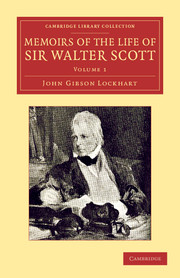
As son-in-law and literary executor to Sir Walter Scott (1771–1832), John Gibson Lockhart (1794–1854) was uniquely placed to produce a definitive biography of the great poet and novelist. First published in 1837–8, shortly after Scott's death, this celebrated seven-volume work is based on personal memories, correspondence, and Scott's own autobiographical sketches. Wide-ranging in his purview, Lockhart is also detailed in his descriptions: the Aberdeen Journal of the day observed that the volumes trace Scott's life and literary efforts with 'the most minute distinctness'. Volume 1 opens with Scott's brief autobiography, written in 1808 and revised in 1825. Lockhart's biography proper opens with Scott's birth in 1771, provides an account of his education, and concludes here with his first contributions to the Edinburgh Review in 1804.
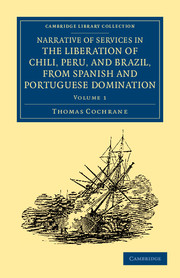
The most renowned naval officer of the mid-nineteenth century, Thomas Cochrane, tenth Earl of Dundonald (1775–1860), led an eventful life. Due to a financial scandal, he left the Royal Navy for a period and became a celebrated mercenary. Volume 1 of this two-volume work, published in 1859, concerns his activity in the wars of independence of Chile and Peru, covering his taking command of the Chilean navy in 1818, his recruitment of British and American officers, attacks on Spanish shipping, littoral warfare on Spanish forts, seizure of booty, and his troubled relationship with the Chilean government. It goes on to recount his command of a Chilean expedition to liberate Peru from the Portuguese in 1820 and his departure from Chile in 1822 before further unrest. Cochrane was the quintessential naval hero of the age, and his memoir remains of interest to both scholars and readers of maritime adventure.