A collection of out-of-copyright and rare books from the Cambridge University Library and other world-class institutions that have been digitally scanned, made available online, and reprinted in paperback.
To save content items to your account,
please confirm that you agree to abide by our usage policies.
If this is the first time you use this feature, you will be asked to authorise Cambridge Core to connect with your account.
Find out more about saving content to .
To save content items to your Kindle, first ensure no-reply@cambridge.org
is added to your Approved Personal Document E-mail List under your Personal Document Settings
on the Manage Your Content and Devices page of your Amazon account. Then enter the ‘name’ part
of your Kindle email address below.
Find out more about saving to your Kindle.
Note you can select to save to either the @free.kindle.com or @kindle.com variations.
‘@free.kindle.com’ emails are free but can only be saved to your device when it is connected to wi-fi.
‘@kindle.com’ emails can be delivered even when you are not connected to wi-fi, but note that service fees apply.
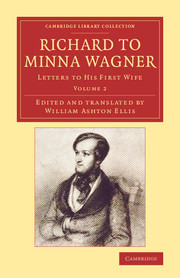
The German actress Minna Planer (1809–66) was Wagner's first wife. Though it lasted until her death, their marriage, never an easy one, was punctuated by long periods of separation, and during its early years Minna was the main breadwinner. William Ashton Ellis (1852–1919) abandoned his medical career to devote himself to his Wagner studies. Best known for his translations of Wagner's prose works, he published in 1909 this collection of letters from the composer, translated from the originals in Baron Hans von Wolzogen's Richard Wagner an Minna Wagner (1908). Concerned predominantly with domestic and business affairs, many of them complaining at Minna's lack of support, the letters offer an intriguing and intimate view of this larger-than-life composer. Spanning the period 1858–63, Volume 2 covers their uneasy, brief reconciliation in Paris, Wagner's concerns over Minna's failing health, and her return to Dresden in 1862, which marked their final separation.
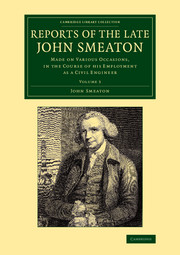
Celebrated for his construction of the Eddystone Lighthouse near Plymouth, John Smeaton (1724–92) established himself as Britain's foremost civil engineer in the eighteenth century. A founder member of the Society of Civil Engineers, he was instrumental in promoting the growth of the profession. After his death his papers were acquired by the president of the Royal Society, Sir Joseph Banks, Smeaton's friend and patron. Using these materials, a special committee decided to publish 'every paper of any consequence' written by Smeaton, as a 'fund of practical instruction' for current and future engineers. These were published in four illustrated volumes between 1812 and 1814. As a consulting engineer, Smeaton carried out surveys and reports of existing structures, as well as drawing up proposals for new designs. Volume 3 contains mainly reports relating to bridges and harbours, including work at such major ports as Aberdeen, Dover and Hull.
Inspired by philhellenism as a law student, George Finlay (1799–1875) took part in the Greek war of independence alongside Lord Byron. While later researching the history and archaeology of the country, Finlay also sought improvements to the administration and economic development of the independent Greek state. Published in 1861, this two-volume account of the Greek revolution, including its military conflicts and political consequences, traces events up to the creation of a constitutional monarchy. Volume 1 gives a detailed overview of the economic and social world of Greece under Ottoman rule; Finlay describes the various ethnic and social groups of Greece and its neighbours, and the structure of the Ottoman administration. Starting with the earliest Greek uprisings, he takes the history up to the end of 1822. Finlay's seven-volume History of Greece (1877) is also reissued in this series.
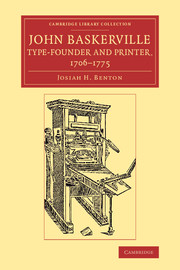
The Baskerville Bible of 1763 is perhaps the most famous work published by Cambridge University Press, and Baskerville's own type punches are among its most treasured possessions. This short biography of John Baskerville (1706–75) was published in 1914 by Josiah Henry Benton (1843–1917), an American lawyer and author. Baskerville, born in Worcestershire, set up as a writing-master and letter-cutter in Birmingham, but later built up a business in 'japanning', the imitation of Japanese lacquer work, from which he made his fortune. He began working as a type-founder and printer around 1750, and made innovations not only in typefaces but also in paper, ink and printing machines. The quality of his books - not only the Bible, but also the Book of Common Prayer, an edition of Virgil, and Milton's Paradise Lost and Paradise Regained, among others - made them collectors' items: Benton provides an appendix listing his own Baskerville books.
The publication in 1881 of The New Testament in the Original Greek, by the Cambridge scholars Brooke Foss Westcott (1825–1901) and Fenton John Anthony Hort (1828–92), marked the culmination of twenty-eight years of work and revolutionised the theory and methods of New Testament textual criticism. The editors broke with tradition and reconstructed a critical text based on the third-century uncial manuscripts Codex Vaticanus and Codex Sinaiticus, paving the way for future editions. Westcott and Hort's claim to reconstruct the 'original text' may seem extravagant today; but according to Bruce Metzger theirs was the 'most noteworthy critical edition of the Greek Testament ever produced by British scholarship'.
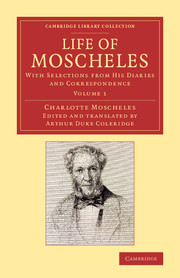
Born in Prague, pianist and composer Ignaz Moscheles (1794–1870) studied in Vienna and rapidly became a central figure in European musical life. He lived and worked in London for twenty-five years, leaving in 1846 to become principal professor of piano at the Leipzig Conservatoire at the invitation of his great friend Mendelssohn. As a pianist, he was renowned for his incisive technique rooted in the tradition of Clementi, and also much admired for his extempore performances. As a composer his output was mainly for the piano, and his studies are still in use today. First published in 1872–3, this lively biography, compiled from his diaries and letters by his wife Charlotte, records his dealings with and feelings about many great musicians of the nineteenth century. Reissued here is the 1873 English translation by Arthur Duke Coleridge, founder of the Bach Choir. Volume 1 covers the years up to 1836.
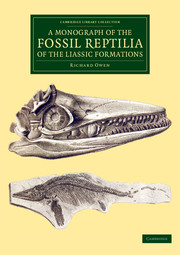
Discoveries of fossil reptiles in the sea cliffs of south-western England helped to consolidate ideas of 'deep time' and extinction by revealing ancient worlds whose unfamiliar and bizarre inhabitants had no living counterparts. Many of these fossils were from the Lower and Upper Lias Groups, suites of rocks laid down in the shallow seas that covered much of southern England during the Early Jurassic period (around 201-174 million years ago). Sir Richard Owen (1804–92) was one of several anatomists who provided extensive descriptions of these animals. His monograph on the Liassic Reptilia (published in three parts in 1861–81) includes the first, and so far only, detailed description of the early armoured dinosaur Scelidosaurus (the first dinosaur known from an almost complete skeleton), an important account of Dimorphodon (the first flying reptile named from the United Kingdom), and critical information on two marine reptile groups, the plesiosaurs and ichthyosaurs.
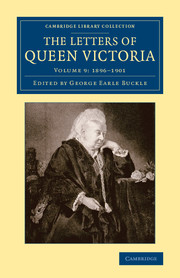
This nine-volume selection from the letters of Queen Victoria, with ancillary material, was commissioned by her son, Edward VII, and published between 1907 and 1932, with a gap of almost twenty years between the third and fourth volumes. The editor of the 'Third Series', which covers the years from 1886 to 1901, was George Earle Buckle (1854–1935), a historian and former editor of The Times, who continued the editorial policy of his predecessors, but who needed to tread carefully, as many of the people mentioned in documents of the final part of Queen Victoria's reign were still alive when Volumes 7–9 were published between 1930 and 1932. The final volume covers the period from 1896 to the Queen-Empress' death in January 1901. The Boer war is a dominating topic, and the final letter from the Queen is a message of gratitude to her troops in South Africa.
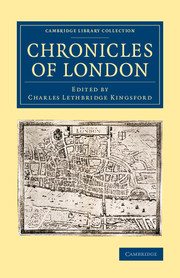
First published in 1905, this work contains editions and discussion of three mid-fifteenth-century manuscript copies of London chronicles giving detailed insight into the city in this period. The volume was compiled by the respected historian Charles Lethbridge Kingsford (1862–1926), who published extensively on many subjects but was notable for his expertise on the reign of Henry V, which underpinned his appreciation of the importance of these chronicles. His scholarly introduction covers each of the London chronicles and discusses their manuscript copies, authorship, contents, dates and the intertextual relationships between them. The texts are accompanied by foliation and marginalia, and footnotes showing other manuscript variations. The appendices, containing details of texts drawn from each manuscript, include a list of lords, knights and gentlemen slain, and details of variations between manuscripts. This work also includes an extensive glossary, endnotes, and an index of names, places and topics.
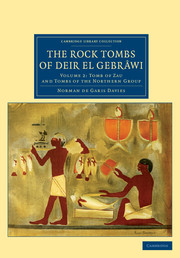
While working as a Congregational minister in England, Norman de Garis Davies (1865–1941) developed an interest in Egyptology. In 1897 he joined Flinders Petrie's excavations at Dendera as a copyist of inscriptions and sculptures. He did further work for the Egypt Exploration Fund, producing many volumes of archaeological surveys, which won him the Leibniz medal of the Prussian Academy of Sciences. From 1907 he worked for New York's Metropolitan Museum of Art, together with his wife Nina. Highly illustrated, this two-volume 1902 publication covers the tombs of the important Old Kingdom necropolis at Deir el-Gabrawi, where many of the governors of the Upper Egyptian 12th nome were buried. Volume 2 covers the northern group of tombs, including that of the nomarch Zau. Davies reproduces the tomb art and hieroglyphic inscriptions, as well as providing archaeological plans. His Rock Tombs of Sheikh Saïd (1901) is also reissued in this series.
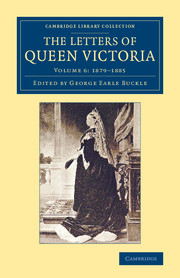
This nine-volume selection from the letters of Queen Victoria, with ancillary material, was commissioned by her son, Edward VII, and published between 1907 and 1932, with a gap of almost twenty years between the third and fourth volumes. The editor of the 'Second Series', which covers the years from 1862 to 1885, was George Earle Buckle (1854–1935), a historian and former editor of The Times, who continued the editorial policy of his predecessors, but who needed to tread carefully, as many of the people mentioned in documents of the second part of Queen Victoria's reign were still alive when Volumes 4–6 were published between 1926 and 1928. Volume 6 covers the period 1879–85, and includes the death of Disraeli, the disaster of General Gordon at Khartoum, and the turbulent political background to the issue of Irish home rule.
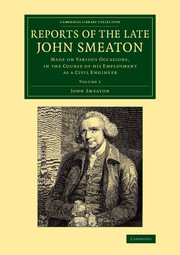
Celebrated for his construction of the Eddystone Lighthouse near Plymouth, John Smeaton (1724–92) established himself as Britain's foremost civil engineer in the eighteenth century. A founder member of the Society of Civil Engineers, he was instrumental in promoting the growth of the profession. After his death his papers were acquired by the president of the Royal Society, Sir Joseph Banks, Smeaton's friend and patron. Using these materials, a special committee decided to publish 'every paper of any consequence' written by Smeaton, as a 'fund of practical instruction' for current and future engineers. These were published in four illustrated volumes between 1812 and 1814. Volume 1 contains correspondence with and reports for clients regarding waterworks, canals, bridges, lighthouses and other engineering works, including harbour improvements at Christchurch, Bristol and Whitby. It also contains descriptions of some of Smeaton's inventions, such as an improved fire engine.
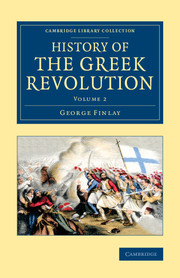
Inspired by philhellenism as a law student, George Finlay (1799–1875) took part in the Greek war of independence alongside Lord Byron. While later researching the history and archaeology of the country, Finlay also sought improvements to the administration and economic development of the independent Greek state. Published in 1861, this two-volume account of the Greek revolution, including its military conflicts and political consequences, traces events up to the creation of a constitutional monarchy. Volume 2 covers the civil wars among the Greeks and the first independent government of Ioannis Kapodistrias. Finlay's narrative includes Kapodistrias's assassination and the international recognition of Greek independence with the creation of the Greek monarchy. He describes the conflicts that arose from autocratic centralised rule, and the unrest in 1843 that led to limits on royal power in a formal constitution. Finlay's seven-volume History of Greece (1877) is also reissued in this series.
Celebrated for his construction of the Eddystone Lighthouse near Plymouth, John Smeaton (1724–92) established himself as Britain's foremost civil engineer in the eighteenth century. A founder member of the Society of Civil Engineers, he was instrumental in promoting the growth of the profession. The Royal Society awarded him its Copley medal for research into wind and water power in 1759. After his death his papers were acquired by the president of the Royal Society, Sir Joseph Banks, Smeaton's friend and patron. Using these materials, a special committee decided to publish 'every paper of any consequence' written by Smeaton, as a 'fund of practical instruction' for current and future engineers. These were published in four illustrated volumes between 1812 and 1814. Published in 1814 using the original engraved plates, Volume 4 contains the papers that Smeaton published in the Royal Society's Philosophical Transactions, as well as related correspondence.
Well versed in oriental languages and antiquities, and possessed of an 'insatiable thirst for seeing new countries', Claudius James Rich (1786/7–1821), the East India Company's resident at Baghdad, set out for Kurdistan in 1820 despite his delicate health. Before he succumbed to cholera the following year, he had visited and described many historic locations in present-day Iraq and Iran. His written account has long stood as an important early record of the region's geography, culture and archaeology. This two-volume work was edited by his widow and published, with maps and other illustrations, in 1836. Rich's Narrative of a Journey to the Site of Babylon in 1811 (1839), including his two archaeological memoirs, is also reissued in this series. Volume 1, including a biographical sketch of the author, covers the journey to and time spent in Kurdistan, closing with the author's 'sorrow at bidding adieu to its interesting people'.
Sir Richard Owen (1804–92) produced a series of monographs on the fossil reptiles found in the Mesozoic and Tertiary rocks of the United Kingdom, describing a wide variety of fossil lizards, turtles, crocodiles, flying reptiles (pterosaurs), marine reptiles and dinosaurs, many of which were new to science and whose names remain in use today. Most of the monographs concentrated on faunas from specific geological formations, but the one Owen began writing as the last in this series, on the Mesozoic Formations (originally published in 1874–7 and gathered together in 1889) described material ranging from the Middle Jurassic through to the Early Cretaceous. It includes the first scientific description of a stegosaurian dinosaur (Omosaurus), which preceded the naming of Stegosaurus from the United States by two years, extensive notes on Jurassic and Cretaceous pterosaurs, and some of the earliest descriptions of the unusual air-filled vertebrae of sauropod dinosaurs.
This nine-volume selection from the letters of Queen Victoria, with ancillary material, was commissioned by her son, Edward VII, and published between 1907 and 1932, with a gap of almost twenty years between the third and fourth volumes. The editor of the 'Third Series', which covers the years from 1886 to 1901, was George Earle Buckle (1854–1935), a historian and former editor of The Times, who continued the editorial policy of his predecessors, but who needed to tread carefully, as many of the people mentioned in documents of the final part of Queen Victoria's reign were still alive when Volumes 7–9 were published between 1930 and 1932. Volume 7 covers the period 1886–90, which was dominated by Gladstone's 'new departure in Irish policy'. Other topics include the Golden Jubilee of 1887 and the tragic early death of Victoria's son-in-law, Emperor Frederick III of Germany, in 1888.
Responsible for the generation of most of the world's electricity, and with applications to sea and land transport, the steam turbine may be regarded as a pivotal invention in the creation of a technologically advanced modern society. Charles Parsons (1854–1931) built the first practical steam turbine in 1884, and he remained at the forefront of its development for nearly fifty years, as he saw his invention become first the prime means by which thermal energy could be turned into electricity, and then the power behind pioneering cruise liners and warships. Alexander Richardson (1864–1928), an engineer and politician, had access to the inventor's papers when writing this account of the turbine's history. Published in 1911, and featuring more than 170 illustrative plates, it provides a valuable insight into the development of a technology that revolutionised power generation, marine transport and naval warfare.
English zoologist Philip Henry Gosse (1810–88) spent several years studying the biodiversity of habitats in North America and the Caribbean. His Naturalist's Sojourn in Jamaica (1851) is reissued in this series. When he settled on the Devonshire coast, the area proved equally rich for research. In this 1859 publication, the deeply religious Gosse considers the 'Divine mechanics' of animal body parts and microorganisms seen through the lens of a microscope. He leads the reader through a selection of specimens ranging from a hog's bristle to the shoe-like protist Paramecium. Gosse's writing style, enlivened with anecdotes and literary references, earned him considerable appreciation among Victorian audiences. His entertaining text is complemented by more than 100 illustrations which showcase his draughtsmanship. While the work shares its year of publication with Darwin's groundbreaking Origin of Species, Gosse's religious views firmly shaped his interpretation of the specimens on show.
August Schleicher (1821–68) is often credited with being the first scholar to apply a 'family tree' model to language groups. He had published extensively on individual European languages before his groundbreaking comparative Indo-European Compendium (also reissued in this series) appeared in German in 1861–2. The book was derived from his lectures, and was intended to save his students note-taking and copying from the blackboard. Each section begins with his reconstruction of a Proto-Indo-European phonological or morphological feature, and then shows how this is reflected in a range of daughter languages. This abridged English translation, based on the German third edition, appeared in 1874–7. Produced for students of Greek and Latin philology, it focuses on the phonology and morphology of 'the original Indo-European language', Sanskrit, Greek and Latin, omitting Schleicher's extensive discussion of other languages and the comparative paradigms provided in the German edition. Volume 1 covers phonology.