A collection of out-of-copyright and rare books from the Cambridge University Library and other world-class institutions that have been digitally scanned, made available online, and reprinted in paperback.
To save content items to your account,
please confirm that you agree to abide by our usage policies.
If this is the first time you use this feature, you will be asked to authorise Cambridge Core to connect with your account.
Find out more about saving content to .
To save content items to your Kindle, first ensure no-reply@cambridge.org
is added to your Approved Personal Document E-mail List under your Personal Document Settings
on the Manage Your Content and Devices page of your Amazon account. Then enter the ‘name’ part
of your Kindle email address below.
Find out more about saving to your Kindle.
Note you can select to save to either the @free.kindle.com or @kindle.com variations.
‘@free.kindle.com’ emails are free but can only be saved to your device when it is connected to wi-fi.
‘@kindle.com’ emails can be delivered even when you are not connected to wi-fi, but note that service fees apply.
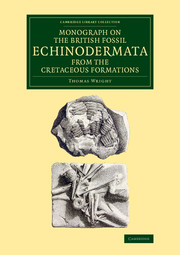
Thomas Wright (1809–84) was a leading nineteenth-century monographer of the Mesozoic echinoderms ('spiny-skinned animals') of the British Isles. The task of describing the British Cretaceous echinoids (sea urchins) was originally to be undertaken by Edward Forbes (1815–54), but his untimely death thrust the responsibility onto Wright. This project was made the more difficult when the accumulated specimens of Forbes disappeared after his death. Fortunately, the British Cretaceous is particularly rich in echinoids which have always been attractive to collectors, so many other sources were available for study. In particular, this work is dominated by the sea urchins of the Chalk, which are diverse, commonly well preserved and sometimes bizarre in morphology. Originally published in ten parts between 1864 and 1882, Wright's text is further enhanced by a suite of fine lithographic plates, mainly by Charles R. Bone (1808–75), who unfortunately died before completion of the project.
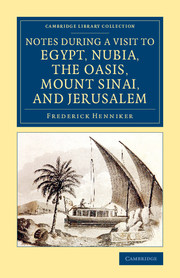
In 1820, the English traveller Sir Frederick Henniker (1793–1825) set out for Egypt, which he would explore for nearly three years. He sailed up the Nile, calling it 'the least romantic, but most useful of rivers', stopping off at many places along the way. His adventures were varied: he was the first known person to climb to the apex of the Pyramid of Khafre at Giza, and he acquired a second-century coffin that is now in the British Museum. He claimed to have met Egypt's khedive, Muhammad Ali Pasha, with whom he discussed English horses and military campaigns. Heading next to Mount Sinai and Jerusalem, he was brutally attacked by bandits on the road to Jericho, leaving him injured and naked. He recovered and continued his journey through the Middle East and back to England, where he published this lively and often amusing account of his adventures in 1823.
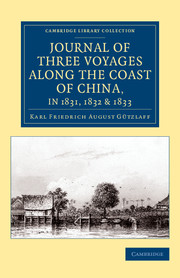
The Prussian-born Protestant missionary Karl Friedrich August Gützlaff (1803–51) sought to spread Christianity in the Far East. A gifted linguist, he sailed to Siam and worked on a translation of the Bible into Thai. The British missionary Robert Morrison had fired his interest in China, and Gützlaff later focused his evangelising efforts there, learning several dialects and distributing translated literature. The present work, featuring an introductory chapter by fellow missionary William Ellis on Chinese attitudes to foreign influence, was first published in 1834. Gützlaff had left Siam in 1831 in a Chinese junk trading along the coast of China. The next year, as an interpreter aboard an East India Company vessel, he also visited Korea and Okinawa. The third voyage recounted here describes the places and peoples encountered from Canton to Manchuria. Also reissued in this series are Gützlaff's Sketch of Chinese History (1834) and China Opened (1838).
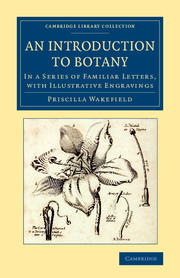
Coming from a prosperous London Quaker family, the author Priscilla Wakefield (1751–1832) wrote educational books for children, and one work for adults, Reflections on the Present Condition of the Female Sex (1798), also reissued in this series. This 1796 book on botany, a science which 'contributes to health of body and cheerfulness of disposition' but is difficult to study because of its Latin nomenclature and the cost of textbooks, offers a simple introduction for children through the medium of letters between sisters, as 'Felicia' shares with 'Constance' her growing understanding of plant science. Felicia's governess is a follower of Linnaeus, whose classificatory system is described as 'the one universally adopted', and by the twenty-eighth and final letter, Felicia is describing the class Cryptogamia. This illustrated account in simple language gives an insight into the level of education thought appropriate for young girls at the end of the eighteenth century.
The Scottish doctor Henry Faulds (1843–1930) and the English judge Sir William James Herschel (1833–1917) both recognised the potential of fingerprints as a means of identification. While working in Japan, Faulds had developed his methods after noticing impressions on ancient pottery. Herschel, during his service as a magistrate in India, had introduced a system of using fingerprints as a way of preventing fraud. In the course of a lengthy controversy, Faulds sought to be acknowledged for the significance of his discoveries. Although there is no doubt that Faulds was first to publish on the subject, it was Herschel's work, begun in the 1850s, which was later developed by Galton and Henry as the tool of forensic science we know today. Reissued here together, these two works, first published in 1912 and 1916 respectively, are Faulds' overview of the subject and Herschel's account of his work in India.
A Treatise on the Laying-Out of Gardens, on the Making and Managing of Hot-Beds and Green-Houses, and on the Propagation and Cultivation of the Several Sorts of Vegetables, Herbs, Fruits and Flowers
The political writer William Cobbett (1763–1835) was also a farmer 'bred at the plough's tail', who took a keen and observant interest in agriculture and gardening throughout his life. (His Cottage Economy and Rural Rides, among other works, are also reissued in the Cambridge Library Collection.) In 1792 he left England, where his views made him very unpopular, for France and then America, where he lived until 1800; in 1817 he fled to America again, leasing a farm on Long Island for two years. This 1821 book is written in Cobbett's characteristically robust style: his purpose is 'to cause the art of gardening to be better understood and practised than it now is in America'. Cobbett starts by explaining how to establish a garden, discusses soil improvement and the building of hot-beds and greenhouses, and gives instruction on the propagation and cultivation of vegetables, fruit trees, and ornamental plants.
This nine-volume selection from the letters of Queen Victoria, with ancillary material, was commissioned by her son, Edward VII, and published between 1907 and 1932, with a gap of almost twenty years between the third and fourth volumes. The editors of the first three volumes, the poet and writer A. C. Benson (1862–1925) and the second Viscount Esher (1852–1930), administrator and courtier, decided that the plan for the selection of letters from the thousands available should be to publish 'such documents as would serve to bring out the development of the Queen's character and disposition, and to give typical instances of her methods in dealing with political and social matters'. Volume 2 covers the period from 1844 to 1853, and reveals the Queen's reactions to an assassination attempt, to the triumph of the Great Exhibition, and to the death of the Duke of Wellington.
The German actress Minna Planer (1809–66) was Wagner's first wife. Though it lasted until her death, their marriage, never an easy one, was punctuated by long periods of separation, and during its early years Minna was the main breadwinner. William Ashton Ellis (1852–1919) abandoned his medical career to devote himself to his Wagner studies. Best known for his translations of Wagner's prose works, he published in 1909 this collection of letters from the composer, translated from the originals in Baron Hans von Wolzogen's Richard Wagner an Minna Wagner (1908). Concerned predominantly with domestic and business affairs, many of them complaining at Minna's lack of support, the letters offer an intriguing and intimate view of this larger-than-life composer. Spanning 1842–58, Volume 1 covers the couple's period in Dresden, Wagner's hurried departure after the 1849 uprising, and the years in Zurich culminating in the relationship with Mathilde Wesendonck.
In this two-volume work, published in 1912, the Hungarian-born archaeologist Marc Aurel Stein (1862–1943) describes his second expedition to the deserts of Chinese Turkestan in 1906–8. (His account of his first expedition, Sand-Buried Ruins of Khotan (1903), is also reissued in this series.) Stein intended this account to be read by non-specialists, and, like his previous book, it is highly illustrated and full of interesting details about his journey and the people he met en route, as well as of the important archaeological discoveries which still link his name with the civilisation of this remote and dangerous area. In Volume 1, Stein describes the problems of setting up the expedition and the excitement and perils of the route, which took him through the tribal areas of the North-West Frontier and the kingdom of Afghanistan, ending with his arrival at the western extremity of the Great Wall of China.
Also an Appendix, Containing a List of Writers on Cornish Dialect, and Additional Information about Dolly Pentreath, the Last Known Person who Spoke the Ancient Cornish as her Mother Tongue
The Cornish dialect stemmed from the influence of English on the declining Cornish language, and contained words from both languages. This glossary was published in 1882 by Frederick W. P. Jago (1817–92) in an effort to describe and preserve the dialect as it too declined. Containing around 3,700 dialect words from both Cornish and English, and annotated with examples, etymological information and literary citations, the work is an invaluable record of a disappearing dialect and way of life. The word list is supplemented by a history of Cornish and the Cornish dialect, showing similarities with the vocabulary of Chaucer, as well as with Welsh and Greek. Also included is an appendix with information about Dolly Pentreath, the last native speaker of Cornish, and a list of writers who had worked on the Cornish language and dialect. Jago's English-Cornish Dictionary (1887) is also reissued in this series.
This highly illustrated 1900 work on Egypt old and new by John Ward (1832–1912) seeks to guide the visitor to the ancient sites while also remarking on the radical changes to the economy and the development of the modern state since the intervention of the British government in 1883 and the appointment of Lord Cromer as consul-general and effective ruler. This blending of ancient and modern can be seen in discussions of Port Said ('not an Egyptian town at all') alongside the abandoned and silted-up delta ports of the Egyptians, Ptolemies and Ottomans. Thebes is discussed both as a city of the living and a city of the dead, and Ward notes approvingly the flattening of the ancient town of Assouan (Aswan), to form the foundations for new public buildings, on the orders of Lord Kitchener. Ward's subsequent book, Our Sudan (1905), is also reissued in this series.
This four-volume edition of the letters of Mrs Elizabeth Montagu (1718–1800), the 'Queen of the Bluestockings', was edited by her nephew and adopted son Matthew (1762–1831) and published in 1809–13. The daughter of wealthy parents, and well educated in history and languages, at the age of twenty-one she married Edward Montagu, a grandson of the earl of Sandwich whose income derived from northern estates and coal mines, and began to establish a London salon attended by the intellectual cream of British society, including Johnson, Burke, Garrick, Hannah More and Hester Chapone. The letters (and some correspondence from her circle) are arranged chronologically. Volume 4 covers the period from 1755 to 1761, and Montagu's correspondents include her sister and Mrs Elizabeth Carter, another member of the Bluestocking circle. The selection ends with her description of the coronation of George III in September 1761.
The young Elizabeth Butler (née Thompson, 1846–1933) and her sister, the poet Alice Meynell, were educated at home by their wealthy father, and much of their childhood was spent in Italy. Elizabeth began to train as an artist at the Female School of Art, South Kensington, in 1866. She became famous for her work in the genre (unusual for a woman) of military art, one of her best known paintings being The Roll Call, an imagined incident from the Crimea. She took great trouble to ensure the accuracy of the detail of regimental uniform, and her depiction of the bravery and stoicism of the 'ordinary British soldier' was much appreciated in the late nineteenth century. This brisk and amusing 1922 autobiography, illustrated with her own sketches, takes the reader from her childhood through her artistic success to her life as the wife of a soldier and the mother of five children.
From the 1850s onwards, the civil engineer Robert Henry Bow (1827–1909) became known for his expertise in structural analysis, publishing on the design of bridge and roof trusses, and working with the prolific railway engineer Sir Thomas Bouch (of later Tay Bridge infamy). In the first part of this 1873 publication, Bow describes 337 different truss structures, grouping them into four classes according to their structural characteristics: statically determinate, kinematically determinate, indeterminate, and other. In the second part, he describes a method for graphically analysing truss structures, based on the work of Thomas Maxwell and others, and applies this method to the structures listed in the first part. Perhaps of most interest to the working engineer are the explanations as to which structures are most efficient given typical material constraints, such as girders of uniform cross-section. The work remained a useful resource for practising engineers well into the twentieth century.
The lawyer, politician and antiquarian John Selden (1584–1654) made his name as an expert on the ancient laws of England, though he was equally at home with classical and Judaic studies: Grotius described him as 'the glory of the English nation', and his advice was sought on all manner of legal and moral problems from tithes to cross-dressing. This collection of his remarks on many topics was compiled by his amanuensis Richard Milward and first published in 1689. Reissued here is a version annotated and with a biographical preface by the literary scholar Samuel Weller Singer (1783–1858) and published in 1847. The topics of Selden's discourse are arranged alphabetically, from 'abbies' to 'zelots', via Christmas, juggling, marriage, and witches. As Singer says of the book, 'it is impossible to open it without finding some important fact or discussion, something practically useful and applicable to the business of life'.
University Librarian at Cambridge from 1867 until his death, Henry Bradshaw (1831–86) had inherited from his banker father an important library of Irish printed books and pamphlets assembled in the early nineteenth century. Having added to it, Bradshaw generously presented the collection to the University Library in 1870, and it has been expanding ever since. Published in 1916, this three-volume catalogue was compiled by the bibliographer Charles Edward Sayle (1864–1924). The works listed here, numbering more than 8,000 items and dating from the early seventeenth century through to the late nineteenth century, represent a valuable resource for students of Irish history and printing. Sayle's catalogue reveals the breadth and richness of the collection at the time of publication. Volume 3 contains the index to the catalogue as a whole.
Cornish had all but died out as a spoken language by the middle of the eighteenth century. However, it experienced a slight resurgence in the nineteenth century, spurred by increased scholarly interest. Published in 1887, this dictionary played a role in preserving Cornwall's linguistic heritage. Compiled by Frederick W. P. Jago (1817–92) and intended as a supplement to existing Cornish word lists and glossaries, it was the first resource to provide Cornish translations for English words and phrases. Jago attempts to provide literary citations for the entries wherever possible, but does not manage to do this throughout, observing that 'life is short, art is long'. Appendices include literal translations of biblical texts such as Genesis and the Ten Commandments. Also by Jago, The Ancient Language, and the Dialect of Cornwall, with an Enlarged Glossary of Cornish Provincial Words (1882) is also reissued in the Cambridge Library Collection.
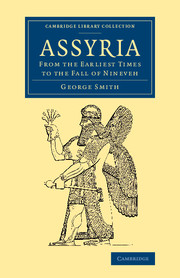
The Assyriologist George Smith (1840–76) was trained originally as an engraver, but was enthralled by the discoveries of Layard and Rawlinson. He taught himself cuneiform script, and joined the British Museum as a 'repairer' of broken cuneiform tablets. Promotion followed, and after one of Smith's most significant discoveries among the material sent to the Museum - a Babylonian story of a great flood - he was sent to the Middle East, where he found more inscriptions which contained other parts of the epic tale of Gilgamesh. In 1875, he published a history of Assyria for the 'Ancient History from the Monuments' series. Using biblical accounts as well as the Akkadian documents in clay and stone then being excavated in the area, Smith traces the history of the Assyrian empire from its origins until the fall of Nineveh in 612 BCE. Several other books by Smith are also reissued in this series.
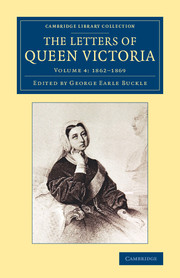
This nine-volume selection from the letters of Queen Victoria, with ancillary material, was commissioned by her son, Edward VII, and published between 1907 and 1932, with a gap of almost twenty years between the third and fourth volumes. The editor of the 'Second Series', which covers the years from 1862 to 1885, was George Earle Buckle (1854–1935), a historian and former editor of The Times, who continued the editorial policy of his predecessors, but who needed to tread carefully, as many of the people mentioned in documents of the second part of Queen Victoria's reign were still alive when Volumes 4–6 were published between 1926 and 1928. Volume 4, dealing with 1862–9, begins with the period of mourning after Prince Albert's death, and includes the marriage of the Prince of Wales, and the death of the Queen's uncle and mentor, Leopold I of Belgium.
Published together in 1846 for a British readership, these reports of two westward expeditions shed light on the challenges of exploration in nineteenth-century North America. Led by the army officer and future presidential candidate John Charles Frémont (1813–90), who became known as 'the Pathfinder', the first expedition ranged west of the Missouri River, while the second pushed beyond the Rocky Mountains, north to Fort Vancouver and then south into Mexican-held California. Frémont's detailed accounts are accessible to the non-specialist: this edition omits 'only the portions which are altogether astronomical, scientific, and philosophical, and, therefore, not adapted for general utility'. When originally published separately in 1843 and 1845, the narratives enthused a great many Americans, encouraging them to migrate west by providing stirring inspiration, valuable maps and practical information. Frémont's words and deeds remain of interest in the debate surrounding the 'manifest destiny' of the United States.