Prehistoric Man

-
Select format
-
- Publisher:
- Cambridge University Press
- Publication date:
- 05 December 2015
- 15 November 2012
- ISBN:
- 9781139481410
- 9781108054843
- Dimensions:
- Weight & Pages:
- Dimensions:
- (216 x 140 mm)
- Weight & Pages:
- 0.65kg, 516 Pages
You may already have access via personal or institutional login
Volume 1
Show more authors 
You may already have access via personal or institutional login
Book description
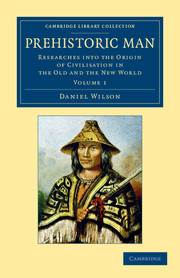
The Scottish archaeologist and anthropologist Daniel Wilson (1816–92) spent the latter part of his life in Canada. Published in 1862, this is a seminal work in the study of early man in which Wilson utilises studies of native tribes 'still seen there in a condition which seems to reproduce some of the most familiar phases ascribed to the infancy of the unhistoric world'. He believed that civilisations initially developed in mild climates and judged the Mayans to have been the most advanced civilisation in the New World. Twentieth-century anthropologist Bruce Trigger argued that Wilson 'interpreted evidence about human behaviour in a way that is far more in accord with modern thinking than are the racist views of Darwin and Lubbock', and it is in this light that this two-volume work can be judged. Volume 1 covers such important areas as the development and use of metals and 'the architectural instinct'.
Contents
Contents
Metrics
Full text views
Full text views helpTotal number of HTML views: 0
Total number of PDF views: 0 *
 Loading metrics...
* Views captured on Cambridge Core between #date#. This data will be updated every 24 hours.
Usage data cannot currently be displayed.
Accessibility standard: Unknown
Why this information is here
This section outlines the accessibility features of this content - including support for screen readers, full keyboard navigation and high-contrast display options. This may not be relevant for you.
Accessibility Information
Accessibility compliance for the PDF of this book is currently unknown and may be updated in the future.