A collection of out-of-copyright and rare books from the Cambridge University Library and other world-class institutions that have been digitally scanned, made available online, and reprinted in paperback.
To save content items to your account,
please confirm that you agree to abide by our usage policies.
If this is the first time you use this feature, you will be asked to authorise Cambridge Core to connect with your account.
Find out more about saving content to .
To save content items to your Kindle, first ensure no-reply@cambridge.org
is added to your Approved Personal Document E-mail List under your Personal Document Settings
on the Manage Your Content and Devices page of your Amazon account. Then enter the ‘name’ part
of your Kindle email address below.
Find out more about saving to your Kindle.
Note you can select to save to either the @free.kindle.com or @kindle.com variations.
‘@free.kindle.com’ emails are free but can only be saved to your device when it is connected to wi-fi.
‘@kindle.com’ emails can be delivered even when you are not connected to wi-fi, but note that service fees apply.
Sophie Germain (1776–1831) was one of the first distinguished female mathematicians of the modern era. Largely self-taught, she won the admiration and friendship of Legendre and Gauss (whose work also appears in this series). Germain is best known for her work on number theory, notably Fermat's Last Theorem, but she played an important part in establishing the foundations of elasticity. This book, described by her slightly younger contemporary Navier as 'a work which few men are able to read and which only one woman was able to write', contains her research on the topic, which was awarded a prize by the Paris Academy of Sciences. This work was published in Paris in 1821.
Championed as one of the gentlest and most calming of field sports, angling has had its notable votaries throughout its history, from Isaak Walton to Horatio Nelson. In this charming book on the pleasures of fly fishing, the eminent chemist Sir Humphry Davy (1778–1829) adds his name to the list. He assigns his often poetic arguments to an imaginary cast of four friends, some of whom adore the sport while others question its morality as they embark on a series of angling trips. As their conversations progress, the friends discuss entomology and biology, the finer techniques of landing trout, and the use of peacock feathers and yellow monkey fur in the making of artificial flies. Originally published in 1828, Davy's book offers a glimpse of the sportsman behind the chemist and remains both accessible and instructive for modern enthusiasts.
In the late eighteenth century, slave labour in Britain's colonies was seen as central to world trade, and the practice was supported by prominent members of society, including the king. Ottobah Cugoano, an emancipated slave living in England, had joined the Sons of Africa, a group whose members wrote to the royal family, aristocrats and leading politicians to condemn slavery and campaign for its abolition. This work, first published in 1787 and sent to George III, was a daring attack on colonial conquest and enslavement, arguing that slaves had a moral duty to rebel against their oppressors. Widely read upon publication, it went through at least three printings that year and was translated into French, with a shorter version published in 1791. This reissue of the original work makes available an important document in the history of colonialism and slavery in the British Empire.
A major actor in the American Revolution, the English intellectual Thomas Paine (1737–1809) is best remembered for his pamphlet Common Sense (1776), which advocated American independence from Britain. Although accorded honorary French citizenship in 1792 for his republican Rights of Man, Paine was later imprisoned and narrowly escaped the guillotine. It was around this time that he started to write The Age of Reason, originally published in two parts between 1794 and 1795. In Part 1, Paine outlines his personal religious views and attacks institutional faith as a human invention, while Part 2 analyses the Bible and highlights its contradictions. The work was met with great hostility in Britain and denounced as espousing atheism, while in America it led to a short-lived revival of deism but was also much reviled. This reissue includes both parts and affords valuable insight into radical freethinking during the age of revolutions.
John Ayrton Paris (1785–1856), writer and physician, became a member of the Linnean Society in 1810, and served as president of the Royal College of Physicians from 1844 until his death. Intended for children and originally composed for the author's family, this three-volume work about science was first published in 1827. Dedicated to the writer Maria Edgeworth (1768–1849) and with illustrations by George Cruikshank (1792–1878), it aims 'to blend amusement with instruction', since youth, as Paris writes, 'is naturally addicted to amusement'. Topics covered in Volume 2 include the collision of bodies, vacuums, motion in flight, and echoes; the science behind these is demonstrated using marbles, a kite and musical instruments, among various other toys and games. A fascinating and popular text in the history of science education, the engaging narrative seeks to prove 'how profitably, and agreeably, the machinery of fiction may be worked for the dissemination of truth'.
William Sawrey Gilpin (1761/2–1843), landscape painter and illustrator, later became a landscape gardener and writer. He set himself up as a drawing master in Paddington Green and also illustrated picturesque travel-writing. Between 1804 and 1806 he was the first president of the Society of Painters in Water Colours, and then the third drawing master at the Royal Military College in Marlow. After being discharged from this post, Gilpin became a successful landscape gardener and advisor to the nobility. His approach to landscape gardening was influenced by painting and Sir Uvedale Price's Essay on the Picturesque (1794). Gilpin's Hints, published in 1832, advocates that landscapes should be improved by the 'taste' of a painter's eye, and artificial buildings united with their surroundings. Like his landscape practice, this book was highly regarded by Gilpin's contemporaries for its emphasis on the picturesque, especially when landscape gardening centred upon the introduction of exotic plants.
The premiere of Otello, Giuseppe Verdi's only new opera for over a decade, was a much-anticipated event in Milan in February 1887, and musical talents from all over Europe had vied for the chance to be part of it. An American author and former opera singer, Blanche Roosevelt (1853–98) took an assignment as a special correspondent in Milan during the weeks surrounding the opera's premiere at La Scala. She was well connected in the artistic community and personally acquainted with Verdi himself, and her dispatches paint an informed and vivid picture of the city and its musical and literary scene in the late 1880s. Published in 1887, along with a short biography of Verdi, anecdotes, illustrations, and reminiscences of conversations with the composer, these writings will appeal to both music scholars and opera lovers.
John Evelyn (1620–1706), intellectual, diarist, gardener and founder member of the Royal Society, is best known for his Diary, the great journal of his life and times, encompassing a momentous period in British history. A lifelong collector of books, like his contemporary Pepys, Evelyn amassed over 4,000 items in his library. This work, originally published in 1664, was the first English-language treatise on forestry. Intended for the gentry, it aimed to encourage tree-planting after the ravages of the Civil War and to ensure a supply of timber for Britain's fast-developing navy. The first work sponsored officially by the Royal Society, it was an offshoot of Evelyn's unpublished manuscript Elysium Britannicum, a compendium of gardens and gardening. This is the 1908 two-volume reprint of the fourth edition, published in the year of Evelyn's death. Volume 2 covers practical aspects of forestry and the use of trees in landscaping.
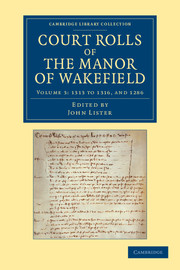
The detailed records of the proceedings of the manorial court of Wakefield provide a unique insight into medieval life and commerce, the many legal disputes arising, and the mechanisms for resolving them. The manor court met every three weeks, as well as holding additional courts, or 'tourns', at various locations around the West Riding of Yorkshire. Recognising the historical significance of these court records, in 1901 the Yorkshire Archaeological Society began publishing them as part of its Record Series, continuing intermittently until 1945 and ultimately producing five volumes that span the years 1274–1331. Edited with an introduction and notes by John Lister (1847–1933) and published in 1917, Volume 3 contains the court rolls for the years 1313–16 and 1286. The texts of the rolls are in English.
Antoine Isaac Silvestre de Sacy (1758–1838), the most distinguished French orientalist of his time, is considered the father of Arab scholarship in Europe. He had a lifelong interest in a little-known religious community, the Druze, which emerged in the eleventh century as an Ismaili schismatic movement. De Sacy's monumental study was begun in the 1790s, when he translated some of the Druze scriptures from Arabic to French. Such was his commitment to learning more about the Druze that he waited forty years before publishing this two-volume work in 1838, as he hoped to uncover further source material. It offers pioneering insight into the religious system founded by Hamza ibn-'Ali ibn-Ahmad during the reign of the caliph al-Hakim bi-Amr Allah. Volume 2 thoroughly examines the Druze hierarchical structures and doctrines, from moral duties to civil law.
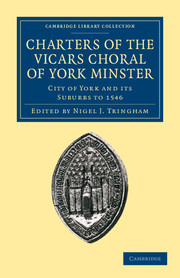
The archive of the York vicars is the largest collection of its type to survive. The present work contains 581 charters relating specifically to the vicars choral of York Minster, dating from the later twelfth century to 1546. It was originally published in 1993 by Nigel J. Tringham, who has written extensively for the Victoria County History. The documents here are a valuable resource for the study of the vicars choral, as well as the topography and social and economic history of medieval York. Painting a picture of the daily affairs of the vicars and of the general population of the city and its suburbs, the charters are arranged geographically according to the street or area mentioned, and then chronologically. Each text up to around 1230 is presented as a full Latin transcription, preceded by a summary in English. Full critical notes accompany each document.
Antoine Isaac Silvestre de Sacy (1758–1838), the most distinguished French orientalist of his time, is considered the father of Arab scholarship in Europe. He had a lifelong interest in a little-known religious community, the Druze, which emerged in the eleventh century as an Ismaili schismatic movement. De Sacy's monumental study was begun in the 1790s, when he translated some of the Druze scriptures from Arabic to French. Such was his commitment to learning more about the Druze that he waited forty years before publishing this two-volume work in 1838, as he hoped to uncover further source material. It offers pioneering insight into the religious system founded by Hamza ibn-'Ali ibn-Ahmad during the reign of the caliph al-Hakim bi-Amr Allah. Volume 1 looks at the early history and doctrines of the Ismaili movement before expanding on the reign of al-Hakim (996–1021).
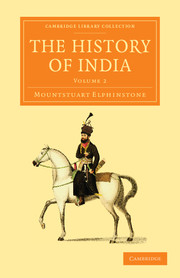
Appointed through family influence to the East India Company, Mountstuart Elphinstone (1779–1859) arrived on the subcontinent in 1796, quickly learning Persian and developing an interest in Indian civilisation. After postings in Benares, Afghanistan and Poona, he became governor in 1819 of the recently acquired territory that became known as the Bombay Presidency, where he remained until his resignation in 1827. On his return to England, he devoted much of his time to writing and was a founder member of the Royal Geographical Society. This two-volume history, based on a range of Indian sources and first published in 1841, is infused with his lifelong understanding of Indian culture, science and philosophy. A scholarly refutation of James Mill's History, it was the most popular work of its kind among the early Victorian public. Volume 2 covers the period from the thirteenth century to the demise of the Mogul empire in the mid-eighteenth century.
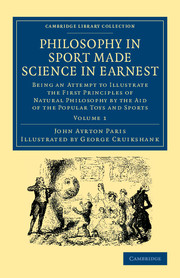
John Ayrton Paris (1785–1856), writer and physician, became a member of the Linnean Society in 1810, and served as president of the Royal College of Physicians from 1844 until his death. Intended for children and originally composed for the author's family, this three-volume work about science was first published in 1827. Dedicated to the writer Maria Edgeworth (1768–1849) and with illustrations by George Cruikshank (1792–1878), it aims 'to blend amusement with instruction', since youth, as Paris writes, 'is naturally addicted to amusement'. Topics covered in Volume 1 include momentum, geometry, elasticity and rotatory motion; the science behind these is demonstrated using a yo-yo, a jack-in-the-box and a slingshot, among various other toys and games. A fascinating and popular text in the history of science education, the engaging narrative seeks to prove 'how profitably, and agreeably, the machinery of fiction may be worked for the dissemination of truth'.
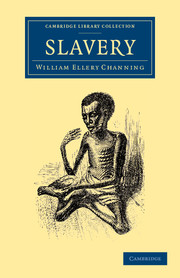
In the years preceding the American Civil War, religion was at the heart of the debate over slavery. William Ellery Channing (1780–1842) had rejected the strict Calvinism of his background to become the leading Unitarian spokesman and preacher, and in later life he began to address the subject of slavery. Published in 1836, this work was Channing's most substantial contribution to the debate, revealing the real difficulties men such as Channing had in questioning a practice with which they had grown up. He vacillates between contempt for the institution and empathy for the slaveholders, writing, 'I do not intend to pass sentence on the character of the slave-holder.' He sees black slaves as humans, but not of equal status with white people. The final chapter is particularly prescient: 'There is a great dread … that the union of the States may be dissolved by the conflict about slavery.'
This work by Edmund Gosse (1849–1928) was commissioned by Macmillan as the third volume in a series of literary histories, and published in 1889, when literary criticism was still a relatively new field of academic study. His earlier work had led to his appointment as Lecturer at Trinity College, Cambridge, in 1884 and to a hugely popular American lecture tour that same year. An established poet, author and critic, Gosse had a loyal following within the literary establishment of Cambridge and London, despite lacking formal academic qualifications. His approach to analysis was through personal impressions, and discussions of the biographies as well as output of a wide range of writers from Dryden to Johnson. Reviewers noted his identification of the years 1660–1780 as being central to the beginnings of the novel and the concern to 'reform and regulate ordinary writing', and praised his comparison of English and Continental literature.
Educated in Prague, Vienna and Leipzig, Moritz Steinschneider (1816–1907) was a Jewish Bohemian orientalist with a deep understanding of classical and Semitic languages and cultures, specialising in bibliography. He edited twenty-one volumes of the journal Hebräische Bibliographie from 1859 to 1882, and his 1878 catalogue of the Hebrew manuscripts held in the Hamburg State Library is also reissued in this series. First published in 1877, this book is an elaborate record of Arabic polemic and apologetic literature among Muslims, Christians and Jews. The product of several decades of work, it offers detailed historical and bibliographic information on each item, alphabetical lists of titles and authors, an appendix of background information, and a useful index. Steinschneider's painstaking work remains of value to scholars of the Abrahamic religions and the history of interfaith relations.
Moritz Steinschneider (1816–1907) is regarded as one of the founding fathers of the study of modern Judaism, and his work is still relevant today. Steinschneider's studies encompassed traditional Jewish subjects as well as classical and Semitic languages and cultures. He belonged to a small group of scholars who changed the scope of Jewish learning from that of rabbinics to a broader view of Jewish civilisation. Steinschneider also sought to provide a complete and accurate record of printed publications of Hebraica and Judaica. In this 1878 publication, Steinschneider lists all the Hebrew manuscripts held in the Hamburg State Library. He divides the manuscripts into thirteen categories, including homiletics, prayers, the Kabbalah, and theology and philosophy. Also represented are poetry, rhetoric, mathematics and medicine. Steinschneider also comments on each manuscript and evaluates the significance of the Hamburg collection compared to other German library collections.
John Ayrton Paris (1785–1856), writer and physician, became a member of the Linnean Society in 1810, and served as president of the Royal College of Physicians from 1844 until his death. Intended for children and originally composed for the author's family, this three-volume work about science was first published in 1827. Dedicated to the writer Maria Edgeworth (1768–1849) and with illustrations by George Cruikshank (1792–1878), it aims 'to blend amusement with instruction', since youth, as Paris writes, 'is naturally addicted to amusement'. Topics covered in Volume 3 include optical illusions, centrifugal forces and the compound nature of white light; the science behind these is demonstrated using concave mirrors, Catharine wheels and a thaumatrope (which Paris is sometimes credited as having invented). A fascinating and popular text in the history of science education, the engaging narrative seeks to prove 'how profitably, and agreeably, the machinery of fiction may be worked for the dissemination of truth'.
Peter Gustav Lejeune Dirichlet (1805–59) may be considered the father of modern number theory. He studied in Paris, coming under the influence of mathematicians like Fourier and Legendre, and then taught at Berlin and Göttingen universities, where he was the successor to Gauss. This book contains lectures on number theory given by Dirichlet in 1856–7. They include his famous proofs of the class number theorem for binary quadratic forms and the existence of an infinity of primes in every appropriate arithmetical progression. The material was first published in 1863 by Richard Dedekind (1831–1916), professor at Braunschweig, who had been a junior colleague of Dirichlet at Göttingen. The second edition appeared in 1871; this reissue is of the third, revised and expanded, edition of 1879; a fourth edition appeared as late as 1894. The appendices contain further work by both Dirichlet and Dedekind.