A collection of out-of-copyright and rare books from the Cambridge University Library and other world-class institutions that have been digitally scanned, made available online, and reprinted in paperback.
To save content items to your account,
please confirm that you agree to abide by our usage policies.
If this is the first time you use this feature, you will be asked to authorise Cambridge Core to connect with your account.
Find out more about saving content to .
To save content items to your Kindle, first ensure no-reply@cambridge.org
is added to your Approved Personal Document E-mail List under your Personal Document Settings
on the Manage Your Content and Devices page of your Amazon account. Then enter the ‘name’ part
of your Kindle email address below.
Find out more about saving to your Kindle.
Note you can select to save to either the @free.kindle.com or @kindle.com variations.
‘@free.kindle.com’ emails are free but can only be saved to your device when it is connected to wi-fi.
‘@kindle.com’ emails can be delivered even when you are not connected to wi-fi, but note that service fees apply.
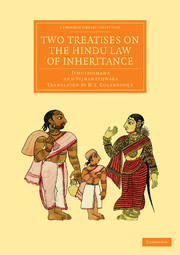
Published in 1810, this work was one of the key translations of texts that formed part of the law books of the Anglo-Indian civil courts under the East India Company. A successor to the orientalist and jurist Sir William Jones, Henry Thomas Colebrooke (1765–1837) had taught himself Sanskrit and became involved in studying and trying to codify Hindu law to apply it in the civil law courts where he held superior judicial positions. Here he translates two medieval texts, Jimutavahana's Dayabhaga and part of Vijnaneshwara's Mitakshara, which formalised an area of legal theory, serving as the principal guides in, respectively, Bengal and the rest of India for laws on inheritance until the Hindu Succession Act of 1956. Despite errors later identified in the translation, Colebrooke's work stands as an important scholarly undertaking, reflecting his desire to promote knowledge of Hindu law, culture and heritage throughout the English-speaking world.
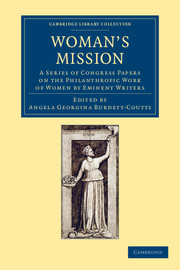
Granddaughter of the banker Thomas Coutts, the philanthropist Angela Georgina Burdett-Coutts (1814–1906) was one of the most remarkable women of her age, giving away an estimated £4 million of her inheritance to a wide range of causes at home and abroad. She set an example to others, offering support in a practical way without fuss, working with Charles Dickens on schemes to improve the lot of the poverty-stricken, striving to ameliorate the conditions in which they lived. The Church of England was another beneficiary of her largesse, receiving endowments for bishoprics, churches, and elementary and technical school buildings. In 1893, she edited this collection of papers from a congress held during the international exposition in Chicago. It offers a fascinating snapshot - drawing on information from over 300 organisations worldwide - of the astonishing variety of charitable work undertaken by women in the late nineteenth century.
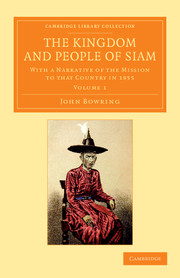
Published in two volumes in 1857, this was the most successful work of the linguist and politician Sir John Bowring (1792–1872). His varied career included work as an editor and translator, service as an MP in Britain and as a consul in China, and the controversial governorship of Hong Kong. His appointment to this last post in 1854 saw him aggressively assert British interests with little regard for Asian sensibilities. The following year he travelled to Siam (Thailand) to negotiate a treaty with that country which became a model for future agreements, giving the Siamese government an insight into Western diplomacy which would be invaluable. Volume 1 is an illustrated introduction to the country, following the structure of Bishop Pallegoix's earlier work, with chapters on Siam's geography and history; population; manners and customs; legislation; resources, industry and finances; culture and religion; and its capital, Bangkok.
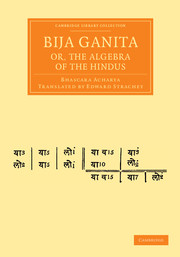
An important mathematician and astronomer in medieval India, Bhascara Acharya (1114–85) wrote treatises on arithmetic, algebra, geometry and astronomy. He is also believed to have been head of the astronomical observatory at Ujjain, which was the leading centre of mathematical sciences in India. Forming part of his Sanskrit magnum opus Siddhānta Shiromani, the present work is his treatise on algebra. It was first published in English in 1813 after being translated from a Persian text by the East India Company civil servant Edward Strachey (1774–1832). The topics covered include operations involving positive and negative numbers, surds and zero, as well as algebraic, simultaneous and indeterminate equations. Strachey also appends useful notes made by the orientalist Samuel Davis (1760–1819). Of enduring interest in the history of mathematics, this was notably the first work to acknowledge that a positive number has two square roots.
'Ancient geography' refers here to India's Buddhist period up to the seventh century CE, during which time Buddhism was the subcontinent's dominant religion. First published in 1871, this detailed study covering this period was written by Sir Alexander Cunningham (1814–93), who served as an officer in the East India Company and then went on to found and direct the Archaeological Survey of India. He had become an expert on the country's ancient geography owing to his experience as a surveyor. In this work he draws on material ranging from the campaigns of Alexander the Great to the travels of the seventh-century Buddhist pilgrim Xuanzang, who recorded much about India's geographical, political, religious and cultural landscape. Although this book was published as Part I, a subsequent volume on the Muslim period was never completed.
Scotsman Charles Grant (1746–1823) travelled to India in 1767. During his 22-year stay, he rose through the ranks of the East India Company, serving as a member of the company's board of trade. Following his return to Britain, he served three times as the company's chairman and was also elected to Parliament. His conversion to a fervent form of Christianity had occurred in 1776, making him a well-known advocate of evangelisation in the newly acquired British territories. In this work, he launches a strong attack on Hindu belief, labelling it as depraved, degenerate and despotic. 'The true cure of darkness is the introduction of light,' he argues. Written in 1792 but first published in 1797, this work was also presented to Parliament in 1813 in a bid to influence the renewal and amendment of the East India Company's charter.
One of the most popular and successful gardening writers of the Victorian era, Shirley Hibberd (1825–90) was editor of three bestselling gardening magazines. He was highly influential - one of the first to highlight issues such as environmental conservation, water recycling and cruelty to animals - and he helped to establish what is now the vast consumer industry of amateur gardening. First published in 1871, this is one of many books he wrote on the subject, intended as a 'handy guide' for the creation of attractive flower gardens. In it Hibberd offers advice on such topics as bedding plants, border flowers, rockeries, and annual and biennial plants. He also presents methods for managing various types of garden, such as subtropical, alpine and rose gardens. Highly detailed and extensively illustrated, this book remains useful and relevant to both amateur enthusiasts and seasoned horticulturists.
Published in two volumes in 1857, this was the most successful work of the linguist and politician Sir John Bowring (1792–1872). His varied career included work as an editor and translator, service as an MP in Britain and as a consul in China, and the controversial governorship of Hong Kong. His appointment to this last post in 1854 saw him aggressively assert British interests with little regard for Asian sensibilities. The following year he travelled to Siam (Thailand) to negotiate a treaty with that country which became a model for future agreements, giving the Siamese government an insight into Western diplomacy which would be invaluable. Volume 2 covers the political make-up of the nation, containing chapters on its dependencies and diplomatic relations, including an account of the work done by Bowring and his party. Also featured are personal accounts from long-term foreign residents of Siam and writings by its king, Mongkut (1804–68).
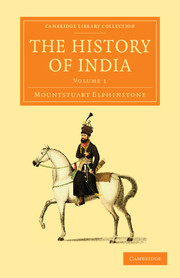
Appointed through family influence to the East India Company, Mountstuart Elphinstone (1779–1859) arrived on the subcontinent in 1796, quickly learning Persian and developing an interest in Indian civilisation. After postings in Benares, Afghanistan and Poona, he became governor in 1819 of the recently acquired territory that became known as the Bombay Presidency, where he remained until his resignation in 1827. On his return to England, he devoted much of his time to writing and was a founder member of the Royal Geographical Society. This two-volume history, based on a range of Indian sources and first published in 1841, is infused with his lifelong understanding of Indian culture, science and philosophy. A scholarly refutation of James Mill's History, it was the most popular work of its kind among the early Victorian public. Volume 1 contains a topographical introduction and covers the history of the Indian subcontinent to the thirteenth century.
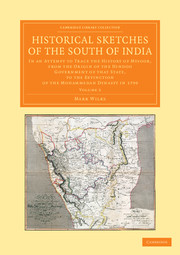
In an Attempt to Trace the History of Mysoor, from the Origin of the Hindoo Government of that State, to the Extinction of the Mohammedan Dynasty in 1799
Classically educated, Mark Wilks (c.1760–1831) joined the Madras army of the East India Company and would go on to serve as political resident at the court of Mysore from 1803 to 1808. He also later served as governor of Saint Helena from 1813 to 1816, during which time he witnessed the arrival of Napoleon Bonaparte. Elected to the Manx parliament in 1816, Wilks became its speaker in 1826 and was elected a fellow of the Royal Society in the same year. Drawing on state records and his own experiences, he first published this acclaimed three-volume history of the kingdom of Mysore between 1810 and 1817. Volume 3 narrates the history of the third (1789–92) and fourth (1798–9) Anglo-Mysore wars, the capture of Seringapatam and the death of Tipu Sultan (1750–99).
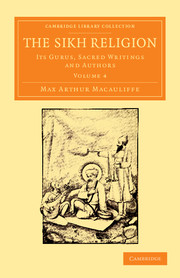
Born and educated in Ireland, Max Arthur Macauliffe (1841–1913) joined the Indian Civil Service in 1862. In 1882 he was promoted to the post of deputy commissioner of the Punjab. But it was after he retired from the civil service in 1893 that he gained public attention. Macauliffe developed a close affinity with Sikhism while in the Punjab, eventually converting to the religion. His translation into English of the Guru Granth Sahib, the holy book of Sikhism, is recognised as the most accurate to date. Following this project, he set to work on this six-volume set, covering the history and philosophy of Sikhism, first published in 1909 and still regarded as the definitive work on the subject. Volume 4 narrates the lives of Hargobind, Har Rai, Harkrishan and Tegh Bahadur, the sixth to ninth Sikh gurus, with translations of Tegh Bahadur's compositions in the Sikh holy book.
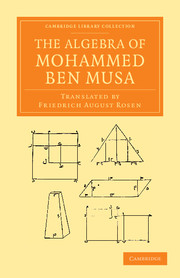
Mohammed ben Musa (c.780–c.850) was a Persian mathematician and astronomer. The word 'algebra' derives from his Compendious Book on Calculation by Completion and Balancing, which introduced modern algebraic methods. First published in 1831, this translation from Arabic into English was prepared by the German orientalist Friedrich August Rosen (1805–37). The key algebraic methods introduced are reduction, completion and balancing. To reduce an equation is to change an expression to a simpler form; completion is to remove a negative quantity from one side of the equation and add it to the other; and balancing is to cancel like terms on opposite sides of the equation. An account is also given of solving polynomial equations up to the second degree. Rosen's introduction and notes accompany the translation, which remains relevant in the history of mathematics.
A Congregationalist clergyman, editor of the influential progressive journal The Outlook, and intimate with Henry Ward Beecher and Theodore Roosevelt, Lymon Abbott (1835–1922) played a central role in religion and politics in turn-of-the-century America. In this work, first published in 1897, Abbott shows his characteristic optimism in human moral development, arguing that the Christian faith can fully accommodate evolution as the means by which God changes and improves the world over time. Abbott writes 'not to disbelievers in evolution to prove that they are mistaken, but to believers in evolution to show them that their belief is not inconsistent with the Christian faith'. A companion to Abbott's popular previous work The Evolution of Christianity (also reissued in the Cambridge Library Collection), this text presents an innovative and often elegant reconciliation of the ongoing debate concerning scientific empiricism and Christian belief.
The Dutch physicist Hendrik Antoon Lorentz (1853–1928) was educated at the University of Leiden, where he later became a Professor of Theoretical Physics. A leading figure in his field, he established the basic mathematical principles that were later used by Albert Einstein for his theory of relativity. Lorentz and his colleague Pieter Zeeman won the Nobel Prize in Physics in 1902 for their researches into the influence of magnetism upon radiation phenomena (the Zeeman effect). In 1905 Lorentz was also elected a Fellow of the Royal Society, which awarded him the Rumford and Copley Medals. Contributing to the discussion of the theory of a luminiferous ether - soon to be superseded by special relativity - this work, first published in 1895, looks at electromagnetic phenomena (the propagation of light) in relation to moving bodies and optics.
Henry Stephens (1795–1874) was a farmer and later a writer on agriculture. After attending lectures on chemistry and agriculture at the University of Edinburgh he boarded with a Berwickshire farmer, George Brown, and gained experience of agricultural work. In 1820 Stephens acquired his own farm, on which he used modern and experimental farming methods. In 1837 he sold the farm, and devoted the rest of his life to writing guides to farming for the use of inexperienced farmers. These influential volumes, first published in 1842, contain Stephens' detailed descriptions of contemporary farming practices. He describes in meticulous detail all aspects of farming, including livestock care and slaughter, dairying, irrigation practices and crop culture. Arranged by season and including copious high-quality illustrations of farming equipment, these extremely popular and fascinating volumes were considered the standard work on practical Victorian agriculture. Volume 2 describes farming tasks performed in spring.
Isabel J. Armstrong (born c.1848) and her travelling companion Edith Payne were part of an increasing cohort of determined women entering territory deemed unsuitable for ladies: travel. Women such as Isabella Bird (whose work is also available in this series) and Mary Kingsley had defied social convention in order to explore the world around them. Their independence of spirit and thirst for knowledge made them inspirational role models. Little is known of Armstrong and Payne other than what is recorded in this engaging account of their Greek adventures, about which 'the general opinion seemed to be that we were going out to be murdered'. First published in 1893, the book depicts a country whose traditions and way of life were in danger of being swept away by the advance of modern technology. Incorporating vivid descriptions of Piraeus, Olympia, Thessaly and the monasteries of Meteora, the narrative is charmingly illustrated with Armstrong's own sketches.
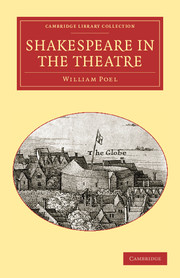
William Poel (1852–1934), actor, director and author, began his acting career in 1876, deliberately choosing provincial touring in order to learn his craft. After a period as manager of the Royal Victoria Hall and Coffee Tavern (later the Old Vic), he worked as stage manager for the actor-manager Frank Benson. In the 1890s he founded the Elizabethan Stage Society in order to demonstrate his fervent belief that only a return to Elizabethan performance methods would enable a true understanding of Shakespeare's plays. This was to have a profound influence on modern productions, with directors such as Tyrone Guthrie and John Gielgud adopting his ideals rather than his often idiosyncratic practices. Moreover, his long-held wish for a replica of the Globe Theatre has since become a reality. Poel was also a prolific author and this work, first published in 1913, explores his philosophy by bringing together four articles on the staging of Shakespeare.