Slavery

-
Select format
-
- Publisher:
- Cambridge University Press
- Publication date:
- 05 April 2014
- 29 August 2013
- ISBN:
- 9781139382090
- 9781108053150
- Dimensions:
- Weight & Pages:
- Dimensions:
- (216 x 140 mm)
- Weight & Pages:
- 0.15kg, 108 Pages
You may already have access via personal or institutional login
Show more authors 
You may already have access via personal or institutional login
Book description
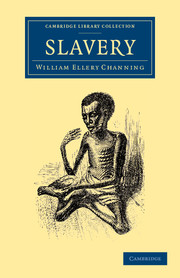
In the years preceding the American Civil War, religion was at the heart of the debate over slavery. William Ellery Channing (1780–1842) had rejected the strict Calvinism of his background to become the leading Unitarian spokesman and preacher, and in later life he began to address the subject of slavery. Published in 1836, this work was Channing's most substantial contribution to the debate, revealing the real difficulties men such as Channing had in questioning a practice with which they had grown up. He vacillates between contempt for the institution and empathy for the slaveholders, writing, 'I do not intend to pass sentence on the character of the slave-holder.' He sees black slaves as humans, but not of equal status with white people. The final chapter is particularly prescient: 'There is a great dread … that the union of the States may be dissolved by the conflict about slavery.'
Contents
Contents
Metrics
Full text views
Full text views helpTotal number of HTML views: 0
Total number of PDF views: 0 *
 Loading metrics...
* Views captured on Cambridge Core between #date#. This data will be updated every 24 hours.
Usage data cannot currently be displayed.
Accessibility standard: Unknown
Why this information is here
This section outlines the accessibility features of this content - including support for screen readers, full keyboard navigation and high-contrast display options. This may not be relevant for you.
Accessibility Information
Accessibility compliance for the PDF of this book is currently unknown and may be updated in the future.