Refine search
Actions for selected content:
26207 results in Theoretical Physics and Mathematical Physics
Errors in Observed Altitudes
-
- Journal:
- The Journal of Navigation / Volume 1 / Issue 4 / October 1948
- Published online by Cambridge University Press:
- 18 January 2010, p. 367
- Print publication:
- October 1948
-
- Article
- Export citation
Experimental evidence for the theory of local isotropy
-
- Journal:
- Mathematical Proceedings of the Cambridge Philosophical Society / Volume 44 / Issue 4 / October 1948
- Published online by Cambridge University Press:
- 24 October 2008, pp. 560-565
- Print publication:
- October 1948
-
- Article
- Export citation
-
Some new measurements of isotropic turbulence produced behind a biplane grid have been made at high Reynolds numbers, and these results are compared with the predictions of the theory of local isotropy developed by A. N. Kolmogoroff. The transverse double-velocity correlation has been measured at mesh Reynolds numbers up to 3·2 × 105, and the observed form agrees well with the predicted form. Measurements of the skewness factor of velocity differences over finite intervals have also been made, and the factor is nearly constant and equal to −0·38, if the interval is small compared with the integral scale. The invariance of dimensionless functions of the velocity derivatives has been confirmed for the flattening factor of ∂u/∂x, namely,
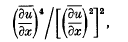
which is nearly constant over a wide range of conditions. It is concluded that the theory of local isotropy is substantially correct for isotropic turbulence of high Reynolds number.
Navigational Awards
-
- Journal:
- The Journal of Navigation / Volume 1 / Issue 4 / October 1948
- Published online by Cambridge University Press:
- 18 January 2010, p. 367
- Print publication:
- October 1948
-
- Article
- Export citation
Proceedings at the Meetings held during the session 1947–1948
-
- Journal:
- Mathematical Proceedings of the Cambridge Philosophical Society / Volume 44 / Issue 4 / October 1948
- Published online by Cambridge University Press:
- 24 October 2008, pp. 601-604
- Print publication:
- October 1948
-
- Article
- Export citation
The lattice properties of asymmetric hyperbolic regions: III. a further result
-
- Journal:
- Mathematical Proceedings of the Cambridge Philosophical Society / Volume 44 / Issue 4 / October 1948
- Published online by Cambridge University Press:
- 24 October 2008, pp. 457-462
- Print publication:
- October 1948
-
- Article
- Export citation
-
1. Let

where a > 0, be an indefinite quadratic form, so that d = b2 − 4ac > 0. A classical theorem of Minkowski states that, if (x0, y0) is any pair of real numbers, there are numbers (x, y) congruent (mod 1) to (x0, y0), such that
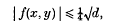
and, more recently, Davenport has shown that this theorem can be sharpened for certain special f, for instance that it is always possible to satisfy

A form of wave propagation associated with the equation of heat conduction
-
- Journal:
- Mathematical Proceedings of the Cambridge Philosophical Society / Volume 44 / Issue 4 / October 1948
- Published online by Cambridge University Press:
- 24 October 2008, pp. 591-594
- Print publication:
- October 1948
-
- Article
- Export citation
The Magnetic Compass: A Survey of Developments
-
- Journal:
- The Journal of Navigation / Volume 1 / Issue 4 / October 1948
- Published online by Cambridge University Press:
- 18 January 2010, pp. 342-353
- Print publication:
- October 1948
-
- Article
- Export citation
The dissection of equilateral triangles into equilateral triangles
-
- Journal:
- Mathematical Proceedings of the Cambridge Philosophical Society / Volume 44 / Issue 4 / October 1948
- Published online by Cambridge University Press:
- 24 October 2008, pp. 463-482
- Print publication:
- October 1948
-
- Article
- Export citation
PSP volume 44 issue 4 Cover and Front matter
-
- Journal:
- Mathematical Proceedings of the Cambridge Philosophical Society / Volume 44 / Issue 4 / October 1948
- Published online by Cambridge University Press:
- 24 October 2008, pp. f1-f2
- Print publication:
- October 1948
-
- Article
-
- You have access
- Export citation
NAV volume 1 issue 4 Front matter
-
- Journal:
- The Journal of Navigation / Volume 1 / Issue 4 / October 1948
- Published online by Cambridge University Press:
- 18 January 2010, pp. f1-f4
- Print publication:
- October 1948
-
- Article
-
- You have access
- Export citation
II.—Tables for the Reduction of Astronomical Sights
-
- Journal:
- The Journal of Navigation / Volume 1 / Issue 4 / October 1948
- Published online by Cambridge University Press:
- 18 January 2010, pp. 298-306
- Print publication:
- October 1948
-
- Article
- Export citation
The ‘thick-film chamber’ method for the measurement of fast neutron flux
-
- Journal:
- Mathematical Proceedings of the Cambridge Philosophical Society / Volume 44 / Issue 4 / October 1948
- Published online by Cambridge University Press:
- 24 October 2008, pp. 581-587
- Print publication:
- October 1948
-
- Article
- Export citation
The cambridge philosophical society statement of accounts for the year ending 31 july 1947
-
- Journal:
- Mathematical Proceedings of the Cambridge Philosophical Society / Volume 44 / Issue 4 / October 1948
- Published online by Cambridge University Press:
- 24 October 2008, pp. 605-606
- Print publication:
- October 1948
-
- Article
- Export citation
A note on the use of weighted orthogonal functions in statistical analysis
-
- Journal:
- Mathematical Proceedings of the Cambridge Philosophical Society / Volume 44 / Issue 4 / October 1948
- Published online by Cambridge University Press:
- 24 October 2008, pp. 588-590
- Print publication:
- October 1948
-
- Article
- Export citation
Collisions through liquid films
-
- Journal:
- Mathematical Proceedings of the Cambridge Philosophical Society / Volume 44 / Issue 4 / October 1948
- Published online by Cambridge University Press:
- 24 October 2008, pp. 566-580
- Print publication:
- October 1948
-
- Article
- Export citation
The thermodynamics of magnetization
-
- Journal:
- Mathematical Proceedings of the Cambridge Philosophical Society / Volume 44 / Issue 4 / October 1948
- Published online by Cambridge University Press:
- 24 October 2008, pp. 534-545
- Print publication:
- October 1948
-
- Article
- Export citation
III.—Institute Comment
-
- Journal:
- The Journal of Navigation / Volume 1 / Issue 4 / October 1948
- Published online by Cambridge University Press:
- 18 January 2010, pp. 306-312
- Print publication:
- October 1948
-
- Article
- Export citation
Annual Dinner 1948
-
- Journal:
- The Journal of Navigation / Volume 1 / Issue 4 / October 1948
- Published online by Cambridge University Press:
- 18 January 2010, p. 367
- Print publication:
- October 1948
-
- Article
- Export citation
A statistical theory of cascade multiplication*
-
- Journal:
- Mathematical Proceedings of the Cambridge Philosophical Society / Volume 44 / Issue 3 / July 1948
- Published online by Cambridge University Press:
- 24 October 2008, pp. 404-412
- Print publication:
- July 1948
-
- Article
- Export citation
The Range and Accuracy of Consol
-
- Journal:
- The Journal of Navigation / Volume 1 / Issue 3 / July 1948
- Published online by Cambridge University Press:
- 18 January 2010, pp. 241-255
- Print publication:
- July 1948
-
- Article
- Export citation
