To save content items to your account,
please confirm that you agree to abide by our usage policies.
If this is the first time you use this feature, you will be asked to authorise Cambridge Core to connect with your account.
Find out more about saving content to .
To save content items to your Kindle, first ensure no-reply@cambridge.org
is added to your Approved Personal Document E-mail List under your Personal Document Settings
on the Manage Your Content and Devices page of your Amazon account. Then enter the ‘name’ part
of your Kindle email address below.
Find out more about saving to your Kindle.
Note you can select to save to either the @free.kindle.com or @kindle.com variations.
‘@free.kindle.com’ emails are free but can only be saved to your device when it is connected to wi-fi.
‘@kindle.com’ emails can be delivered even when you are not connected to wi-fi, but note that service fees apply.
A method of obtaining aircraft altitude to within 50 feet at altitudes of 10,000 to 20,000 feet is described. This accuracy is necessary in a few special cases. The method consists of determining the height of a pressure level at some convenient point by radar or other means, and then calculating from a knowledge of the wind vector the change of height of this pressure level between the check point and the point at which an accurate altitude is required. The limitations of alternative methods of height finding, such as the use of an aneroid altimeter corrected for temperature at the upper level, are discussed.
For most purposes the aircraft type aneroid altimeter gives a sufficiently accurate indication of height, provided corrections are made for the temperature at flight level. In the application of radar to topographical surveying, however, it is necessary to know the altitude of the aircraft used in the measurement to within 50 feet when flying at heights of 10,000 to 20,000 feet. This can be achieved only by special techniques. The method here outlined has been used extensively during investigations into the use of radar for surveying. It is simple and appears to give satisfactory results.
This paper is confined to a non-technical survey of the particular application of radar to the maintenance of a fast schedule of ferry vessels operating across a busy tidal river. After some seventeen months' practical experience of this application it is possible to give some opinions of the value of radar as a commercial aid to navigation.
Wallasey Ferries operates a twenty-four hour service between Wallasey and Liverpool, and carries some twenty million passengers per annum.
At the request of the Ministry of Transport and the Humber Conservancy Board, a visit was made to the River Humber in H.M.S. Fleetwood to determine whether the navigational marks at present in use would be suitable for pilotage of the river in poor visibility by a ship fitted with a U.K. radar.
1. When crystals of a metal are highly perfect, their elastic limit is low, plastic flow taking place when the applied shear stress is very small. The elastic limit reaches higher values as the perfect structure is progressively broken up by cold-work. A steady state is finally reached where further distortion of the metal does not increase the elastic limit. The stress at which a metal passes beyond the elastic limit and begins to yield is ill-defined, as in general the crystal begins to ‘creep’ appreciably near this point and the time element enters into the definition of the stress-strain curve. Nevertheless, there is a fairly well-defined stress beyond which a metal, which has been brought into a steady state by being saturated with cold-work, ceases to behave elastically and undergoes permanent deformation. An attempt is made in this paper to derive an expression for the ultimate elastic limit or yield stress of a cold-worked metal, in terms of its structure and elastic constants.
1. The problem in question is to find a necessary and sufficient condition which numbers co, …, cm must satisfy in order that there shall be a non-decreasing function σ(t) such that
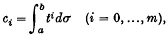
where (a, b) is an unbounded interval. (When (a, b) is a bounded interval, the problem has been solved. See Achyèser and Krein, Communications de la Société Mathématique de Kharkoff, Série 4, 12 (1935), 13–35, Satz C.)
Prior to the outbreak of war in 1939, flight planning procedure was not generally practised in civil aviation operations except in a few outstanding cases. Such operations as the Imperial Airways transatlantic flying boat flights called for the careful compilation of a flight plan in order that an indication of the flight time could be obtained. Since the range of these boats did not provide for any very great reserve, the flight plan was obviously an essential part of the preparation for the flight. In the case of a few shorter range operations, flight planning was also carried out to a certain extent: one operator, for instance, adopted a procedure whereby departures and arrivals were made to a schedule, and the aircraft operated so as to comply with this schedule. The increase in the length of route stages and the need for more technical operation of aircraft from the economic point of view indicated the need for more general use of serious flight planning, and it is now well established that flight planning is essential to the safe and efficient operation of flights of all kinds.
The special features of polar navigation are examined with a view to the design of tables for astronomical navigation in polar regions. The use of long intercepts and curved position lines is thoroughly investigated. It is shown that considerable economy of presentation can be achieved; as an example, a one-page table covering all bodies and both polar caps is given. Making the fullest use of polar astronomy, samples are given of permanent tables for the Sun and stars independent of the Air Almana.
The following critical review of tabular methods for astronomical polar navigation was written originally as a comment on a proposal to extend the Astronomical Navigation Tables (at present limited to latitudes between S. 79° and N. 79°) to the poles. Although it has been slightly amended, it has not been entirely recast and it therefore still retains some of the ‘thinking on paper’ of the original version. So far as is known the tables proposed are new, but there is clearly no great originality involved.
We shall first give some definitions concerning parametric surfaces. Denote by H a closed circle (disk) and by M a variable point on it. Let P = Ф(M) be a continuous function on H whose value P is a point in three-dimensional space. The symbols Ф(E), Ф−1(P), where E is a set of points on H and P a point in the three-dimensional space, will have their usual meaning. Ф−1(P) is a closed set. Any saturated continuum in Ф−1(P) or any point of Ф−1(P) that does not belong to such continua is called a Ф-element of H. Thus to any continuous function Ф(M) corresponds a representation of H in the form of the sum σQ of Ф-elements. The set of the pairs (P, Q), where Q runs through all Ф-elements of H and, for any Q, P = Ф(Q), is called a parametric surface, and any pair (P, Q) is called a point of the parametric surface. We shall often speak of a point Ф(M) of the parametric surface, by which we shall mean either the point (P, Q), where P = Ф(M) and Q is the Ф-element containing M, or the point P = Ф(M) of the three-dimensional space. The exact meaning will always be clear from the context. If there are exactly k points of the parametric surface whose first member is P0 we say that P0 is a point of multiplicity k. If k = 1, P0 is a simple point.
When designing the periscopic sextant now coming into production it was realized that the conditions in the pressurized aircraft for which this sextant was designed differed sufficiently from those previously experienced to make it worth while reconsidering what methods would be most applicable to the new combination of pressurized aircraft and periscopic sextant.
The conditions differ from previous experience in providing (a) a higher speed; (b) very little, if any, direct view of the sky by the navigator.
The determinantal quartic primal in [4], represented on [3] by quartic surfaces passing through a decimic curve of genus eleven, has already been the subject of a number of papers. The primal for which the base curve is a general curve C10 has twenty nodes, mapped by the twenty quadrisecant lines of the curve. If the C10 breaks up into a number of curves of lower order, the primal has, in addition, other nodes, mapped by the neighbourhoods of the intersections of two simple branches of the base curve. When the C10 consists of ten lines, having twenty mutual intersections to preserve the virtual genus eleven, the primal has forty nodes; the two primals of this type which contain no planes are the subject of a paper by Todd (3). Further specialization of the ten lines, giving more additional nodes, is possible; it has been shown in another paper (Todd (4)) that there is a quartic primal with forty-five nodes (the maximum number) which is determinantal. The figure in [3] formed by the base curve is described there; for a description of the configuration formed by the nodes in [4], and many other interesting properties of this primal, the reader is referred to two recent works (Baker (1) and Todd (5)). Further details about the general quartic primal, and references to a number of special cases, may be found in Room (2), chapters XV and XVI.
The calculation and publication of the errors in measured altitudes due to tilt of the sextant serve a useful purpose in impressing users more strongly with the need for care than does the unbacked advice to rock the sextant always given in the text-books, and also in indicating that carelessness carries greater penalties the greater the altitude. The work once done is done for ever, so we may as well get the sum right.
1. Introduction. A considerable amount of attention has been paid to the problem of determining the conditions which decide whether a liquid heated from below is stable or unstable. The motion consequent upon the disturbance of an unstable ideal gas does not, however, seem to have been treated so far, and this problem forms the subject of the present paper. Heat conduction and viscosity are at first neglected, and we are therefore dealing with the small motions of a gas slightly disturbed from a position of equilibrium under the influence of gravity. The condition for the stability of such a gas is well known, namely, the temperature gradient must be less than the adiabatic gradient. Furthermore, it is known that there is a sharp distinction between slow large-scale (meteorological) and rapidly varying small-scale (acoustical) phenomena. The present paper confirms these points and derives the time scale of meteorological phenomena. Heat conduction and viscosity are then shown to set a lower limit to the dimensions of such disturbances, while the effect of the earth's rotation is shown to be negligible.
An attempt is made to interpret quantum mechanics as a statistical theory, or more exactly as a form of non-deterministic statistical dynamics. The paper falls into three parts. In the first, the distribution functions of the complete set of dynamical variables specifying a mechanical system (phase-space distributions), which are fundamental in any form of statistical dynamics, are expressed in terms of the wave vectors of quantum theory. This is shown to be equivalent to specifying a theory of functions of non-commuting operators, and may hence be considered as an interpretation of quantum kinematics. In the second part, the laws governing the transformation with time of these phase-space distributions are derived from the equations of motion of quantum dynamics and found to be of the required form for a dynamical stochastic process. It is shown that these phase-space transformation equations can be used as an alternative to the Schrödinger equation in the solution of quantum mechanical problems, such as the evolution with time of wave packets, collision problems and the calculation of transition probabilities in perturbed systems; an approximation method is derived for this purpose. The third part, quantum statistics, deals with the phase-space distribution of members of large assemblies, with a view to applications of quantum mechanics to kinetic theories of matter. Finally, the limitations of the theory, its uniqueness and the possibilities of experimental verification are discussed.
The quartz clock has made possible a notable improvement in the precision of timekeeping, with the additional advantage of providing a standard of frequency as well. This is perhaps putting the cart before the horse, for the quartz crystal oscillator was developed in the first instance as a precision standard of frequency; it was then adapted, by frequency subdivision and the use of a low frequency output for driving a phonic motor from which seconds impulses could be taken, to serve as a clock. It is primarily from its use as a standard of frequency that it is of navigational interest, for various radio aids to navigation, such as Gee, Loran, Consol and Decca depend upon accurately standardized frequencies. For the satisfactory checking of a frequency, comparison must be made with a standard whose accuracy is at least one degree higher than that of the frequency which has to be checked. Calibration laboratories, in turn, require to check their own standards. As the rotation of the Earth provides our fundamental unit of time, it follows that time, and therefore also frequency, must be determined from astronomical observations; hence it is necessarily the responsibility of the Royal Greenwich Observatory to provide both time and frequency with an accuracy sufficient for all practical requirements. The practical requirements have become more stringent in recent years, and that is why great efforts have been made to improve the precision of time determination and of timekeeping at the Observatory.
