Refine search
Actions for selected content:
26208 results in Theoretical Physics and Mathematical Physics
Random associations on a lattice
-
- Journal:
- Mathematical Proceedings of the Cambridge Philosophical Society / Volume 45 / Issue 3 / July 1949
- Published online by Cambridge University Press:
- 24 October 2008, p. 488
- Print publication:
- July 1949
-
- Article
-
- You have access
- Export citation
A note on podolsky electrodynamics
-
- Journal:
- Mathematical Proceedings of the Cambridge Philosophical Society / Volume 45 / Issue 3 / July 1949
- Published online by Cambridge University Press:
- 24 October 2008, pp. 441-451
- Print publication:
- July 1949
-
- Article
- Export citation
On the steady motion of viscous liquid in a corner
-
- Journal:
- Mathematical Proceedings of the Cambridge Philosophical Society / Volume 45 / Issue 3 / July 1949
- Published online by Cambridge University Press:
- 24 October 2008, pp. 389-394
- Print publication:
- July 1949
-
- Article
- Export citation
Centre Belge de Navigation
-
- Journal:
- The Journal of Navigation / Volume 2 / Issue 3 / July 1949
- Published online by Cambridge University Press:
- 18 January 2010, pp. 267-268
- Print publication:
- July 1949
-
- Article
- Export citation
Jet Streams and their Importance to Air Navigation
-
- Journal:
- The Journal of Navigation / Volume 2 / Issue 3 / July 1949
- Published online by Cambridge University Press:
- 18 January 2010, pp. 210-221
- Print publication:
- July 1949
-
- Article
- Export citation
The thermodynamics of magnetization
-
- Journal:
- Mathematical Proceedings of the Cambridge Philosophical Society / Volume 45 / Issue 3 / July 1949
- Published online by Cambridge University Press:
- 24 October 2008, p. 476
- Print publication:
- July 1949
-
- Article
- Export citation
-
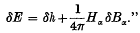
A paper under the above title (1) by G. H. Livens was published recently in this journal. The main object of this paper appears to be to show that the treatment of the same subject (2) by myself is unsound. I shall not attempt to refute Professor Livens's opinions. His views concerning magnetic energy have already been criticized by others (3) more expert than myself. I merely wish to draw attention to two completely untrue statements of fact in Professor Livens's paper, namely the following:
(a) On p. 538 “Guggenheim writes therefore
Local Organization
-
- Journal:
- The Journal of Navigation / Volume 2 / Issue 3 / July 1949
- Published online by Cambridge University Press:
- 18 January 2010, p. 266
- Print publication:
- July 1949
-
- Article
- Export citation
The American Institute
-
- Journal:
- The Journal of Navigation / Volume 2 / Issue 3 / July 1949
- Published online by Cambridge University Press:
- 18 January 2010, pp. 266-267
- Print publication:
- July 1949
-
- Article
- Export citation
An integral equation for Whittaker's confluent hypergeometric function
-
- Journal:
- Mathematical Proceedings of the Cambridge Philosophical Society / Volume 45 / Issue 3 / July 1949
- Published online by Cambridge University Press:
- 24 October 2008, pp. 482-483
- Print publication:
- July 1949
-
- Article
- Export citation
Weather Ships Agreement
-
- Journal:
- The Journal of Navigation / Volume 2 / Issue 3 / July 1949
- Published online by Cambridge University Press:
- 18 January 2010, p. 268
- Print publication:
- July 1949
-
- Article
- Export citation
PSP volume 45 issue 3 Cover and Front matter
-
- Journal:
- Mathematical Proceedings of the Cambridge Philosophical Society / Volume 45 / Issue 3 / July 1949
- Published online by Cambridge University Press:
- 24 October 2008, pp. f1-f2
- Print publication:
- July 1949
-
- Article
-
- You have access
- Export citation
Note on a theorem of R. Baer
-
- Journal:
- Mathematical Proceedings of the Cambridge Philosophical Society / Volume 45 / Issue 3 / July 1949
- Published online by Cambridge University Press:
- 24 October 2008, pp. 321-327
- Print publication:
- July 1949
-
- Article
- Export citation
The problem of a rotating incompressible disk
-
- Journal:
- Mathematical Proceedings of the Cambridge Philosophical Society / Volume 45 / Issue 3 / July 1949
- Published online by Cambridge University Press:
- 24 October 2008, pp. 405-410
- Print publication:
- July 1949
-
- Article
- Export citation
-
In this paper an investigation is made of the properties of material which is under isotropic stress p when in a strained state, and is such that the relation between the stress and the dilatation Δ is

where α is the density, assumed constant in the unstrained state, and c is the velocity of light. It is shown that in this material the waves of dilatation travel with the velocity of light and that a disk or cylinder composed of this kind of matter suffers no change in radius when it is made to rotate.
It is suggested that it is not unreasonable to attach the label incompressible to matter having these properties.
The Navigator's Problem in Aerial Survey
-
- Journal:
- The Journal of Navigation / Volume 2 / Issue 3 / July 1949
- Published online by Cambridge University Press:
- 18 January 2010, pp. 222-226
- Print publication:
- July 1949
-
- Article
- Export citation
A Radar Instruction Vessel
-
- Journal:
- The Journal of Navigation / Volume 2 / Issue 3 / July 1949
- Published online by Cambridge University Press:
- 18 January 2010, p. 268
- Print publication:
- July 1949
-
- Article
- Export citation
Standardization of Navigation Instruments
-
- Journal:
- The Journal of Navigation / Volume 2 / Issue 3 / July 1949
- Published online by Cambridge University Press:
- 18 January 2010, p. 267
- Print publication:
- July 1949
-
- Article
- Export citation
Some new methods for the numerical integration of ordinary differential equations
-
- Journal:
- Mathematical Proceedings of the Cambridge Philosophical Society / Volume 45 / Issue 3 / July 1949
- Published online by Cambridge University Press:
- 24 October 2008, pp. 373-388
- Print publication:
- July 1949
-
- Article
- Export citation
The interaction between floating particles
-
- Journal:
- Mathematical Proceedings of the Cambridge Philosophical Society / Volume 45 / Issue 2 / April 1949
- Published online by Cambridge University Press:
- 24 October 2008, pp. 288-295
- Print publication:
- April 1949
-
- Article
- Export citation
The Bose-Einstein statistics of particles, with special reference to the case of low temperatures
-
- Journal:
- Mathematical Proceedings of the Cambridge Philosophical Society / Volume 45 / Issue 2 / April 1949
- Published online by Cambridge University Press:
- 24 October 2008, pp. 275-287
- Print publication:
- April 1949
-
- Article
- Export citation
-
In this paper, it has been shown that the usual demonstrations of the phenomenon of Bose-Einstein condensation are invalid. Exact formal solutions have been derived for the partition functions and the mean occupation numbers in classical and Bose statistics, and the theory of fluctuations in the case of Bose statistics has been given.
In a second paper, convenient approximations will be derived for the mean occupation numbers in Bose statistics, and it will be shown that for temperatures well above the critical temperature of the supposed Bose-Einstein condensation the well-known result
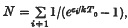
 for the mean occupation numbers is valid, whilst for temperatures rather lower than this critical value it will be shown that particles will condense into the lowest available state. The critical temperature T0 is given by
  where the summation is over all energy levels except the lowest.
 for the mean occupation numbers is valid, whilst for temperatures rather lower than this critical value it will be shown that particles will condense into the lowest available state. The critical temperature
  where the summation is over all energy levels except the lowest.
Some calculations on the γ-ray dose produced by a 14 Mev. betasynchrotron using an internal target
-
- Journal:
- Mathematical Proceedings of the Cambridge Philosophical Society / Volume 45 / Issue 2 / April 1949
- Published online by Cambridge University Press:
- 24 October 2008, pp. 305-310
- Print publication:
- April 1949
-
- Article
- Export citation
