Refine search
Actions for selected content:
26208 results in Theoretical Physics and Mathematical Physics
Hyperbolic Projections
-
- Journal:
- The Journal of Navigation / Volume 2 / Issue 3 / July 1949
- Published online by Cambridge University Press:
- 18 January 2010, pp. 227-229
- Print publication:
- July 1949
-
- Article
- Export citation
Ionic hydration
-
- Journal:
- Mathematical Proceedings of the Cambridge Philosophical Society / Volume 45 / Issue 3 / July 1949
- Published online by Cambridge University Press:
- 24 October 2008, pp. 477-481
- Print publication:
- July 1949
-
- Article
- Export citation
The cardinal series in Hilbert space
-
- Journal:
- Mathematical Proceedings of the Cambridge Philosophical Society / Volume 45 / Issue 3 / July 1949
- Published online by Cambridge University Press:
- 24 October 2008, pp. 335-341
- Print publication:
- July 1949
-
- Article
- Export citation
-
The name ‘cardinal function’ was given to

by E. T. Whittaker (1), who considered it as a ‘smooth’ approximation to a function f(x), having the same values as f(x) at the points a + rw (r = 0, ± 1, ± 2, …). It has since been extensively studied (2), mainly from the point of view of interpolation theory. Hardy (3), however, observed that the functions νr(t) defined by
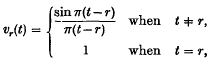
form a normal orthogonal set on the interval (−∞, ∞), for r = 0, ± 1, ± 2, …. This fact suggests a discussion of the cardinal series from the point of view of mean-square approximation.
Equivalent Head Winds on Air Routes
-
- Journal:
- The Journal of Navigation / Volume 2 / Issue 3 / July 1949
- Published online by Cambridge University Press:
- 18 January 2010, pp. 195-209
- Print publication:
- July 1949
-
- Article
- Export citation
Collisions through liquid layers
-
- Journal:
- Mathematical Proceedings of the Cambridge Philosophical Society / Volume 45 / Issue 3 / July 1949
- Published online by Cambridge University Press:
- 24 October 2008, p. 488
- Print publication:
- July 1949
-
- Article
-
- You have access
- Export citation
-
The initial collision (see pp. 571–2). The instantaneous velocity change of the hammer (from V0 to V) when it first strikes the liquid film should be calculated from energy and not momentum considerations, since the hammer has momentum in the vertical direction whilst the liquid is expressed in a horizontal direction and its total momentum is, by symmetry, zero at every instant. The kinetic energy dE of an annulus of liquid of radius r will be ½mc2, where m = 2πrhρdr, and c, the radial velocity of flow, is ½rV/h, since the liquid starts moving in plug flow. Integrating from r = 0 to r = R, we find that the total kinetic energy E imparted to the liquid film is
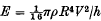 . Assuming that extraneous energy losses, including any energy imparted to the anvil, are negligible, we may equate this to the energy loss of the hammer
  . Hence
To a first approximation this yields

The term at the right-hand side of the denominator is one-half that given in the original derivation (equation (20)), so that the instantaneous decrease in the velocity of the hammer is even less marked. For the given case where M = 400g., R = 1 cm., ρ = 1.6 and h = 5 × 10⁻² cm., the velocity decrease is less than 2%.
Vol. 44 (1948), pp. 566–80.
 . Assuming that extraneous energy losses, including any energy imparted to the anvil, are negligible, we may equate this to the energy loss of the hammer
  . Hence
NAV Volume 2 issue 3 Back Matter
-
- Journal:
- The Journal of Navigation / Volume 2 / Issue 3 / July 1949
- Published online by Cambridge University Press:
- 18 January 2010, p. b1
- Print publication:
- July 1949
-
- Article
-
- You have access
- Export citation
The Argentine Nautical Almanac - Almanaque Nautico for the year 1949, prepared by the Observatorio Naval and published by the Ministerio de Marina of the Republica Argentina. 9½ × 8 ins.; 372 pp. + star chart + book-mark + printed end papers; price 8 dollars.
-
- Journal:
- The Journal of Navigation / Volume 2 / Issue 3 / July 1949
- Published online by Cambridge University Press:
- 18 January 2010, pp. 269-271
- Print publication:
- July 1949
-
- Article
- Export citation
The Birth of the Compass
-
- Journal:
- The Journal of Navigation / Volume 2 / Issue 3 / July 1949
- Published online by Cambridge University Press:
- 18 January 2010, pp. 259-263
- Print publication:
- July 1949
-
- Article
- Export citation
Radar Leading Patterns
-
- Journal:
- The Journal of Navigation / Volume 2 / Issue 3 / July 1949
- Published online by Cambridge University Press:
- 18 January 2010, p. 258
- Print publication:
- July 1949
-
- Article
- Export citation
Note on the geometrical optics of diffracted wave fronts
-
- Journal:
- Mathematical Proceedings of the Cambridge Philosophical Society / Volume 45 / Issue 3 / July 1949
- Published online by Cambridge University Press:
- 24 October 2008, pp. 395-404
- Print publication:
- July 1949
-
- Article
- Export citation
-
It is well known that a solution of the wave equation

for which u = ∂u/∂t = 0 initially outside a surface S0, vanishes at time t in the exterior of a surface St parallel to, and at normal distance ct from S0, so that the wave fronts of disturbances represented by the solutions of the wave equation obey the laws of geometrical optics. Analogous results hold for the solutions of any linear hyperbolic second-order partial differential equation with boundary value conditions of the ‘Cauchy’ type. But the wave fronts of solutions of problems in which some of the boundary conditions are of the type representing reflexion do not seem to have been treated, and in particular the case of diffraction, when there is a ‘shadow’, does not seem to have been considered at all.

Precomputed Altitudes
-
- Journal:
- The Journal of Navigation / Volume 2 / Issue 3 / July 1949
- Published online by Cambridge University Press:
- 18 January 2010, pp. 264-265
- Print publication:
- July 1949
-
- Article
- Export citation
I.C.A.O. African-Indian Ocean Region
-
- Journal:
- The Journal of Navigation / Volume 2 / Issue 3 / July 1949
- Published online by Cambridge University Press:
- 18 January 2010, p. 268
- Print publication:
- July 1949
-
- Article
- Export citation
The Compton scattering by particles possessing charge and dipole moment
-
- Journal:
- Mathematical Proceedings of the Cambridge Philosophical Society / Volume 45 / Issue 3 / July 1949
- Published online by Cambridge University Press:
- 24 October 2008, pp. 411-428
- Print publication:
- July 1949
-
- Article
- Export citation
On the theory of statistical procedures
-
- Journal:
- Mathematical Proceedings of the Cambridge Philosophical Society / Volume 45 / Issue 3 / July 1949
- Published online by Cambridge University Press:
- 24 October 2008, pp. 354-359
- Print publication:
- July 1949
-
- Article
- Export citation
The interaction of point particles with charged fields
-
- Journal:
- Mathematical Proceedings of the Cambridge Philosophical Society / Volume 45 / Issue 3 / July 1949
- Published online by Cambridge University Press:
- 24 October 2008, pp. 429-440
- Print publication:
- July 1949
-
- Article
- Export citation
On the quantum-mechanical treatment of the optics of crystal lattices
-
- Journal:
- Mathematical Proceedings of the Cambridge Philosophical Society / Volume 45 / Issue 3 / July 1949
- Published online by Cambridge University Press:
- 24 October 2008, pp. 452-462
- Print publication:
- July 1949
-
- Article
- Export citation
Magnetic Compass Problems— A Fresh Approach
-
- Journal:
- The Journal of Navigation / Volume 2 / Issue 3 / July 1949
- Published online by Cambridge University Press:
- 18 January 2010, pp. 230-242
- Print publication:
- July 1949
-
- Article
- Export citation
A note on the algebra of S-functions
-
- Journal:
- Mathematical Proceedings of the Cambridge Philosophical Society / Volume 45 / Issue 3 / July 1949
- Published online by Cambridge University Press:
- 24 October 2008, pp. 328-334
- Print publication:
- July 1949
-
- Article
- Export citation
Point-curve correspondences: III. Correspondences on a single surface
-
- Journal:
- Mathematical Proceedings of the Cambridge Philosophical Society / Volume 45 / Issue 3 / July 1949
- Published online by Cambridge University Press:
- 24 October 2008, pp. 342-353
- Print publication:
- July 1949
-
- Article
- Export citation
NAV Volume 2 issue 3 Front matter
-
- Journal:
- The Journal of Navigation / Volume 2 / Issue 3 / July 1949
- Published online by Cambridge University Press:
- 18 January 2010, pp. f1-f4
- Print publication:
- July 1949
-
- Article
-
- You have access
- Export citation
