To save content items to your account,
please confirm that you agree to abide by our usage policies.
If this is the first time you use this feature, you will be asked to authorise Cambridge Core to connect with your account.
Find out more about saving content to .
To save content items to your Kindle, first ensure no-reply@cambridge.org
is added to your Approved Personal Document E-mail List under your Personal Document Settings
on the Manage Your Content and Devices page of your Amazon account. Then enter the ‘name’ part
of your Kindle email address below.
Find out more about saving to your Kindle.
Note you can select to save to either the @free.kindle.com or @kindle.com variations.
‘@free.kindle.com’ emails are free but can only be saved to your device when it is connected to wi-fi.
‘@kindle.com’ emails can be delivered even when you are not connected to wi-fi, but note that service fees apply.
This chapter offers a brief overview of the history of operetta in Russia, starting with performances and reception of German and French operettas from the eighteenth to the twentieth century, and exploring home-grown, Soviet operetta. It will show that operetta was big business in tsarist Russia, and later in the Soviet Union, and demonstrate that it was a valuable resource, a laughter therapy, for the Soviet authorities with which to anaesthetize the masses to the realities of life. The works by German and French composers dominated Russian operetta stages, with the most popular composers being Suppé, Offenbach, Planquette, Hervé and Lecocq, until Soviet composers began to create operettas according to the new, official socialist realism style. This chapter will briefly introduce significant operetta composers – Dunayevsky, Strelnikov, Aleksandrov and Milyutin – and discuss contributions to the genre from such well-known composers as Shostakovich and Kabalevsky. It also gives a brief account of how operetta was instrumental to boosting the morale of the population ravaged by World War II, especially in blockaded Leningrad, and shows that operetta (both European and Soviet) is still popular in today’s Russia.
During the long nineteenth century, the Nordic countries witnessed economic growth, the industrial revolution and the prominent expansion of the bourgeois classes. The growing need for entertainment explains the popularity and increase in production of operettas from the 1850s onwards. Jacques Offenbach and his satirical operettas enjoyed success in Copenhagen at the Folketeatret. During the great Lehár craze, Danish performers toured Scandinavian cities. By the 1870s, Christiania (now Oslo) in Norway also had an operetta epidemic, and new venues opened for the active Danish and Swedish companies and some domestic initiatives. The first production of Offenbach’s Orfeus i underjorden in Stockholm was staged by Pierre Deland in 1860. An elegant new venue, the Oscarsteatern (built in 1906) had its first major success with Lehár’s Den glada änkan in 1907. A Swedish Theatre was erected in Helsinki 1860 and opened with Deland’s production of Orfeus i underjorden. Helsinki also accommodated Russian officers and their families, who found entertainment first in the Arkadia-theatre, where several Russian-language operetta productions were given. Operettas in Finnish found their best home at the Kansan Näyttämö (People’s Stage) founded in 1907 in Helsinki.
This introduction serves as an overview of the development of operetta and points to the neglect of operetta by many scholars of music and theatre. The editors begin by defining this genre, which is multi-faceted and often difficult to categorize. The introduction sets the stage for the following chapters by guiding the reader towards the important landmarks in the historical developments of operetta, such as those that occurred in France, Austria and London, and, in the twentieth century, in Berlin. In doing so, it also comments on notable composers and works. It concludes with some reflections on operetta reception in the twenty-first century.
Operettas and their creation have long been considered a system of standardized production. This chapter examines the ‘operetta industry’ as it developed in Vienna around 1900 with a focus on theatrical production practice and the ways it shaped the genre’s artistic development. Sources include librettos, periodicals, archival sources and Operettenkönige, a backstage operetta novel of unknown authorship, published in 1911. Vienna’s operetta circle was a self-contained, vertically integrated system which controlled all aspects of operetta composition and production, from the mentorship of young composers to press reception and the publication and export of successful works. Critics saw this regulation as an impediment to artistic innovation, but to insiders the high level of control was necessary to set genre conventions. For them, innovation belonged in the small-scale, self-conscious manipulation of these norms. While lucrative and popular, the industry did not often easily respond to large-scale change, and eventually became so highly leveraged that a single unsuccessful season could put a major theatre out of business. As operetta declined in favour of the revue and film, the industry disintegrated.
This chapter will show that although Warsaw is not a city readily associated with the global success of operetta, it was the place where operetta performances were not only popular but lucrative, and that they rivalled Vienna and Berlin with the quality of their productions and star-studded casts. Before World War I, operetta had no competition in Warsaw: it had publicity, stars, excellent productions, stunning stage sets and the latest lighting and stage equipment. Polish musicians, actors and directors had direct links with European theatres, and Warsaw was close to such operetta centres as Vienna, Berlin and Budapest. Warsaw operetta divas were celebrities adored by the public and critics alike. Some of them died leaving astronomical fortunes and lasting memories and recordings, some died tragically, and some died in complete oblivion. The chapter will look at the most significant operetta theatre not only in Warsaw but arguably in the whole of Poland, Teatr Nowosci, and some of the people who made it one of the city’s biggest attractions: Ludwik Sliwinski, Wiktoria Kawecka, Kazimira Niewiarowska, Jósef Redo and Lycina Messal.
Four prominent ‘origin stories’ for the American musical intertwine with the history of American operetta, which bifurcated, through the American legacies of Gilbert and Sullivan (including Cohan’s musical comedies) and The Merry Widow, into two distinct types: fast-paced musical comedies with an American profile, and the more romantically tinged, Viennese-derived American operetta. In balancing elements of these types, the American musical stage fostered camp reception modes, overtly emergent especially in Naughty Marietta, but becoming more closeted in the 1920s, when the two types again reached an extreme point of separation, with Gershwin’s and other musical comedies on one side of the divide, and Romberg’s and Friml’s hit operettas (along with Deep River), on the other, with operetta (or the ‘musical play’) bolstered by Hammerstein’s rhetoric laying claim to the higher aesthetic ground. Show Boat marked a probably deliberate attempt to remix and fuse the two types in a hybrid form that eventually stabilized in the wake of Oklahoma! Throughout, the element of camp, often passing as unintentional, governed the negotiations between the two types, allowing them to coexist in the musical play as it (re)emerged in the 1940s.
The history of operetta in Italy is inextricably entangled with discourses about the status of Italian opera and the formation of an Italian national identity. In the 1860s, it was Offenbach, Hervé and Lecocq that conquered the Italian stages, then, later, the ‘Viennese’ imports of Suppé, Strauss Jr and Lehár. Italian operettas based on parodies of foreign works and combining elements of dialect and couleur locale flourished at this time but struggled to undermine both the foreign monopoly and the time-honoured tradition of opera buffa. The relationship between operetta and Italian opera – not only buffa but also seria – was central also to critical discourses about the rise of the Italian bourgeois, becoming closely intertwined with questions on the position of musical theatre between entertainment and art. Inevitably, discussions of operetta also took strong nationalistic undertones in a country that was struggling to find a unifying national identity and that recognized operetta as a foreign import that could contaminate opera or illegitimately undermine its primacy on Italian stages. The extraordinary success of La vedova allegra in Milan in 1907 and the growing political tensions between Italy and Austria-Hungary in ensuing years sparked new interest in the creation of a national operetta.
This chapter examines the work and significance of Offenbach in the field of French operetta. With the rise of Napoleon III in the 1850s, a combination of political optimism, renewed prosperity, an abundance of artistic talent and a cultural obsession with appearances made Paris the perfect environment for a new form of entertainment to appear and thrive – operetta. Pioneered by Hervé, it became an international sensation thanks to the creativity and determination of Jacques Offenbach, whose opéras bouffes remain the musical embodiments of France’s Second Empire. He composed and produced dozens of hits that took comic aim at the foibles of all levels of society, from beggars to the royal court. With France’s humiliating defeat in the Franco-Prussian War of 1870, the Parisian public briefly turned against the German-born Offenbach. But he found new success by composing light-hearted spectacles. Composer Charles Lecoq, whose career took off thanks to Offenbach, achieved a major success with La fille de Madame Angot. Lecoq and others continued to compose operettas for Parisian audiences, but none matched the popularity French operetta had enjoyed with Offenbach.
In the famous monologue from Act II scene 5 of Lully and Quinault's Armide (1686), the title character attempts to slay the sleeping hero Renaud but, overcome by his beauty, falls in love with him instead. As commentators have noted, the monologue departs from the opera's source material, Tasso's epic poem La Gerusalemme liberata (1581). In contrast to the placid scene recounted by Tasso in canto 14 of the original work, the libretto depicts Armide's transformation from enemy to lover as a moment of struggle and psychological doubt. While scholarship has generally credited Quinault with having recognised the dramatic potential of the encounter, this article argues for a broader contextualisation of the scene in seventeenth-century French artistic production. A review of the major translations and adaptations of Tasso's poem published in France before 1686 reveals that Quinault's libretto represents not a decisive break with the past but rather one contribution to a much broader tradition of literary and musical experimentation.
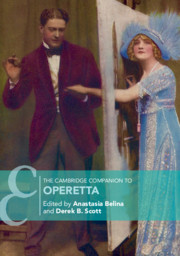
Those whose thoughts of musical theatre are dominated by the Broadway musical will find this book a revelation. From the 1850s to the early 1930s, when urban theatres sought to mount glamorous musical entertainment, it was to operetta that they turned. It was a form of musical theatre that crossed national borders with ease and was adored by audiences around the world. This collection of essays by an array of international scholars examines the key figures in operetta in many different countries. It offers a critical and historical study of the widespread production of operetta and of the enthusiasm with which it was welcomed. Furthermore, it challenges nationalistic views of music and approaches operetta as a cosmopolitan genre. This Cambridge Companion contributes to a widening appreciation of the music of operetta and a deepening knowledge of the cultural importance of operetta around the world.
When London's new Pantheon Opera opened in 1791, the artist Henry Tresham, not long returned from Italy, was paid to paint the ceiling and proscenium of the new auditorium and to provide a drop curtain. The curtain provided a focus for the new institution's aspirations and for the audience's attention on those inspirations when they arrived at the theatre. Its elaborate nature – the zodiac, the music of the spheres, ancient and modern composers, the passions, and with a centrepiece of the apotheosis of Pietro Metastasio – was the subject of a series articles in the press explaining the curtain's allegory. All visual material was thought to be lost, but the recent identification of a preparatory watercolour of the apotheosis has offered an opportunity to re-examine both its place in the context of late eighteenth-century iconography and the place of Metastasio in the late eighteenth-century London opera house.
In his autobiography, John Adams mused that his 2005 opera, Doctor Atomic, challenges directors and conductors owing to its ‘abstracted treatment’ of time and space. This abstraction also challenges scholars. In this article, I bring the cross-disciplinary field of sound studies into the opera house to demonstrate that Adams's obfuscation of operatic space–time is achieved primarily through the use of a spatialised electroacoustic sound design. Drawing on archival materials and new interviews with director Peter Sellars and sound designer Mark Grey, I outline the dramaturgical, epistemological and hermeneutic ramifications of sound design for opera studies and advocate for disciplinary engagement with the spatial dimensions of electroacoustic music generally, and within opera specifically.
Young Millie Dilmount arrives in New York City during the jazz age, shingles her hair and looks for a job with a rich, handsome boss she can marry. The musical-film Thoroughly Modern Millie (dir. George Roy Hill, Universal, 1967) may have been a spoof of the 1920s but various twists and turns in its plot nonetheless reveal its middlebrow scaffolding. Social aspiration is written into the plot, as is the ambiguity of its signifiers: although Millie (Julie Andrews) falls for the penniless Jimmy Smith (James Fox), she sets her sights on the seemingly more appropriate Trevor Graydon (John Gavin) only to discover that, of course, Jimmy was a millionaire all along. This is a narrative as much about cultural and social as financial capital. Through its ‘second-order parody’ of racial, ethnic and gender stereotypes, Angelo Pao argues, Thoroughly Modern Millie – along with other American musicals – ‘has played a significant role in the formation of a national persona’. The middlebrow, though, is not necessarily about identity politics, storylines or style; it is also closely bound with modes of dissemination and their relative costs and, because of that, with questions of class. Indeed, the Broadway musical was (and continues to be) a mainly middle-class affair, from its makers to its consumers, who David Savran points out have long needed ‘a good deal of disposable income’, given that ticket prices have always outstripped cinema, spoken theatre – and, on occasion, opera.
Active at the height of the apartheid regime, the Eoan Group treated South Africans to operas ‘in the true tradition of Italy’. The group relied on elaborate, naturalistic stage settings and the most stereotypical of operatic conventions to construct a hereditary link between itself and Italy, thus creating an alignment with the cultural ideal of Europe and its colonial representative – whiteness. This article offers a materialist reading of the Eoan Group's first operatic endeavour, La traviata in 1956, to argue that their invocation and emulation of the ‘Italian tradition’ served to situate them within a class-based discourse of racially inscribed civility. Drawing on archival records relating to props, costumes, advertisements and funding, it shows how the group constructed an imagined Italian heritage both to emphasise the quality of their productions, and to create an affinity with their white audiences. In this reading, the construction of an Italian operatic tradition functions not as a neutral aesthetic category, but as a historically situated politics of race and class.
It is now a historical commonplace that nineteenth-century operatic singing became generally louder and heavier over the course of the century. Early in the century, before the advent of singers such as Gilbert-Louis Duprez, tenors sang high notes with a light, mixed voice, sometimes even falsetto. Strikingly, while such singing was virtually eliminated from Italian opera by the end of the century, the vocal practice continued in certain cases in the French repertory, some of which were created with one particular tenor in mind, Jean-Alexandre Talazac (1851–1896). Talazac was praised for his unique ability to sing high notes both softly and loudly. This article investigates the physical practice of producing what pedagogues and critics have called voix mixte, an enigmatic timbre applied to moments of soft, high tenor singing. In exploring these moments of what I call ‘léger mode’, I suggest that, by singing high notes softly in a post-Duprez operatic world, tenors transcend stage gestures through their use of a formerly normative performance style to mark moments musically as representations of vocal and masculine vulnerability. The historical evidence also argues for a renewed focus on what soft tenor singing might do for opera today.
It seems historiographically implausible to ascribe the reputation of fin-de-siècle Lyon as France's Bayreuth to the impact of a single middle-ranking soprano, but the Danish singer Louise Janssen's long-term presence, galvanic musical influence and box-office value suggest precisely that conclusion. Part of the explanation lies with the diva-worship of her supporters (‘Janssenistes’), who curated her image both during her career and in her retirement to create an adopted musical heroine whose memory remains guarded by Lyon council policy. That image, selectively constructed from among her Wagner roles, also typecast her as a singer who had much in common with Symbolist art – a potential Mélisande that Lyon never saw. This article brings together archival and press materials to explain how a foreign-born singer's agency and mythification contributed to a double French naturalisation – her own, and that of Wagner(ism).