To save content items to your account,
please confirm that you agree to abide by our usage policies.
If this is the first time you use this feature, you will be asked to authorise Cambridge Core to connect with your account.
Find out more about saving content to .
To save content items to your Kindle, first ensure no-reply@cambridge.org
is added to your Approved Personal Document E-mail List under your Personal Document Settings
on the Manage Your Content and Devices page of your Amazon account. Then enter the ‘name’ part
of your Kindle email address below.
Find out more about saving to your Kindle.
Note you can select to save to either the @free.kindle.com or @kindle.com variations.
‘@free.kindle.com’ emails are free but can only be saved to your device when it is connected to wi-fi.
‘@kindle.com’ emails can be delivered even when you are not connected to wi-fi, but note that service fees apply.
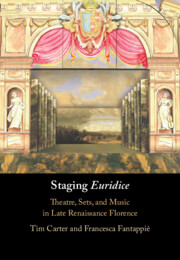
The stage and sets for Euridice were designed by the Florentine artist Lodovico Cardi, called “Il Cigoli.” His invoice survives, as do an inventory of their elements made when they were disassembled and put into storage, and a list of materials provided by the mattress maker, Francesco Ricoveri. These documents are remarkably precise, even with measurements, and they would permit an accurate reconstruction of the staging of the opera in the room in the Palazzo Pitti originally intended for it, the current Sala delle Nicchie (although it was eventually done in a different space later known as the Sala delle Commedie). Cigoli’s contribution renders problematic conventional views of any shift from “Renaissance” to “Baroque” scenography. The three main issues concern the design of the proscenium, how to render a proper perspectival view, and the most effective way to make set changes (Euridice moves from a pastoral scene to an Underworld one and back), whether by way of rotating “periaktoi,” sliding flats, or canvases pulled up and down. Our digital reconstructions make clear how things worked for the opera from the point of view of the stage itself, and as to what the audience saw.
The marriage of Maria de’ Medici and King Henri IV in October 1600 was a triumph of Florentine diplomacy celebrated by a range of entertainments. Some were provided by the Medici, and others by young patricians such as Jacopo Corsi to gain their favor. They also used the occasion to display a novel form of musical theatre recently developed in Florence: opera. Euridice was performed on a temporary stage before a small audience in the Medici’s private residence (the Palazzo Pitti), and Il rapimento di Cefalo in the much larger Teatro degli Uffizi. Not all went well: members of the old guard, including the theatre designer Bernardo Buontalenti and the Florentine intellectual Giovanni de’ Bardi were highly critical. But the choice to have dramas presented entirely in music was both artistic and political. It also forced painters, poets, and musicians to create innovative solutions to typical theatrical problems. The archival documents presented here include inventories, financial accounts, and memoranda that pose important questions about the mechanisms for creating, administering, and funding such events, moving far beyond conventional notions of princely extravagance.
Euridice was one of several music-theatrical works commissioned to celebrate the wedding of Maria de' Medici and King Henri IV of France in Florence in October 1600. As the first 'opera' to survive complete, it has been viewed as a landmark work, but its libretto by Ottavio Rinuccini and music by Jacopo Peri and Giulio Caccini have tended to be studied in the abstract rather than as something to be performed in a specific time and place. Staging “Euridice” explores how newly-discovered documents can be used to precisely reconstruct every aspect of its original stage and sets in the room for which it was intended in the Palazzo Pitti. By also taking into account what the singers and instrumentalists did, what the audience saw and heard, and how things changed from creation through rehearsals to performance, this book brings new aspects of Euridice to light in startling ways.
This book has been in my bag for a long time and, on reflection, I am glad that I have read it gradually. When the central premise is so simple – Grand Opera Outside Paris is, indeed, about Grand Opera outside Paris – the payback comes in the detail of individual chapters and the slow emergence of a Europe-wide survey of encounter and exchange. The volume's editor, Jens Hesselager, provides an erudite and generous introduction, beginning with the familiar difficulty of defining grand opera and the importance of attending to specific performance contexts. In the first instances, of course, this meant the Paris Opéra, and Hesselager draws our attention to Sarah Hibberd's observation that the coherence of the genre was initially established ‘more through the licensing requirements of [this] institution than by [any] specific dramatic content’ (1). From here, the introduction gently encourages us to look outward.
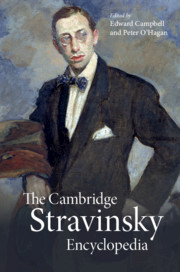
Igor Stravinsky is one of a small number of early modernist composers whose music epitomises the stylistic crisis of twentieth-century music, from the Russian nationalist heritage of the early works, the neo-classical works which anticipate the stylistic diversity of the contemporary musical scene in the early twenty-first century and the integration of serial techniques during his final period. With entries written by more than fifty international contributors from Russian, European and American traditions, The Cambridge Stravinsky Encyclopedia presents multiple perspectives on the life, works, writings and aesthetic relationships of this multi-faceted creative artist. This important resource explores Stravinsky's relationships with virtually all the major artistic figures of his time, painters, dramatists, choreographers and producers as well musicians and brings together fresh insights into to the life and work of one of the twentieth century's greatest composers.
In June 2020 one more video was released into the all-accommodating cloud. This one shows a concert addressed to 2,292 plants, one in each seat of a red velvet-lined auditorium at the Teatre del Liceu in Barcelona. These hand-selected plants are the leafy audience at a performance of Puccini's ‘Crisantemi’ string quartet, conducted in honour of healthcare workers amid lockdown measures to slow the spread of COVID-19. Once the usual announcements about silencing cell phones have been made, the camera closes in on four musicians as each bows to the verdant audience and takes a seat. When the music starts, our view advances from behind the musicians into the opera house: the camera scans the initial rows of the orchestra stalls, then moves into the boxes and balconies. In each successive section of the theatre we see the avatars chosen to listen in place of us. Our representatives are docile and beatific – Puccini seems to soothe them. For a moment the wondrous intrusion of the outside world indoors even starts to seem natural, as if the auditorium can hold the whole world within it, as if there is no outside to this windowless world.
Sergei Prokofiev's The Fiery Angel (Ognennyi angel) has remained comparatively little studied among his operatic works, interpreted primarily as a parody of Russian symbolist beliefs and practice. In the last few years, however, new biographical information has emerged about the period during which Prokofiev wrote The Fiery Angel that points to ways of reconsidering the opera's compositional history and legacy. Furthermore, recent scholarship on the application of narrative theory to opera studies presents new methods for examining how opera might incorporate a narrative point of view. Combining these lines of inquiry, this article scrutinises Prokofiev's two complete versions of Angel (1923 and 1927) in the context of the composer's conversion to Christian Science during the intervening period. It argues that the 1927 version privileges its central character's point of view, as he experiences a process of spiritual awakening similar to the composer's own.