To save content items to your account,
please confirm that you agree to abide by our usage policies.
If this is the first time you use this feature, you will be asked to authorise Cambridge Core to connect with your account.
Find out more about saving content to .
To save content items to your Kindle, first ensure no-reply@cambridge.org
is added to your Approved Personal Document E-mail List under your Personal Document Settings
on the Manage Your Content and Devices page of your Amazon account. Then enter the ‘name’ part
of your Kindle email address below.
Find out more about saving to your Kindle.
Note you can select to save to either the @free.kindle.com or @kindle.com variations.
‘@free.kindle.com’ emails are free but can only be saved to your device when it is connected to wi-fi.
‘@kindle.com’ emails can be delivered even when you are not connected to wi-fi, but note that service fees apply.
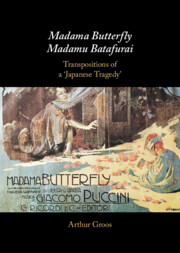
Traces the convoluted genesis of Madama Butterfly, using unpublished archival sources. Illica’s and Giacosa’s construction of the libretto, with input from Puccini and publisher Giulio Ricordi, required reconciling Long’s story and Belasco’s play while also accommodating different approaches to the “Japanese tragedy” in Illica’s anticolonial perspective and Giacosa’s focus on Butterfly’s domestic alienation. Consensus was further complicated by Puccini’s decision to eliminate an entire scene/act set at the American consulate. The dialogic libretto that resulted incorporated much contemporary knowledge of Japan but was also deliberately “orientalized” – Puccini’s setting appropriated Japanese popular melodies as well as Chinese songs from a souvenir music box. Genre ambiguity, especially scenes with Butterfly’s relatives that resembled comic opera, and the libretto-driven score’s impression of musical formlessness contributed to the opera’s catastrophic premiere at La Scala on February 17, 1904, and it arguably remains open-ended even after a successful revision for Brescia a few months later and the publication of a temporary “standard” score in 1907.
Let's start with where opera happens: the opera house. For the 2022/23 season, Opernhaus Dortmund, known for its fine instinct for rare gems on the operatic stage, decided to mount Jacques François Fromental Halévy's La Juive. Having been introduced to this grand opéra as a first-year musicology student, I was excited to see the premiere of Sybrand van der Werf's production on a Sunday night in November 2022 – while preparing this review. As it turns out, the performance transferred me straight into the core arguments of each of the three books under consideration here: the intense co-presence unfolding between the performer and audience, generated as in Clemens Risi's account by a briefly indisposed singer; the inclusion of visual codes evoking SM erotic play on stage, which also informs Axel Englund's investigation; and finally, the production of a hypermedia spectacle, which is Tereza Havelková's central concern. A single performance demonstrated the relevance and applicability of each of Risi's, Englund's and Havelková's studies.
Puccini's famous but controversial Madama Butterfly reflects a practice of 'temporary marriage' between Western men and Japanese women in nineteenth-century treaty ports. Groos' book identifies the plot's origin in an eye-witness account and traces its transmission via John Luther Long's short story and David Belasco's play. Archival sources, many unpublished, reveal how Puccini and his librettists imbued the opera with differing constructions of the action and its heroine. Groos's analysis suggests how they constructed a 'contemporary' music-drama with multiple possibilities for interpreting the misalliance between a callous American naval officer and an impoverished fifteen-year-old geisha, providing a more complex understanding of the heroine's presumed 'marriage'. As an orientalizing tragedy with a racially inflected representation of Cio-Cio-San, the opera became a lightning rod for identity politics in Japan, while also stimulating decolonizing transpositions into indigenous theatre traditions such as Bunraku puppet theatre and Takarazuka musicals.
In 1828, five years after the premiere in Venice of Rossini's final Italian opera, Semiramide, Gaetano Rossi's libretto was again set to music, this time by the famed bel canto tenor and composer Manuel García in Mexico City. The opera, one of the first to be composed in Latin America after the collapse of the Spanish empire, was intended to demonstrate independent Mexico's ability not just to import Italian opera from Europe but also to produce new works. Instead of proving Mexico's credentials as a successful operatic nation, however, García's Semiramide became a problematic space for bringing to light tensions between underlying colonial resistance and the new liberal influence of France, England and Italy. This article contextualises this momentous operatic event within the wider frame of Mexico's nation building and investigates how the manifold political tensions and cultural contradictions of Mexico's postcolonial transition were absorbed and amplified by both García's composition and its staging.
This article interrogates how Franz Schreker's Die Gezeichneten and its early reception reflected an uneasiness about the confines of manhood. As an opera with a complex genesis and a difficult reception history, Die Gezeichneten's allure comes from its resistance to being reduced to only one thing. I nevertheless seek to locate this opera around the time of its premiere towards the end of the First World War. I contend that Die Gezeichneten and its immediate reception charted a key transition in Austro-German masculinity. Specifically, the opera's early performances marked a move away from the period's normative models of bourgeois masculinity (and their corresponding ideas about appearance, health and nationhood) and towards an alternative masculinity preoccupied with degeneracy. I focus on the opera's masks, arguing that, through acts of concealment and disclosure, the opera's two male protagonists struggle to negotiate expectations of an emotionally controlled modern manhood, calling attention to wartime anxieties about what it meant to be a man. Such anxieties resulted in a hardening of attitudes towards the masculine gender, which influenced contemporary music criticism too. Die Gezeichneten's highly sensationalist early reviews relied on a language of degeneracy. Yet I suggest that the opera's initial reception captured a critical moment in this language's history before it was subsumed under Nazi ideology.
This article retraces Giuseppe Verdi's Otello (1887) to the great Italian mattatori (star actors), particularly Tommaso Salvini (1829–1915), whose ground-breaking performances of the Moor of Venice, in a translation by Giulio Carcano, coincided with the time when Verdi and his librettist, Arrigo Boito, were collaborating on their Otello. The grandi attori enjoyed a reputation for realistic immediacy and impulsiveness readily associated with cultural stereotypes about Italy's perceived ‘otherness’. In the ethnographic context of nineteenth-century Italy, it is argued here that the actors’ interpretation of Shakespeare's Moor not only synthesised the multilateral cultural threads of the Jacobean Othello, but also partnered this racial alterity with a new dramatic language, which went on to influence Verdi's opera and prompt book, and, ultimately, to perpetuate an exoticised ‘brand’ of Italian artistic culture on stage at a time when Italy was fashioning its own national identity.
Acknowledging the experimental beginnings of opera and expressing high hopes for its future, Marco da Gagliano (1582–1643) thus reviews the origins of ‘such spectacles’ in the 1608 preface of his own first effort in the new genre, La Dafne, itself a reworking and expansion of the earliest completely sung music drama a decade earlier. He goes on to explain how, after a great deal of discussion concerning the way the ancients had represented their tragedies and about what role music had played in them, the court poet Ottavio Rinuccini (1562–1621) began to write the story (favola) of Dafne, and the learned amateur Jacopo Corsi (1561–1602) composed some airs on part of it. Determined to see what effect a (completely sung) work would have on the stage, they approached the skilled composer and singer Jacopo Peri, who finished the work and probably premièred the role of Apollo ‘on the occasion of an evening entertainment’ during the carnival of 1597/8 and on subsequent occasions. In the invited audience at the first performance were Don Giovanni de’ Medici and ‘some of the principal gentlemen’ of Florence.2
Opera, ‘as every school boy knows’, started life in the 1590s; and we might well suppose that such a novel phenomenon would cry out for entirely new techniques of staging. But in this we would be wrong. Most of the elements which fused to create opera as a form were already present in other musical and dramatic modes in the later sixteenth century, and that was the case, too, when it came to putting the form on stage.
The invention of opera not only introduced musical, dramatic, and aesthetic innovations, but it also prompted unexpected changes in gender roles and social relationships, in particular the appearance of the first women to sing on the operatic stage as professionals and the rise of the castrato. The stricter gender roles of early modern society meant that a professional female singer appearing in public was perceived to be committing a significant transgression. The public sphere was primarily a male space where men could act professionally and still maintain their honour and prestige, whereas the reputation of a woman who performed on stage was considerably more precarious: her career was likely to be viewed as indistinguishable from prostitution. The embodiment of an object of desire, the female singer was viewed as both threatening and appealing. Crossing the border between public and private spheres was therefore a bold move for a woman and exposed those who did it to all kinds of attacks. In everyday life, chastity, moderation, silence, and invisibility were the major virtues associated with an honest woman. Female opera singers became visible and professionally active by exhibiting themselves onstage; they also transgressed the border between silence and voice.1