To save content items to your account,
please confirm that you agree to abide by our usage policies.
If this is the first time you use this feature, you will be asked to authorise Cambridge Core to connect with your account.
Find out more about saving content to .
To save content items to your Kindle, first ensure no-reply@cambridge.org
is added to your Approved Personal Document E-mail List under your Personal Document Settings
on the Manage Your Content and Devices page of your Amazon account. Then enter the ‘name’ part
of your Kindle email address below.
Find out more about saving to your Kindle.
Note you can select to save to either the @free.kindle.com or @kindle.com variations.
‘@free.kindle.com’ emails are free but can only be saved to your device when it is connected to wi-fi.
‘@kindle.com’ emails can be delivered even when you are not connected to wi-fi, but note that service fees apply.
This chapter explores how Czech translations and productions of Die Zauberflöte intertwined with the development of Czech national culture between the late eighteenth and late nineteenth centuries. The history of the Czech Zauberflöte adaptations illustrates the gradual transformation of the Czech national movement from a branch of Bohemian regional patriotism into a confident and even aggressive nationalistic movement with strong anti-German tendencies. Die Zauberflöte was the first Mozart opera to be translated into Czech in 1794. In the early nineteenth century, Czech nationalists called for a new translation that would express their anti-German sentiments. Similar sentiments also dominated Czech criticism of Die Zauberflöte in the 1860s, according to which Mozart’s Singspiel was inferior to his Italian operas. In the 1880s, the Czech National Theater managed to incorporate Die Zauberflöte into the canon of national operas, but only by suppressing Schikaneder’s original plot and rearranging Mozart’s music.
This chapter shows how ethnic concepts became prominent in Bohemian debates about Mozart in the late nineteenth and early twentieth centuries. The chapter first explores the writings of Mozart’s first biographer Franz Xaver Niemetschek to show that around 1800 regional identity in Prague was dominated by the ambiguous concept of Bohemian patriotism. With the rise of Czech and German ethnic nationalism in the ensuing decades, Prague’s critics and musicologists mined Mozart’s operas, as well as works by his eighteenth-century contemporaries and predecessors, such as Stamitz and Gluck, for inherent qualities associated with Czech and German-Bohemian cultures, especially folk music. In the 1930s, Czech and German-Bohemian musicologists used racial criteria to prove that Gluck’s and Mozart’s music was inherently Czech or German (or Sudeten German, as many Czechoslovak Germans identified themselves by then). These ethnocentric preoccupations were further emphasized by Czech Marxist musicologists in the post–World War II period.
This chapter explores the relationship between political developments in Bohemia from the 1790s to the 1880s and the concept of fidelity to “authentic” texts and music (Werktreue) in Mozart’s operas. The idea of Werktreue appeared in Prague in the 1790s in response to Bohemian patriotism and negative attitudes to the central government in Vienna. In the 1820s, Czech nationalists embraced similar attitudes in approaching Don Giovanni, and both the first Czech production of 1825 and the first production of the work at the Czech National Theater (1884) showcased the opera with musical numbers that were cut in contemporaneous German productions. German-Bohemians appropriated Werktreue as well but understood “authentic” performances of Don Giovanni as a link to the ideals of a pan-German national culture. By the time of the 1887 Don Giovanni centennial celebrations, however, some German-Bohemian critics considered Werktreue in Mozart’s operas antithetical to true German art under the influence of Wagnerian ideas.
This chapter focuses on the history of three Mozart monuments in Prague: a Mozart foundation in Prague’s university library established in 1837 to compete with the plans for a Mozart monument in Salzburg; a German Mozart monument that was to be built in the city center in 1914; and Bertramka, a suburban estate where Mozart supposedly lived during his Bohemian visits and where he purportedly finished Don Giovanni. All three commemorative sites were embroiled in various Czech–German national conflicts. The chapter focuses on the process through which Bertramka transformed into a national shrine and the patriotic myths that contributed to this transformation. Whereas Czech commentators viewed Bertramka as a monument to Mozart’s ties to the Czechs, German Bohemians considered it a symbolic site of German culture. Patriotic and nationalist concerns eventually imbued the myths about Mozart and Bertramka with an aura of truth.
This chapter explores how post–World War II nationalism affected the understanding of the transnational dissemination of Don Giovanni in late eighteenth-century Central Europe. The chapter traces one of the earliest German adaptations of Don Giovanni, created in Prague in 1790–91 for the company of Wenzel Mihule. This adaptation was later used in many South German cities (such as Nuremberg), in Saxony (Leipzig and Dresden), the Viennese Wiednertheater, and in many places in Bohemia, Moravia, and Slovakia. The adaptation was largely overlooked by previous studies of Don Giovanni reception because after 1945, both Czech scholars in the newly de-Germanized Bohemia and Austro-German scholars were not interested in researching German culture in what after the forced resettlement of the German population became predominantly Slavic regions.
This chapter explores how Bohemians, Czechs, and German Bohemians projected their views of Bohemia’s relationship to the Habsburg dynasty onto La clemenza di Tito between 1791 and 1891. The opera initially expressed the Bohemians’ allegiance to Habsburg emperors and was used to commemorate various Habsburg anniversaries. In 1873, this pro-Habsburg symbolism aligned with the political interests of German Bohemians, when Tito was performed in the German Theater to celebrate the twenty-fifth anniversary of Emperor Franz Joseph’s rule and the defeat of the 1871 Fundamental Articles, in which the emperor promised to acknowledge Bohemian autonomy to Czech leaders. At the same time, already by the 1790s, some Bohemian commentators associated the opera with anti-Habsburg sentiments. This symbolic meaning became particularly prominent in 1891, when the Czech National Theater’s centennial production of La clemenza di Tito was canceled because of fears that it would incite anti-German and anti-dynastic passions.
Although Mozart spent only a few weeks altogether in Prague, the city has been generally considered one of the most prominent sites associated with the composer. Czech- and German-language commentators in Bohemia usually take the successful production of Die Entführung aus dem Serail in 1783 as the starting point for the positive reception of Mozart’s music in Prague. The enthusiasm aroused by Die Entführung intensified with the success of Le nozze di Figaro in late 1786 and led to Mozart’s first visit to the Bohemian capital in early 1787. The most famous link between Mozart and Prague was created a few months later, when Mozart finished, rehearsed, and premiered his Don Giovanni at Prague’s Nostitz Theater (a theater initially created mainly for the production of German works, though later also featuring Italian operas and occasional Czech offerings) on October 29, 1787. One more famous premiere followed in September 1791 – that of La clemenza di Tito, commissioned for the coronation of Leopold II as the king of the Bohemian crownlands.
Alva Belmont and Elsa Maxwell's Melinda and Her Sisters (1916) is a little-known work promoting women's suffrage, which was publicly performed only once in New York City. It was advertised as an operetta, a decision which minimised its overt stylistic and functional similarities to other genres of popular musical theatre from the period, namely, musical comedy and pageantry. Framed through Jeffrey Kallberg's concept of genre as a ‘gesture of labeling’, this article asks what could be gained – artistically, financially and politically – by Belmont and Maxwell's invocation of operetta and by their disavowal of other appropriate genre alternatives. I argue that the strategy reflects their fundraising priorities, the attitudes of their intended audience, and the social, political and artistic climates that constrained women's activities. This case study offers genre as a productive lens through which to interpret gynocentric musical production and performance.
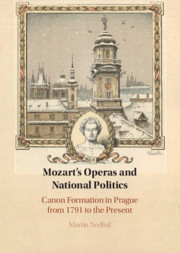
As both an in-depth study of Mozart criticism and performance practice in Prague, and a history of how eighteenth-century opera was appropriated by later political movements and social groups, this book explores the reception of Mozart's operas in Prague between 1791 and the present and reveals the profound influence of politics on the construction of the Western musical canon. Tracing the links between performances of Mozart's operas and strategies that Bohemian musicians, critics, directors, musicologists, and politicians used to construct modern Czech and German identities, Nedbal explores the history of the canonization process from the perspective of a city that has often been regarded as peripheral to mainstream Western music history. Individual chapters focus on Czech and German adaptations of Mozart's operas for Prague's theaters, operatic criticism published in Prague's Czech and German journals, the work of Bohemian historians interpreting Mozart, and endeavours of cultural activists to construct monuments in recognition of the composer.
Sergei Prokofiev's operatic career exhibits a multitude of exceptional successes and failures, political and cultural idiosyncrasies and compromises, and bold convictions and uncertainties. Prokofiev considered himself an opera composer and showed his affinity for it from an early age, completing his first opera by age nine and continuing his work in the art form for the remainder of his life and career. Each opera takes on vastly different subjects, topics and time periods, evidence of his diverse selection of libretto sources. For his mature works, Prokofiev adapted literary works from Russia's nineteenth-century greats (Dostoyevsky and Tolstoy), a Russian twentieth-century symbolist author (Bryusov) and two socialist-realist authors (Katayev and Polevoy). He adapted two other operas from the eighteenth century with Richard Brinsley Sheridan's comic opera libretto for The Duenna and Carlo Gozzi's fiaba L'amore delle tre melarance.