To save content items to your account,
please confirm that you agree to abide by our usage policies.
If this is the first time you use this feature, you will be asked to authorise Cambridge Core to connect with your account.
Find out more about saving content to .
To save content items to your Kindle, first ensure no-reply@cambridge.org
is added to your Approved Personal Document E-mail List under your Personal Document Settings
on the Manage Your Content and Devices page of your Amazon account. Then enter the ‘name’ part
of your Kindle email address below.
Find out more about saving to your Kindle.
Note you can select to save to either the @free.kindle.com or @kindle.com variations.
‘@free.kindle.com’ emails are free but can only be saved to your device when it is connected to wi-fi.
‘@kindle.com’ emails can be delivered even when you are not connected to wi-fi, but note that service fees apply.
Chapter 8 examines the instruments of the violin family in the cultural imagination, addressing why they captivated so many people, what associations became attached to both the instrument and the person who handled it, and the underlying social currents those associations suggest. Two main topics are treated: the veneration around the instruments of Stradivari and others from the Cremonese School and the concomitant idealization of old artisanal craftsmanship; and how contemporary writers and illustrators sought to understand the instruments’ allure for players, especially women. The discussion assesses the idealization of old instruments in the context of industrialized violin making and broader social anxieties about the modernizing world. Building on scholarship about the gendering and sexualization of stringed instruments, the chapter also considers depictions of people’s responses to them through the lens of sensory and sensual perception, arguing that the prevalence of such material reflects attempts to make sense of the violin family’s powerful hold on British society.
The remarkable take-up of the violin and the coalescence of a culture of learning and playing stringed instruments in the classical tradition, 1870–1930, had structural and democratizing effects on how British musical life developed. Expanding numbers of competent players increased the size and depth of the music profession and contributed to the growth of opportunities for audiences to hear live music, often well beyond the concert hall. The interrelated expansion of teacher numbers generated new generations of learners who would treat music as a leisure pursuit and whose critical mass prompted the foundation of many amateur symphony orchestras and often sustained amateur choral performances nationwide. Alongside came a significant revolution in string playing’s social demography. Whereas in 1870 string playing was the occupation or pastime of men, by the early twentieth century women had broken firmly into these arenas and were obtaining work in many (though not all) areas of the music profession. Cross-class, multigenerational learning contributed to the sea change, especially in the wave of working-class adults and children who found affordable group string instruction at local educational institutes or in elementary schools.
Commercially run grade examinations and competitive music festivals, which tested learners’ attainment, were central to the consolidation of violin culture across Britain. Chapter 3 analyzes the string exams operated by three institutions, each of which targeted different socioeconomic groups. Bringing the College of Violinists – the first exam board to offer elementary string exams and the only one to guarantee string players would be assessed by specialists– into dialog with the more often discussed ABRSM and Society of Arts, the discussion evaluates exam requirements, candidate numbers, and success rates. At root, exams were tools for motivating students and supporting and shaping learning. Regional competition festivals offered additional opportunities for more advanced pupils’ performance to be assessed (in a public hall, as opposed to a private exam room) and, along with the exam boards, they contributed to the informal standardization of core repertoire. The chapter also surveys instructional materials, some of which were responses to the exam culture, and weighs students’ experiences of learning.
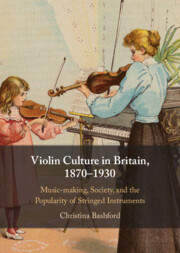
Interweaving a social history of string playing with a collective biography of its participants, this book identifies and maps the rapid nationwide development of activities around the violin family in Britain from the 1870s to about 1930. Highlighting the spread of string playing among thousands of people previously excluded from taking up a stringed instrument, it shows how an infrastructure for violin culture coalesced through an expanding violin trade, influential educational initiatives, growing concert life, new string repertoire, and the nascent entertainment and catering industries. Christina Bashford draws a freshly broad picture of string playing and its popularity, emphasizing grassroots activities, amateurs' pursuits, and everyday work in the profession's underbelly—an approach that allows many long-ignored lives to be recognized and untold stories heard. The book also explores the allure of stringed instruments, especially the violin, in Britain, analyzing and contextualizing how the instruments and their players, makers, and collectors were depicted and understood.
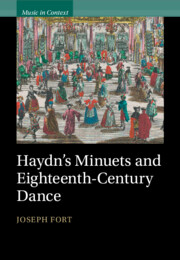
Audiences in eighteenth-century Vienna attended the city's popular public balls, where they danced the minuet. This book explores the public dance culture of Vienna in the late eighteenth century as an essential context in which to understand minuet composition from this period, focusing on the music of Haydn, and restores the array of kinaesthetic associations and expectations that eighteenth-century audiences brought to the listening experience through their knowledge of the dance. It reconstructs the choreography of the minuet as it was performed in the Viennese dance halls and examines the repertoire of minuets composed specifically for dancing, bringing new perspectives to the minuet genre. This recovered bodily knowledge allows the author to put forward an analytical method of 'somatic enquiry' and apply it to Haydn's symphonic minuets from the 1790s, revealing previously hidden features in this music that come to light when listening with an understanding of the dance.
Two months after its premiere in Leipzig, Ernst Krenek’s Leben des Orest (1930) came to the Berlin Kroll Opera, a notorious centre for experimental, modernist productions. Inevitably, critics compared the two productions, much to the Berlin production’s detriment. In particular, critics faulted the Berlin stage designs by Greek-Italian painter Giorgio de Chirico. I argue that this reception reflected a fundamental divergence in Krenek and de Chirico’s neoclassicism, which was only exacerbated by how neither Krenek nor de Chirico’s neoclassicism aligned with pre-existing expectations about the Kroll Opera’s production aesthetic, as exemplified in Igor Stravinsky’s Oedipus Rex (staged at the Kroll in 1928). Attending to these differences not only explains the troubled reception of Leben des Orest at the Kroll, but also provides fertile ground to examine the complicated and sometimes contradictory meanings ascribed to neoclassicism in the interwar period, especially as it moved between media and across national borders.
J. S. Bach’s Cello Suites, like his English Suites, all follow the same basic format: prelude, allemande, courante, sarabande, and gigue, with various modern dances known as “galanteries” placed in the penultimate position. Bach insisted that his students study a number of suites to develop an intimate knowledge of these various genres of stylized dances. Writings by his North German contemporaries—especially Johann Gottfried Walther’s Musicalisches Lexikon (1732) and Johann Mattheson’s Der vollkommene Capellmeister (1739)—offer some sense of how Bach may have understood the characters and styles of each dance type. Bach’s suites often exemplify elements of unity across the various movements, with musical motives or figures introduced in the prelude that recur in various ways across a suite. These elements of unity suggest the influence of a technique of musical variation discussed in Friedrich Erhardt Niedt’s Musikalische Handleitung (1706). The chapter closes with a complete analysis of Cello Suite No. 4 (BWV1010), illuminating harmony, form, motives, and possible Christian symbolism in the Prelude.
This chapter traces the transmission, performance history, and reception of J. S. Bach’s Cello Suites up through the dawn of the recording era. Composed around 1720, the Cello Suites circulated for their first century only in manuscript copies and were therefore only known by people with connections to the composer’s students. Various books and reference materials highlight the Sonatas and Partitas and Cello Suites in works lists and appraisals of the composer’s work, but these pieces were not widely played. The first published editions appeared starting in the 1820s, initially presenting the Cello Suites as instrumental studies. Subsequent editions with extensive editorial expressive markings and sometimes with added piano accompaniment aspired to adapt the Cello Suites to suit contemporaneous tastes, serving to usher them gradually into the concert hall. Starting around the 1860s, individual movements or groups of movements (and rarely complete suites) were performed in concerts primarily in Germany, England, and France. These performances were initially met with a mixed critical reception: While some concerts received rave reviews, other critics considered the Cello Suites to be historical curiosities or to be better suited for instrumental study than concert performances.
Whereas Bach’s Violin Solos are preserved in a calligraphic autograph manuscript, the lack of a surviving autograph of the Cello Suites has long been a problem for performers and critical editors alike. The Cello Suites survive in four manuscript copies, which musicians consult in facsimile copies to guide their choices about discrepant articulations, ornaments, and notes. For some 150 years, most cellists and editors have taken the manuscript copied by the composer’s second wife, Anna Magdalena Bach (Source A), to be a kind of surrogate for the lost autograph, despite the fact that it contains numerous inconsistencies as well as slur markings that are ambiguous or apparently inaccurate. A recent edition by Andrew Talle (2018) has reevaluated the four sources, drawing particular attention to Sources C and D, which had long been disregarded due to their geographical and temporal distance from the composer. However, these manuscripts were copied by excellent professional scribes working from another (now lost) manuscript in the possession of Carl Philipp Emanuel Bach. They moreover preserve various details, clarifications, and embellishments that were added through the composer’s initiative, probably in the context of lessons or music making, and which are not preserved in Anna Magdalena Bach’s copy.
J. S. Bach’s tenure as Capellmeister in Cöthen, with its focus on secular music, afforded an opportunity to explore the violin and cello as solo instruments. While his Sonatas and Partitas for Solo Violin represent the pinnacle of an established German tradition, the Cello Suites are among the earliest music composed for unaccompanied cello and may have been inspired partly by unaccompanied music for viola da gamba (pièces de viole). Bach’s Violin Solos and Cello Suites are both “opus collections”—sets of (usually six) pieces exemplifying his mastery of a particular genre or instrument. An obituary coauthored by Carp Philipp Emanuel Bach and Johann Friedrich Agricola illustrates the special importance the composer attached to these pieces. While Bach was best known during his lifetime as an organist, he had intimate knowledge and full mastery of the violin. There is no record of Bach playing cello, but his composition of virtuoso suites that draw a maximum musical effect from such minimal instrumental resources suggest an intimate knowledge of that instrument. Moreover, during Bach’s lifetime, an instrument called “viola da spalla”—considered a type of cello but played similarly to the violin—could have enabled a violinist to play the Cello Suites.