To save content items to your account,
please confirm that you agree to abide by our usage policies.
If this is the first time you use this feature, you will be asked to authorise Cambridge Core to connect with your account.
Find out more about saving content to .
To save content items to your Kindle, first ensure no-reply@cambridge.org
is added to your Approved Personal Document E-mail List under your Personal Document Settings
on the Manage Your Content and Devices page of your Amazon account. Then enter the ‘name’ part
of your Kindle email address below.
Find out more about saving to your Kindle.
Note you can select to save to either the @free.kindle.com or @kindle.com variations.
‘@free.kindle.com’ emails are free but can only be saved to your device when it is connected to wi-fi.
‘@kindle.com’ emails can be delivered even when you are not connected to wi-fi, but note that service fees apply.
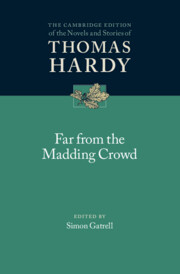
For the first time since its publication in 1874, this volume presents the text and illustrations of the first edition of Far from the Madding Crowd, a definitive work of nineteenth-century literature and the novel that made Thomas Hardy famous. It includes in footnotes all the revisions that Hardy made to the work, both in manuscript and serial, before 1874 and in numerous subsequent editions. A carefully-researched, accessibly-written introduction examines in detail the successive stages in Hardy's initial inscription and subsequent adjustments to the work from 1873 to the 1920s, and includes analysis of contemporary reviews, as well as a previously unpublished account of the relationship between the novel and George Eliot's Middlemarch. Appendices include discarded manuscript fragments, a discussion of the environments of the novel and consideration of the work of the compositors who first set the novel in type.
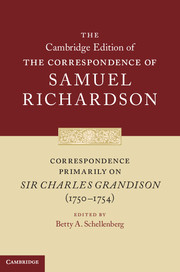
Samuel Richardson (1689–1761) was a highly regarded printer and influential novelist when he produced his final work of fiction, The History of Sir Charles Grandison (1753). Like his other novels, it was written in epistolary form, reflecting his lifelong interest in letter writing and the letter as a genre. Covering the period 1750–1754, many of these fully annotated letters are published from manuscript for the first time, or have been restored to their complete original form. Recording Richardson's relationships with leading cultural figures including Samuel Johnson, Colley Cibber and Elizabeth Carter, the volume reveals his support for other authors while struggling to complete his own 'story of a Good Man'. This publishing saga also incorporates Richardson's responses to the Irish piracy of his novel, and his exchanges with anonymous fans, including those who attacked the novel's tolerance for Catholicism and those who pleaded for a sequel.
This bilingual anthology presents the best of Arabic classical poetry's musings over the many faceted states of the human condition, among them love, generosity, life, time, youth, beauty, ecstasy, longing, wine, death and plenty more. Mansour Ajami's selection of topical verses and poems is guided by what was deemed best in its genre by the consensus of the great classical Arab literary critics and theoreticians.
This book is an annotated edition of 'The Correspondents: An Original Novel' (1775), a work, as the introduction argues, derived from 'A Sentimental Journey', and one of the best of the many later efforts to capture Sterne's unique blend of sensibility and sensuality. The introduction will make the case for its authorship being an actual exchange of love letters between George Lord Lyttelton (1709-1773) and Apphia Peach Lyttelton (1743-1840), his daughter-in-law, thirty years younger than her father-in-law at the time of the exchange. In our inability to understand precisely what happened between the two is the genius of their imitation of Sterne. It is an ambiguity that results from the conscious reshaping of original letters into a narrative, probably by Apphia Peach in the two years between Lyttelton's death and its publication. The correspondents exchange some 80 letters in all, many with references and quotations to writers in the literary tradition; these allusions will be annotated when at all possible. Particularly important are the allusions to Sterne's 'Sentimental Journey', which was the origin of the design of 'The Correspondents', and to Shakespeare, Apphia Peach joining Lyttelton's good friend Elizabeth Montagu in this early indication that the eighteenth-century elevation of Shakespeare was often the direct result of his women readers.
This book makes an argument critical to literary theory and sexuality in 2022. It argues that Colette's fiction portrays a woman struggling to live in the throes of the incest taboo, understood in its psychological implications for power relations both private and public, then and now. Informed by Julia Kristeva's work, it approaches Colette's writing and its translation along with two films via close, psychoanalytic readings. It demonstrates that this version of Kristeva's psychoanalytic theory, in an accessible form and with emphasis on the psychology of women and social transformation, helps to read Colette for the twenty-first century as well as to show how Kristeva's theory works. This volume examines especially Colette's most admired novels, especially from the second half of her life, including the much misunderstood 'La Maison de Claudine' (1922), where the incest taboo surfaces in the relationship of the narrator with the mother. The taboo had appeared two years earlier in 'Chéri' (1920), in the rapport between the maternal Léa, a woman of a certain age, and the young man, Chéri; finally, in 'Gigi', the incest taboo characterises the relations between the young teenager of the eponymous title and her much older, uncle figure Gaston.
The volume includes a prologue and an epilogue. Each chapter constitutes an extensive interview with one of these colleagues. Chapter one (Mignolo): colonial and postcolonial dimensions since the Early Modern / colonial period (circa 1500) and the legacy of post-structuralism in American academia. Crucial notion of 'the colonial difference' vis-à-vis the critical interrogation of the category of 'West.' Chapter two (John Beverley): we are dealing with the insertion of postmodernism, cultural studies and subaltern studies, and also the insertion of the sign 'Baroque,' inside American life. Chapter three (Adorno): we are dealing with avatars of colonial studies of Latin America in the 'Home of the Brave' particularly in relation to the work that defines her on the historical figure of Guaman Poma de Ayala. Chapter four (Rabasa): we are dealing with the themes of (epistemic) violence apropos Precolombian legacies, the historical relations between Mexico and the United States and the implications of subaltern studies. Chapter five (González Echevarría): in marked contrast with what has preceded, we are dealing with the vindication of pleasure in literary and cultural criticism and repudiations of politics or ideology, within rich historical continuities between Spain and Latin America. There are at least five different nationalities (Argentina, American, Mexican, Cuban, Spaniard) and more than five institutional affiliations (Duke, Yale, Pittsburgh, etc.). Fernando Gomez Herrero has had a roving faculty experience in a few American and British universities (Duke, Stanford, Pittsburgh, Oberlin College, Birmingham, Manchester, etc.).
Gothic Appalachian Literature examines the ways contemporary Appalachian authors utilize gothic tropes to explore the complex history and contemporary problems of the region, particularly in terms of their representation of economic and environmental concerns. It argues that across Appalachian fiction, the plight of characters to save their homes, land and way of life from the destructive forces of extractive industries brings sharply to bare the histories of colonization and slavery that problematize questions of belonging, ownership and possession.
Robertson extensively considers contemporary manifestations of the gothic in Appalachian literature, arguing that gothic tropes abound in fiction that focuses on the impacts of extractive industries that connect this micro-region with other parts of the Global North and Global South where the devastating impacts of extractive industries are also experienced socially, economically and environmentally.
Informed by fourth-wave feminism, Crime Fiction in the Age of #MeToo presents a compelling and timely reading of crime fiction in the age of #MeToo. The book explores five major fourth-wave feminist topics, #MeToo, rape culture, toxic masculinity, LBGTQ+ perspectives, and transgender. These topics have been the subject of intense feminist scrutiny and campaigning, and the book demonstrates how this attention is reflected in contemporary crime fiction and its generic and thematic preoccupations. The book opens with a chapter presenting an overview of existing critical perspectives and feminist debates, demonstrating how fourth-wave feminist ideas and debates are inspiring innovations in the genre, as well as generating fresh ways of reading past and present crime fictions. Providing an overview and context for both fourth-wave feminism and the #MeToo movement, the chapter establishes the critical and cultural framework for its analysis. The chapter also outlines the book's methodology and approach, detailing the contents of the chapters. Each of the five subsequent chapters uses critical vocabulary and concepts from feminism and the #MeToo movement to reassess canonical works and present new readings of contemporary crime fiction, producing compelling analyses of gender and genre.
Through its critical examination of crime fiction, Crime Fiction in the Age of #MeToo offers a powerful feminist analysis of the genre which draws links between literature and ongoing urgent social and cultural debates such as the #Metoo movement and fourth-wave feminism.
In late eighteenth- and early nineteenth-century British literature, Scandinavia emerged as a setting for Gothic terror. This book explores the extensive use of Nordic superstition as it provided a vocabulary for Gothic texts, examining the cultural significance these references held for writers exploring Britain's northern heritage. In Gothic publications, Nordic superstition sometimes parallels the representations of Catholicism, allowing writers to gloat at its phantasms and delusions. Thus, runic spells, incantations, and necromantic communications (of which Norse tradition afforded many examples) could replace practices usually assigned to Catholic superstition. Yet Nordic lore did more than merely supplant hackneyed Gothic formulas; it presented readers with an alternative conception of 'Otherness'. Nordic texts - chiefly based on the Edda and the supernatural Scandinavian ballad tradition - were seen as pre-Christian beliefs of the Gothic (i.e., Germanic) peoples, including the Anglo-Saxons. The book traces the development of this Nordic Gothic, situating it within wider literary, historical, political, and cultural contexts.
Theory Does Not Exist: Comparative Ancient and Modern Explorations in Psychoanalysis, Deconstruction, and Rhetoric is a collection of essays that makes a strong case for a comparative approach to what we term 'theory' today. It argues that our disciplinary boundaries create artificial divisions between philosophy, rhetoric, and literature, which historically would not have been recognized and which have come to function as conceptual straitjackets. These essays contend that a concerted engagement with the crucial texts in these debates over the last 2500 years not only offers a better understanding of the issues involved but also provides the necessary political, ethical, and existential tools for fashioning a better and more inclusive life. Theory Does Not Exist offers a full-throated defense of the humanities and crucial counterarguments against the reduction of education to the vocational and the operational.
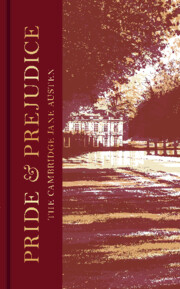
Pride and Prejudice is the most popular of Austen's six remarkable novels. Full of crackling dialogue, it achieves the finest balance of comedy and reflection, liveliness and solemnity. While revealing the restrictive life of genteel women at the turn of the nineteenth century, it provides as the central consciousness the clever, witty, and flirtatious Elizabeth Bennet, arguably Austen's most alluring heroine. One of the great love stories of English literature, the novel has spawned countless films and fantasies. In its brilliant balance of psychological observation and social comedy, the original effortlessly survives its global exploitation. The novels Austen wrote later in life were more complex but, drafted when the author was close to her heroine's age of twenty, Pride and Prejudice remains her most vivacious and sparkling work. Prefaces and explanatory endnotes supplied by Janet Todd illuminate the cultural, historical and literary context, bringing Jane Austen's world to life.
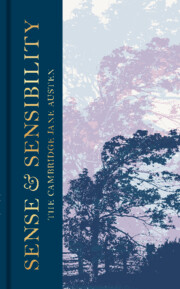
Money and destructive passion overshadow romance in this darkly humorous novel of sexual manoeuvring and greed. Appearing anonymously in 1811 under the attribution 'By A Lady', Sense and Sensibility is Jane Austen's first published work. Uniquely among her novels it has two heroines: stoical Elinor, the sensitive consciousness of the book, representative of 'sense', and flamboyant, self-indulgent Marianne, whose emotional adventures deliver energy and zest, representative of 'sensibility'. The novel is an edgy contrapuntal tale of different personalities and experiences, revealing much about the constraints and difficulties of a woman's life. In addition, the book offers a remarkable window onto the material culture of Austen's time; it includes some memorable bric-a-brac such as an ornamented toothpick case and some fine breakfast china quarrelled over by rich and poor relatives. Prefaces and explanatory endnotes supplied by Janet Todd illuminate cultural, historical and literary context, bringing Jane Austen's world to life.