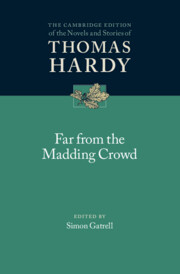
Far from the Madding Crowd

-
Select format
-
- Publisher:
- Cambridge University Press
- Publication date:
- 15 November 2025
- 20 November 2025
- ISBN:
- 9781108655057
- 9781108475051
- Dimensions:
- (229 x 152 mm)
- Weight & Pages:
- 1.49kg, 960 Pages
- Dimensions:
- Weight & Pages:
You may already have access via personal or institutional login- Subjects:
- Literature, Literary Texts, English Literature 1830-1900
- Collection:
- The Novels and Stories of Thomas Hardy
Show more authors 
You may already have access via personal or institutional login
Book description
For the first time since its publication in 1874, this volume presents the text and illustrations of the first edition of Far from the Madding Crowd, a definitive work of nineteenth-century literature and the novel that made Thomas Hardy famous. It includes in footnotes all the revisions that Hardy made to the work, both in manuscript and serial, before 1874 and in numerous subsequent editions. A carefully-researched, accessibly-written introduction examines in detail the successive stages in Hardy's initial inscription and subsequent adjustments to the work from 1873 to the 1920s, and includes analysis of contemporary reviews, as well as a previously unpublished account of the relationship between the novel and George Eliot's Middlemarch. Appendices include discarded manuscript fragments, a discussion of the environments of the novel and consideration of the work of the compositors who first set the novel in type.
Contents
Contents
Metrics
Altmetric attention score
Full text views
Full text views helpTotal number of HTML views: 0
Total number of PDF views: 0 *
 Loading metrics...
* Views captured on Cambridge Core between #date#. This data will be updated every 24 hours.
Usage data cannot currently be displayed.
Accessibility standard: Missing or limited accessibility features
Why this information is here
This section outlines the accessibility features of this content - including support for screen readers, full keyboard navigation and high-contrast display options. This may not be relevant for you.
Accessibility Information
The PDF of this book is known to have missing or limited accessibility features. We may be reviewing its accessibility for future improvement, but final compliance is not yet assured and may be subject to legal exceptions. If you have any questions, please contact accessibility@cambridge.org.
Content Navigation
Table of contents navigation
Allows you to navigate directly to chapters, sections, or non‐text items through a linked table of contents, reducing the need for extensive scrolling.
Index navigation
Provides an interactive index, letting you go straight to where a term or subject appears in the text without manual searching.
Reading Order and Textual Equivalents
Single logical reading order
You will encounter all content (including footnotes, captions, etc.) in a clear, sequential flow, making it easier to follow with assistive tools like screen readers.
Short alternative textual descriptions
You get concise descriptions (for images, charts, or media clips), ensuring you do not miss crucial information when visual or audio elements are not accessible.