To save content items to your account,
please confirm that you agree to abide by our usage policies.
If this is the first time you use this feature, you will be asked to authorise Cambridge Core to connect with your account.
Find out more about saving content to .
To save content items to your Kindle, first ensure no-reply@cambridge.org
is added to your Approved Personal Document E-mail List under your Personal Document Settings
on the Manage Your Content and Devices page of your Amazon account. Then enter the ‘name’ part
of your Kindle email address below.
Find out more about saving to your Kindle.
Note you can select to save to either the @free.kindle.com or @kindle.com variations.
‘@free.kindle.com’ emails are free but can only be saved to your device when it is connected to wi-fi.
‘@kindle.com’ emails can be delivered even when you are not connected to wi-fi, but note that service fees apply.
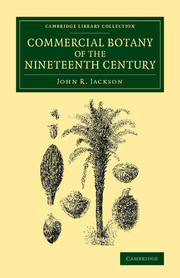
The nineteenth century witnessed great advances in technology which made transporting natural resources overseas significantly easier. At the centre of a global empire, Britain felt the full economic benefits of introducing and cultivating a range of commercial plants both domestically and in her colonies abroad. First published in 1890, this succinct work by the English botanist John Reader Jackson (1837–1920) surveys these plants. The concise descriptions are enhanced by instructive drawings of significant species. The introduction also contains a chronological table of the century's most important developments in commercial botany. This is followed by chapters organised according to the applications of plants, notably in food, drink, medicine, and the building trade. Jackson points out the species which revolutionised these industries, identifying those at the heart of rapidly growing markets. The coverage includes many commodities which remain commercially significant, such as palm oil, sugar cane, and cotton.
Following his stint as the naturalist aboard the Endeavour on James Cook's pioneering voyage, Sir Joseph Banks (1743–1820) became a pre-eminent member of the scientific community in London. President of the Royal Society from 1778, and a friend and adviser to George III, Banks significantly strengthened the bonds between the practitioners and patrons of science. Between 1796 and 1800, the Swedish botanist and librarian Jonas Dryander (1748–1810) published this five-volume work recording the contents of Banks' extensive library. The catalogue was praised by many, including the distinguished botanist Sir James Edward Smith, who wrote that 'a work so ingenious in design and so perfect in execution can scarcely be produced in any science'. Volume 5 (1800) contains a list of works from the first four volumes indexed by author, as well as a supplementary list of those items that were acquired after the publication of the previous volumes.
Although without formal scientific training, Henry John Elwes (1846–1922) devoted his life to natural history. He had studied birds, butterflies and moths, but later turned his attention to collecting and growing plants. Embarking on his most ambitious project in 1903, he recruited the Irish dendrologist Augustine Henry (1857–1930) to collaborate with him on this well-illustrated work. Privately printed in seven volumes between 1906 and 1913, it covers the varieties, distribution, history and cultivation of tree species in the British Isles. The strictly botanical parts were written by Henry, while Elwes drew on his extensive knowledge of native and non-native species to give details of where remarkable examples could be found. Each volume contains photographic plates as well as drawings of leaves and buds to aid identification. The species covered in Volume 4 (1909) include fir, chestnut, ash and birch.
Although without formal scientific training, Henry John Elwes (1846–1922) devoted his life to natural history. He had studied birds, butterflies and moths, but later turned his attention to collecting and growing plants. Embarking on his most ambitious project in 1903, he recruited the Irish dendrologist Augustine Henry (1857–1930) to collaborate with him on this well-illustrated work. Privately printed in seven volumes between 1906 and 1913, it covers the varieties, distribution, history and cultivation of tree species in the British Isles. The strictly botanical parts were written by Henry, while Elwes drew on his extensive knowledge of native and non-native species to give details of where remarkable examples could be found. Each volume contains photographic plates as well as drawings of leaves and buds to aid identification. The species covered in Volume 6 (1912) include spruce, juniper, laburnum, cherry, mulberry and gum trees.
After the death of the younger Carl Linnaeus in 1783, the entirety of the Linnean collections, including the letters received by the elder Linnaeus from naturalists all over Europe, was purchased by the English botanist James Edward Smith (1759–1828), later co-founder and first president of the Linnean Society of London. In 1821, Smith published this two-volume selection of the letters exchanged by Linnaeus père et fils and many of the leading figures in the study of natural history, revealing some of the close ties of shared knowledge and affection that bound the European scientific community at that time. Where necessary, Smith translates the letters into English, with the exception of those written in French, which are presented in the original. Volume 1 illuminates the epistolary relationships of Linnaeus senior with Peter Collinson, John Ellis and Alexander Garden, providing a very brief biography of each. Garden's letters to Ellis also feature prominently.
A member, and later president, of the Académie des Sciences, French botanist and doctor René Louiche Desfontaines (1750–1833) spent the years 1783–5 on an expedition to North Africa. During his time in Tunisia and Algeria, he collected over a thousand plant specimens: more than three hundred genera were new to European naturalists at this time. Having succeeded Le Monnier in the chair of botany at the Jardin du Roi in 1786, Desfontaines helped found the Institut de France following the Revolution and published his two-volume Flora atlantica in Latin in 1798–9. A lavishly illustrated second edition appeared in four volumes in 1800. Combining its two volumes of plates into one, this reissue will give modern researchers an insight into the promulgation of pioneering plant science. Volume 2 contains classes 14 to 24 in the Linnaean system of plant taxonomy, from Didynamia to Cryptogamia.
A member, and later president, of the Académie des Sciences, French botanist and doctor René Louiche Desfontaines (1750–1833) spent the years 1783–5 on an expedition to North Africa. During his time in Tunisia and Algeria, he collected over a thousand plant specimens: more than three hundred genera were new to European naturalists at this time. Having succeeded Le Monnier in the chair of botany at the Jardin du Roi in 1786, Desfontaines helped found the Institut de France following the Revolution and published his two-volume Flora atlantica in Latin in 1798–9. A lavishly illustrated second edition appeared in four volumes in 1800. Combining its two volumes of plates into one, this reissue will give modern researchers an insight into the promulgation of pioneering plant science. Volume 3 brings together all 261 line engravings from the volumes that accompanied the botanical catalogue.
Jane Haldimand Marcet (1769–1858) wrote across a range of topics, from natural philosophy to political economy. Her educational books were especially intended for female students, to combat the prevalent idea that science and economics were unsuitable for women, but they found broader popularity: Michael Faraday, as a young bookbinder's apprentice, credited Marcet with introducing him to electrochemistry. This two-volume work, first published in 1829, is a beginner's guide to botany. Since the chief aim was accessibility, Marcet does not dwell on the often burdensome process of plant classification, but focuses on plant forms and botany's practical applications. She presents the facts in the form of simple conversations between two students and their teacher. Based on the lectures of the Swiss botanist Candolle, Volume 1 introduces roots, leaves, sap, and the effects of different soil and air.
Although without formal scientific training, Henry John Elwes (1846–1922) devoted his life to natural history. He had studied birds, butterflies and moths, but later turned his attention to collecting and growing plants. Embarking on his most ambitious project in 1903, he recruited the Irish dendrologist Augustine Henry (1857–1930) to collaborate with him on this well-illustrated work. Privately printed in seven volumes between 1906 and 1913, it covers the varieties, distribution, history and cultivation of tree species in the British Isles. The strictly botanical parts were written by Henry, while Elwes drew on his extensive knowledge of native and non-native species to give details of where remarkable examples could be found. Each volume contains photographic plates as well as drawings of leaves and buds to aid identification. The species covered in Volume 2 (1907) include horse chestnut, buckeye, hemlock, walnut and larch.
This reissue contains two works by the botanist Maria Elizabetha Jacson (1755–1829), a Cheshire clergyman's daughter. Her interest in science, and especially botany, may have been encouraged by a family connection with Erasmus Darwin, but it was not until she was in her forties that domestic circumstances drove her to professional writing. In 1797 she published Botanical Dialogues, between Hortensia and her Four Children, an introduction to the Linnaean system for use in schools. This technically rather demanding work was recast for adults in 1804 as Botanical Lectures: 'a complete elementary system, which may enable the student of whatever age to surmount those difficulties, which hitherto have too frequently impeded the perfect acquirement of this interesting science'. The more practical Florist's Manual (1816) was aimed at female gardeners, offering advice on garden design and the war against pests as well as notes on plants and cultivation.
Jane Haldimand Marcet (1769–1858) wrote across a range of topics, from natural philosophy to political economy. Her educational books were especially intended for female students, to combat the prevalent idea that science and economics were unsuitable for women, but they found broader popularity: Michael Faraday, as a young bookbinder's apprentice, credited Marcet with introducing him to electrochemistry. This two-volume work, first published in 1829, is a beginner's guide to botany. Since the chief aim was accessibility, Marcet does not dwell on the often burdensome process of plant classification, but focuses on plant forms and botany's practical applications. She presents the facts in the form of simple conversations between two students and their teacher. Based on the lectures of the Swiss botanist Candolle, Volume 2 considers agriculture and plant diseases, the cultivation of trees and culinary vegetables, and the effects of humans on flora.
By the middle of the nineteenth century, botany was a popular amateur pursuit as well as a rapidly developing science. First published in 1850, this catalogue covers the flora of Britain, France, Germany, Switzerland and Italy - the most popular tourist destinations of the period. It was compiled over several years by Joseph Woods (1776–1864), who was an architect by profession but also an avid botanist and contributor to the Transactions of the Linnean Society. Taking care to clearly define his terms in the still-developing botanical lexicon, Woods includes hundreds of entries and technical descriptions. A testament to the contemporary market for scholarly amateur guides, this rigorous publication is the product of the author's lifelong interest and a retirement devoted to painstaking study. It remains an instructive resource for those interested in the history and dissemination of plant science.
A keen collector and sketcher of plant specimens from an early age, the author, educator and clergyman Charles Alexander Johns (1811–74) gained recognition for his popular books on British plants, trees, birds and countryside walks. The Forest Trees of Britain (1847–9), one of several works originally published by the Society for Promoting Christian Knowledge, is also reissued in this series. First published by the Society in 1851, Johns' best-known work is this two-volume botanical guide to common British flowering plants. Following the Linnaean system of classification, Johns describes the various plant families, providing the common and Latin names for each species. The work is especially noteworthy for its delicate and meticulous line drawings, based on watercolours by the botanical artist Emily Stackhouse and the author's sisters Julia and Emily. Volume 1 includes an introduction to the Linnaean system and the botanical terms used in the text.
A Scottish doctor and botanist, George Watt (1851–1930) had studied the flora of India for more than a decade before he took on the task of compiling this monumental work. Assisted by numerous contributors, he set about organising vast amounts of information on India's commercial plants and produce, including scientific and vernacular names, properties, domestic and medical uses, trade statistics, and published sources. Watt hoped that the dictionary, 'though not a strictly scientific publication', would be found 'sufficiently accurate in its scientific details for all practical and commercial purposes'. First published in six volumes between 1889 and 1893, with an index volume completed in 1896, the whole work is now reissued in nine separate parts. Volume 2 (1889) contains entries from cabbage (introduced to India by Europeans) to Cyperus (a genus of grass-like flowering plants).
In the early nineteenth century, live plant cuttings were commonly transported between continents in wooden boxes exposed to the elements on the decks of ships; unsurprisingly, it was rare for them to arrive in good health. The glass cases devised by Nathaniel Bagshaw Ward (1791–1868) were a revolutionary step forward in preserving botanical specimens. In this monograph, first published in 1842, Ward explores some of the most common causes of plant deaths in cities and aboard ships, including air quality and temperature. Most importantly, he emphasises the need for light. Although photosynthesis would not be chemically understood until later that century, Ward recognised that a glass case was infinitely preferable to an opaque one. His rapidly adopted invention would have far-reaching effects, allowing for the safe transportation of tea from China to the Himalayas, rubber from the Amazon and medicinal species from the Andes to India.
A Scottish doctor and botanist, George Watt (1851–1930) had studied the flora of India for more than a decade before he took on the task of compiling this monumental work. Assisted by numerous contributors, he set about organising vast amounts of information on India's commercial plants and produce, including scientific and vernacular names, properties, domestic and medical uses, trade statistics, and published sources. Watt hoped that the dictionary, 'though not a strictly scientific publication', would be found 'sufficiently accurate in its scientific details for all practical and commercial purposes'. First published in six volumes between 1889 and 1893, with an index volume completed in 1896, the whole work is now reissued in nine separate parts. Volume 4 (1890) contains entries from Gossypium (the cotton genus) to Linociera intermedia (a species of small tree, used for timber).
The eminent British botanist Sir William Jackson Hooker (1785–1865) expanded and developed the Royal Botanic Gardens at Kew into a world-leading centre of research and conservation. Appointed its first full-time director in 1841, Hooker came to Kew following a highly successful period in the chair of botany at Glasgow University. He quickly began to extend the gardens, arranging for the building of the now famous Palm House and establishing the Museum of Economic Botany. This volume reissues Hooker's popular guides to the gardens (sixteenth edition) and to the museum (third edition), both published in 1858. Illustrated throughout, these documents reveal the areas and specimens accessible to a receptive Victorian public. Hooker's ten volumes of Icones Plantarum (1837–54) have also been reissued in this series, along with many works by his son and equally accomplished successor, Sir Joseph Dalton Hooker (1817–1911).
A Scottish doctor and botanist, George Watt (1851–1930) had studied the flora of India for more than a decade before he took on the task of compiling this monumental work. Assisted by numerous contributors, he set about organising vast amounts of information on India's commercial plants and produce, including scientific and vernacular names, properties, domestic and medical uses, trade statistics, and published sources. Watt hoped that the dictionary, 'though not a strictly scientific publication', would be found 'sufficiently accurate in its scientific details for all practical and commercial purposes'. First published in six volumes between 1889 and 1893, with an index volume completed in 1896, the whole work is now reissued in nine separate parts. Volume 6, Part 2 (1893) contains entries from Sabadilla (an imported plant, the seeds of which produce a neurotoxin) to silica (used in the production of glass).
Trained by his father, a market gardener, Philip Miller (1691–1771) rose to become Britain's most eminent horticulturalist in the eighteenth century. Following a period as a nurseryman in Southwark, he was appointed the head gardener of the Chelsea Physic Garden by the Society of Apothecaries in 1722, upon the recommendation of Sir Hans Sloane. Under Miller's supervision, the diversity of plants at Chelsea outstripped that of all other European botanic gardens. His talent was equally reflected in his writings. Miller's most famous work, The Gardener's Dictionary, ran to eight editions during his lifetime, as did his celebrated abridgement, reissued here in its 1771 sixth edition. Ranging widely in coverage from agriculture to winemaking, as well as incorporating traditional gardening topics, the work reflects the progress of contemporary plant science and the breadth of knowledge acquired by one of its foremost practitioners.
Being Practical Directions for the Cultivation of Flowering and Foliage Plants in Windows and Glazed Cases, and the Arrangement of Plants and Flowers for the Embellishment of the Household
The later nineteenth century saw a dramatic increase in the popularity of domestic gardening and the cultivation of plants and flowers in the home. Largely a middle-class pursuit, it caught the attention of writers and publishers who recognised and nurtured the growing demand for advice. This detailed guide first appeared in 1877 and was written for those living in towns and cities who, without substantial gardens, cultivated plants mainly in their windows. The author, John R. Mollison, intended for it to be 'understood by all', and advises on matters ranging from suitable vases, window boxes, hanging baskets and soil, to watering methods, insect prevention and the labelling of specimens, while also discussing the health-related pros and cons of keeping plants in the home. Complete with an alphabetical list of suitable species, and illustrated with a host of wood engravings, this attractive resource will interest both gardening enthusiasts and social historians.