To save content items to your account,
please confirm that you agree to abide by our usage policies.
If this is the first time you use this feature, you will be asked to authorise Cambridge Core to connect with your account.
Find out more about saving content to .
To save content items to your Kindle, first ensure no-reply@cambridge.org
is added to your Approved Personal Document E-mail List under your Personal Document Settings
on the Manage Your Content and Devices page of your Amazon account. Then enter the ‘name’ part
of your Kindle email address below.
Find out more about saving to your Kindle.
Note you can select to save to either the @free.kindle.com or @kindle.com variations.
‘@free.kindle.com’ emails are free but can only be saved to your device when it is connected to wi-fi.
‘@kindle.com’ emails can be delivered even when you are not connected to wi-fi, but note that service fees apply.
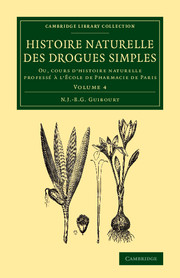
The French pharmacist Nicolas Jean-Baptiste Gaston Guibourt (1790–1867) first published this work in two volumes in 1820. It provided methodical descriptions of mineral, plant and animal substances. In the following years, Guibourt became a member of the Académie nationale de médicine and a professor at the École de pharmacie in Paris. Pharmaceutical knowledge also progressed considerably as new methods and classifications emerged. For this revised and enlarged four-volume fourth edition, published between 1849 and 1851, Guibourt followed the principles of modern scientific classification. For each substance, he describes the general properties as well as their medicinal or poisonous effects. Volume 4 (1851) looks at pharmaceutical substances derived from animals. Guibourt draws on Cuvier's recent classificatory work, dividing animals into four groups: vertebrates (mammals, birds, reptiles, fish), articulates (insects, arachnids, crustaceans et al.), molluscs, and zoophytes.
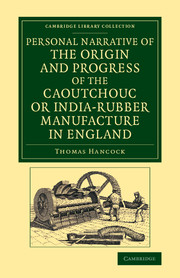
Over the course of three decades, the English businessman and inventor Thomas Hancock (1786–1865) took out sixteen patents relating to the potential applications of natural rubber. Hancock's fascination with this material, the properties of which had not been fully appreciated in England, drove him to experiment extensively with manufacturing methods. This led to the development of the mechanical process of 'mastication' and the chemical process of vulcanization, the end product of which was used by Macintosh to create waterproof garments. This illustrated account of Hancock's discoveries and methods was first published in 1857. It covers the origin of his interest in natural rubber and his subsequent experiments and patents. Also included are details about the plants from which natural rubber is extracted. The result is an informed chronicle of the commercial exploitation of a versatile and lucrative resource.
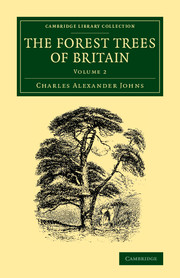
A keen collector and sketcher of plant specimens from an early age, the author, educator and clergyman Charles Alexander Johns (1811–74) gained recognition for his popular books on British plants, trees, birds and countryside walks. Flowers of the Field (1851), one of several works originally published by the Society for Promoting Christian Knowledge, is also reissued in this series. First published by the Society between 1847 and 1849, this two-volume botanical guide for amateur enthusiasts focuses on the trees found in British woodland. Johns describes each species, noting also pests and diseases, uses for the wood, and associated myths and legends. The work is noteworthy for its meticulous engravings of leaves, seeds and blossom, and of the trees in natural settings. Volume 2 (1849) covers such species as chestnut, birch, elm, willow, ivy, yew and cedar. An index to the whole work is also provided.
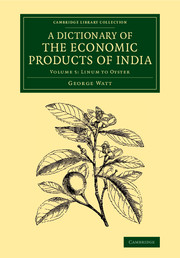
A Scottish doctor and botanist, George Watt (1851–1930) had studied the flora of India for more than a decade before he took on the task of compiling this monumental work. Assisted by numerous contributors, he set about organising vast amounts of information on India's commercial plants and produce, including scientific and vernacular names, properties, domestic and medical uses, trade statistics, and published sources. Watt hoped that the dictionary, 'though not a strictly scientific publication', would be found 'sufficiently accurate in its scientific details for all practical and commercial purposes'. First published in six volumes between 1889 and 1893, with an index volume completed in 1896, the whole work is now reissued in nine separate parts. Volume 5 (1891) contains entries from Linum (the flax genus) to oyster (the subcontinent's best oyster beds were to be found 'on the coast near Karachi, Bombay and Madras').
After the death of the younger Carl Linnaeus in 1783, the entirety of the Linnean collections, including the letters received by the elder Linnaeus from naturalists all over Europe, was purchased by the English botanist James Edward Smith (1759–1828), later co-founder and first president of the Linnean Society of London. In 1821, Smith published this two-volume selection of the letters exchanged by Linnaeus père et fils and many of the leading figures in the study of natural history, revealing some of the close ties of shared knowledge and affection that bound the European scientific community at that time. Where necessary, Smith translates the letters into English, with the exception of those written in French, which are presented in the original. The varied correspondents of Linnaeus senior, whose letters appear in Volume 2, include the botanists Johann Dillenius and Bernard de Jussieu, and the philosopher Jean-Jacques Rousseau.
After training as an apothecary and surgeon, Jonathan Pereira (1804–53) taught materia medica for many years. His lectures at the medical school in London's Aldersgate Street were highly successful and formed the basis for the first edition of his major encyclopaedic work on medicinal substances. A pioneering text in the field of pharmacology, Pereira's work, which he subsequently updated in further editions, provided pharmacists and medical professionals with a more rigorous scientific understanding of the drugs and remedies they prescribed. After Pereira's death, medical jurist Alfred Swaine Taylor (1806–80) and physician George Owen Rees (1813–89) prepared this revised and expanded fourth edition, interspersed with instructive woodcuts. Volume 2 is divided into two parts. Part 2 (1857) contains new articles, additional illustrations and a separate index. It concludes the analysis of organic compounds, both vegetable and animal.
After training as an apothecary and surgeon, Jonathan Pereira (1804–53) taught materia medica for many years. His lectures at the medical school in London's Aldersgate Street were highly successful and formed the basis for the first edition of his major encyclopaedic work on medicinal substances. A pioneering text in the field of pharmacology, Pereira's work, which he subsequently updated in further editions, provided pharmacists and medical professionals with a more rigorous scientific understanding of the drugs and remedies they prescribed. After Pereira's death, medical jurist Alfred Swaine Taylor (1806–80) and physician George Owen Rees (1813–89) prepared this revised and expanded fourth edition, interspersed with instructive woodcuts. Volume 2 is divided into two parts. Part 1 (1855) continues with articles on special pharmacology, moving on from inorganic compounds to discuss the medicinal properties of organic compounds.
Following his stint as the naturalist aboard the Endeavour on James Cook's pioneering voyage, Sir Joseph Banks (1743–1820) became a pre-eminent member of the scientific community in London. President of the Royal Society from 1778, and a friend and adviser to George III, Banks significantly strengthened the bonds between the practitioners and patrons of science. Between 1796 and 1800, the Swedish botanist and librarian Jonas Dryander (1748–1810) published this five-volume work recording the contents of Banks' extensive library. The catalogue was praised by many, including the distinguished botanist Sir James Edward Smith, who wrote that 'a work so ingenious in design and so perfect in execution can scarcely be produced in any science'. Volume 4 (1799) lists books pertaining to geology and mineralogy, including works on the medical and economic applications of minerals and metals.
First published in 1874 and reissued here in its second edition of 1879, this substantial work provides information on the vegetable material medica used by Victorian pharmacists, principally in Britain but also in India. Arranging the entries according to the type of plant from which each drug is derived, Daniel Hanbury (1825–75) and Friedrich August Flückiger (1828–94) give a description of each drug as well as covering its botanical origin and history, including its first medicinal application. They also discuss chemical composition, referring to the investigations of other scientists as well as their own, and comment on microscopic structure. Intending to create a broad reference work rather than an encyclopaedia, the authors chose not to focus on the therapeutic applications of the drugs. In many instances, however, they give some information on how the plant products are used. The appendix provides short biographical and bibliographical notes.
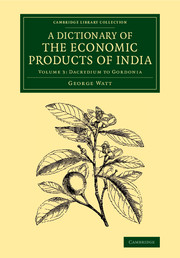
A Scottish doctor and botanist, George Watt (1851–1930) had studied the flora of India for more than a decade before he took on the task of compiling this monumental work. Assisted by numerous contributors, he set about organising vast amounts of information on India's commercial plants and produce, including scientific and vernacular names, properties, domestic and medical uses, trade statistics, and published sources. Watt hoped that the dictionary, 'though not a strictly scientific publication', would be found 'sufficiently accurate in its scientific details for all practical and commercial purposes'. First published in six volumes between 1889 and 1893, with an index volume completed in 1896, the whole work is now reissued in nine separate parts. Volume 3 (1890) contains entries from Dacrydium (a genus of coniferous trees) to Gordonia obtusa (a species of evergreen tree).
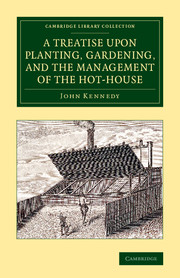
This practical guide was first published in 1776: in this reissue of the two-volume 1777 second edition, the two volumes have been bound in one book. John Kennedy (d.1790) was the gardener to Sir Thomas Gascoigne, the owner of Parlington Hall in Yorkshire, and his book is addressed to landowners and their head gardeners. His concern is with 'the planting of poor wastes, moorlands, and apparent mountains', as well as with hothouse plants such as pineapples and vines, and delicacies including asparagus and cultivated mushrooms. At the other end of the scale, he also provides sections on field-cabbages, carrots and turnips as feed for cattle. In each of these areas, he gives detailed descriptions of the preparation of the ground, the tools needed, propagation techniques, and the subsequent management of pests and diseases. This is a fascinating treatise on the gardening skills needed on a grand eighteenth-century agricultural estate.
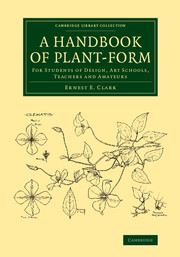
Written and richly illustrated by the Derby-born artist Ernest Ellis Clark (1869–1932), this guide was originally published in 1904 to demonstrate the decorative possibilities of certain plants, mainly English wild flowers, to art students sitting examinations in plant drawing and design. Clark emphasises the importance of retaining a certain amount of botanical accuracy and provides examples of the ornamental possibilities of selected plants in various stages of their development. The language employed in describing the plants is not rigorously scientific and may be understood by those with little familiarity with botanical terms (a brief glossary is also provided). By focusing primarily on accurate renderings of the plants, rather than decorative applications, Clark allows the student's originality to remain unaffected by his personal preferences, and in so doing he allows students to adapt his teachings to their particular tastes and styles.
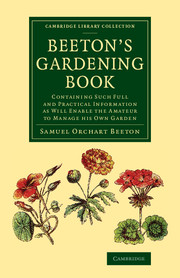
Samuel Orchart Beeton (1831–77), the publishing entrepreneur who made his wife's Book of Household Management one of the bestselling titles of the century, gave his name to many other books of domestic, medical and general information for the middle classes. (The 1871 Book of Garden Management, published and probably compiled by him, is also reissued in this series.) This work was published in 1874 by Ward Lock, to whom Beeton was forced to sell his own business after a financial collapse in 1866. The book contains 'such full and practical information as will enable the amateur to manage his own garden'. It covers flower, fruit and vegetable gardening, with a section on garden pests and a monthly calendar of tasks. It also contains advertisements for gardening and medicinal products, as well as for other books from the publishers, offering a fascinating insight into social as well as garden history.
Following his stint as the naturalist aboard the Endeavour on James Cook's pioneering voyage, Sir Joseph Banks (1743–1820) became a pre-eminent member of the scientific community in London. President of the Royal Society from 1778, and a friend and adviser to George III, Banks significantly strengthened the bonds between the practitioners and patrons of science. Between 1796 and 1800, the Swedish botanist and librarian Jonas Dryander (1748–1810) published this five-volume work recording the contents of Banks' extensive library. The catalogue was praised by many, including the distinguished botanist Sir James Edward Smith, who wrote that 'a work so ingenious in design and so perfect in execution can scarcely be produced in any science'. Volume 1 (1798) lists books pertaining to various branches of science, including accounts in a multitude of languages from scientific institutions all over the world.
Having served as a military surgeon in India, where he also pursued botanical research and investigated the efficacy of Hindu medicines, John Forbes Royle (1798–1858) went on to become a professor of materia medica at King's College, London. Acknowledging the need for a thorough yet manageable textbook on the subject, he published in 1847 this manual containing entries on the medicinal substances derived from minerals, plants and animals that were used in Britain at that time. The terminology, operations and aims of pharmaceutical practice are also addressed, and the differing preparations of the London, Edinburgh and Dublin pharmacopoeias are taken into account for the benefit of students. Furthermore, the work provides information on recently discovered medicines, 'as may be seen among the Preparations of Iron and of Gold, as well as in Matico, Indian Hemp, Bebeerine &c'.
Following his stint as the naturalist aboard the Endeavour on James Cook's pioneering voyage, Sir Joseph Banks (1743–1820) became a pre-eminent member of the scientific community in London. President of the Royal Society from 1778, and a friend and adviser to George III, Banks significantly strengthened the bonds between the practitioners and patrons of science. Between 1796 and 1800, the Swedish botanist and librarian Jonas Dryander (1748–1810) published this five-volume work recording the contents of Banks' extensive library. The catalogue was praised by many, including the distinguished botanist Sir James Edward Smith, who wrote that 'a work so ingenious in design and so perfect in execution can scarcely be produced in any science'. Volume 2 (1796) focuses on books relating to animals, including humans, particularly their physiology, maladies and economic functions.
Although without formal scientific training, Henry John Elwes (1846–1922) devoted his life to natural history. He had studied birds, butterflies and moths, but later turned his attention to collecting and growing plants. Embarking on his most ambitious project in 1903, he recruited the Irish dendrologist Augustine Henry (1857–1930) to collaborate with him on this well-illustrated work. Privately printed in seven volumes between 1906 and 1913, it covers the varieties, distribution, history and cultivation of tree species in the British Isles. The strictly botanical parts were written by Henry, while Elwes drew on his extensive knowledge of native and non-native species to give details of where remarkable examples could be found. Each volume contains photographic plates as well as drawings of leaves and buds to aid identification. The species covered in Volume 3 (1908) include cedar, hornbeam, southern beech, hickory, maple and redwood.
An eminent botanist and natural historian, George Simonds Boulger (1853–1922) wrote a number of books on plant life in the British Isles. First published in 1902, this manual explores the characteristics and uses of one of the most abundant and versatile natural materials. In the first part, Boulger outlines the general biological function and uses of wood. He also describes the classification of wood, and the durability of different timbers. The second part catalogues the types of wood that are used commercially. Boulger explains the distinguishing characteristics and uses of hundreds of different kinds of timber, which are listed alphabetically. Featuring 82 illustrations, the book also includes appendices explaining some of the terminology and science of wood, and a select bibliography. Boulger's work on economic botany, The Uses of Plants (1889), is also reissued in the Cambridge Library Collection.
An eminent botanist and natural historian, George Simonds Boulger (1853–1922) wrote a number of books on plant life in the British Isles. He published this concise work in 1889. It opens with a brief survey of the progress made in economic botany over the years, particularly in the period 1837–87. Boulger then notes the commercial application of plants across many fields, notably food production, medicine, and the building trade. Common and botanical names are given, followed by succinct descriptions of each plant. Including both a general and synoptical index, this accessible resource can be read with profit alongside John Jackson's Commercial Botany of the Nineteenth Century (1890) and Boulger's Wood: A Manual of the Natural History and Industrial Applications of the Timbers of Commerce (1902), both of which are reissued in this series.