To save content items to your account,
please confirm that you agree to abide by our usage policies.
If this is the first time you use this feature, you will be asked to authorise Cambridge Core to connect with your account.
Find out more about saving content to .
To save content items to your Kindle, first ensure no-reply@cambridge.org
is added to your Approved Personal Document E-mail List under your Personal Document Settings
on the Manage Your Content and Devices page of your Amazon account. Then enter the ‘name’ part
of your Kindle email address below.
Find out more about saving to your Kindle.
Note you can select to save to either the @free.kindle.com or @kindle.com variations.
‘@free.kindle.com’ emails are free but can only be saved to your device when it is connected to wi-fi.
‘@kindle.com’ emails can be delivered even when you are not connected to wi-fi, but note that service fees apply.
Uton gan on þysne weald innan, on þisses holtes hleo.
Let us go into this forest, into the shelter of this wood.
Genesis 840–1
IN THE SPIRIT of the forest and the arboreal metaphors that inspire and shape our thoughts, the final remarks in this book are open-ended. This is no point of conclusion, rather, these ideas seed a wider consciousness. As leaves on a tree and trees in the forest, as parts of a greater whole, the words in this book are intended to spark new growth. In the final chapter we saw how the Universal Tree spoke to Ibn ʿArabī, telling him that its fruits ‘contain more sciences and knowledge than sound intellects and subtle hearts can bear’. Like the trees of the sun and the moon in Alexander's Letter to Aristotle, or the dream tree in The Dream of the Rood, trees like the Universal Tree can speak directly, revealing hidden wonders (and horrors). Equally, like Nebuchadnezzar's dream tree in the Book of Daniel, they can serve more obliquely as signs of things to come. The language of arboreal signs and our metaphorical use of them is what drives the collective thought presented in this book. In much the same manner that forests, trees and their wood provided the material for new human-made realities on an altogether different plane, in the world of language a metaphor provides the path to new meaning: ‘It is the in-between-languages workshop where new semantic categories are first intuited and forged’. Juxtaposing two separate ideas, a ‘metaphor consists in giving the thing a name that belongs to something else’, according to Aristotle. To understand it, one has to seek correspondence in difference – ‘to see the like is to see the same in spite of, and through, the different’. Indeed, a metaphor deals in similarities and differences. It forces a language to grow. Just as the metaphor has a privileged meaning-creating role, so too, at a material level, does the forest and its trees. Far beyond the visual, in their thoughts humans can see themselves connected to trees on deeper structural and linguistic levels.
The death of Napoleon and the consequent withdrawal of perhaps half of the island's population – all those who had been involved more or less directly in his incarceration – brought about one of the recessions in the island's economy that followed repeatedly in the later years of the nineteenth century. When Darwin passed through the island in 1836 the guide he employed probably spoke for the majority of the population when he looked back on the ‘fine times’ of the Napoleonic interlude as something of a golden age.
For the British government the role of the island in isolating the former emperor from contact with the outside world was judged to have been – with the possible exception of the cost of it all – entirely satisfactory, so it was perhaps inevitable that the name of St Helena should be invoked again whenever the need arose for secure and suitably remote accommodation. For nineteenth-century politicians and colonial administrators such a choice would have been considered expedient and routine. As late as 1968, when King Goodwill Zwelithini acceded to the throne of the Zulu nation at the age of fifteen and was judged to be at risk from his opponents until he reached his majority, it seemed appropriate that until the moment for his coronation in 1971 a refuge could be found for him on St Helena. His grandfather, Dinuzulu, had been accommodated there more formally some eighty years earlier (see below). More extraordinary is the survival even today of a perception in Whitehall that the island might still reasonably function as an appropriate sanctuary – or a prison – in which politically problematical individuals might conveniently be sequestered.
Policing the slave trade
Having witnessed the introduction of slavery from the earliest years of its human occupation and having itself become a regular consumer of enslaved Africans and others – it will be remembered that the EIC had long accepted the principle that no plantation in the tropics could be sustained without them – there was a certain piquancy in the choice of the island as a key base in enforcing its prohibition in later years. Within a year of the passage of the Act for the Abolition of the Slave Trade (1807), the Royal Navy had established a West Africa Squadron with the aim of suppressing the trade by sea.
WHILE IT is impossible to be exhaustive in drawing together all works that have touched on trees, vegetation, and their derivatives in medieval studies and allied fields, here we bring together some of the research in this area from recent decades. Scholarship on medieval English literary-historical contexts has mainly focused on the later Middle Ages, often crossing disciplines, time periods, and forms of evidence, such as Derek Pearsall and Elizabeth Salter's foundational Landscapes and Seasons of the Medieval World. An influential early collection on plant-life in early medieval England, From Earth to Art, was edited by Carole Biggam, including work by Jennifer Neville, who like Heide Estes, published a seminal monograph on representations of the natural world in Old English literary landscapes and environments. Della Hooke produced a landmark account of trees and woodland in early medieval England in Trees in Anglo-Saxon England, covering their appearances in the physical and textual landscapes of the period and their role in material culture and religious belief. Bintley has worked on the same region, considering visual and material culture including stone sculpture and archaeology, together with Old English and Old Norse texts, in Trees in the Religions of Early Medieval England. Work on trees in Old Norse literature and material culture has been relatively limited until recently. Clive Tolley explored the literary evidence thoroughly for its mythology, with Carl Phelpstead producing the first dedicated ecocritical study of a Norse saga (Eyrbyggja saga), and Christopher Abram the first book-length work of ecocriticism in the field. More recently, trees and woodland have also been tackled by Eleanor Barraclough, Alaric Hall, and Shamira Meghani, in a burgeoning of article-length works in Norse studies focused on trees.
A review of recent scholarship by Danielle Allor and Haylie Swenson in postmedieval draws together a number of influential publications in the later Middle Ages and Early Modern era. Allor and Swenson's review forms part of a postmedieval special edition on ‘Premodern Plants’, whose direct aim, editor Vin Nardizzi writes, is to encourage readers ‘to further explore the discourses and the material practices associated with premodern plants’.
TREES PLAYED AN important role in the communication of knowledge in medieval thought. Whether it be the stylised diagrammatic trees used to organise scientific thought, genealogical trees that structure kinship relations as a trunk with branches, or the many trees in religious imagery, the shape, form, and behaviours of a tree are universally recognisable and endlessly reiterable. The Christian Bible, of course, holds a special place for trees as the instrument of both Adam's sin and Christ's death, which endows them with a cosmic significance at the heart of salvation history. The Wood of the Cross legends, which imagine that it was the Tree of Paradise that became the material for Christ's cross, participated in the communication of biblical knowledge in both theological and popular contexts, offering a concrete representation of the connection between sin and redemption. For the majority of lay people, access to the text of the Bible was heavily mediated by translations, sermons, and adaptations, which made linguistic and cultural interventions in order to adapt the content for a general audience who lacked clerical or monastic training. In this article, I examine the way in which thirteenth-century Wood of the Cross stories were instrumentalised to convey theological information to lay audiences in an accessible mode, focusing on a Latin version called the Legenda (c.1220) and its French adaptations, particularly the Bible Anonyme.
Jacobus de Voragine describes the Wood of the Cross in the Legenda Aurea as lignis vilibus (‘cheap wood’) that transiuit in pretiositatem (‘passed into preciousness’) through its role in the Passion. As Shannon Gayk and Robyn Malo argue, this elevates the tree over and above its basic materiality, allowing it to transcend ‘its arboreal properties’. While the Wood of the Cross is evidently marked as sacred and exceptional because of this role, it is paradoxically the very materiality of the tree's arboreal properties that is essential to its transcendence in the texts I examine. The tree in the Legenda and its French versions is not the thinking, feeling subject of The Dream of the Rood, who speaks to the audience and experiences Christ's pain, nor is it the speaking cross that, according to legend, expressed its wish to be placed in Røldal church in Norway.
Napoleon Bonaparte's dazzling military adventures in the European theatre seemed to have run their course with his defeat by the Allied forces and his abdication on 6 April 1814, followed by incarceration on the isle of Elba. It was perhaps characteristic of him that in less than a year the emperor's star once more flared into life with his escape from imprisonment and his dramatic (though short-lived) re-entry to the Tuileries Palace, but the prospect of his renewed domination of the Continent was finally extinguished with the crushing defeat at Waterloo. In the aftermath of the battle, Napoleon himself made hastily for Paris and then for Rochefort on the Atlantic coast, where a rendezvous had been arranged with a frigate that might carry him to freedom in America. An impregnable blockade by the Royal Navy put that prospect out of reach and – with Bourbon and Prussian forces closing in on him – on 15 July the fugitive emperor presented himself on board HMS Bellerophon, where he announced to the commander, Captain Frederick Maitland, that he had come to place himself ‘under the protection of the laws of England’. The courtesies with which the formalities were carried out were indeed more appropriate to a noble seeker of asylum rather than a prisoner of war: Maitland gave up his own cabin to Napoleon's use, while the members of his accompanying entourage were accommodated as best they could be; after a short delay, Bellerophon, with her extraordinary French complement, set sail for England, with an air of measured politeness prevailing on all sides.
At this point Napoleon evidently had every hope that his days might be lived out in congenial retirement in the comfort of a secluded country estate (preferably ‘ten or twelve leagues from London’). But in Whitehall the cabinet had already discussed his fate in the event of his recapture, with a primary concern that there should be no opportunity whatever for a repeat of the Elba fiasco: even before Bellerophon had left Rochefort, the prime minister of the day, Lord Liverpool, had informed his foreign secretary (then in Vienna) that it was the collective resolve of the cabinet that there could be no question of confinement on English soil.
ALTHOUGH IMAGES OF distributive diagrammatic trees, such as trees of virtues and vices, trees of Jesse, and trees of knowledge from the liberal arts, are omnipresent in the meditative imaginary of the late Middle Ages, they are not the only exegetical tools and mnemotechnic devices to use the model of a tree to guide the faithful on the path of wisdom (Fig. 6.1). Other structures that played an essential role in meditation, exegesis, and the recollection of Scripture from the thirteenth century onwards were vegetal and/or arboreal areas such as forests and orchards. These places are characterised by large numbers of trees, and when used as a mnemotechnic device they describe, by analogy, the organisational activity of the mind. Indeed, in a similar manner to the trees of the forest, which are thinned for humans to find their bearings more easily as they traverse it, and planted for their produce, so too must the individual who desires knowledge clear her mind and cultivate her memory in order to gain new knowledge and remember Scripture. In the Middle Ages and the Renaissance, forests and orchards had close lexical, imaginary, and metaphorical links with other places where plants grow, such as meadows and gardens. While neither the meadow nor the garden is, strictly speaking, an area containing a significant number of trees, in the Middle Ages an area described as a ‘meadow’ could also refer, by extension, to an orchard. On the one hand a meadow is, by definition, a place where no trees grow: the only trees that come into contact with meadows are those that mark their boundaries, i.e. hedgerows. On the other hand, the garden, whose definition varies from one context and period to another, is characterised by the coexistence of several kinds of plants that are not necessarily trees.
Among the areas covered by tree canopy, the orchard occupies an intermediate position between the garden and the forest. Unlike a forest, an orchard does not consist of trees that have grown naturally according to an ordo determined by the Creator, rather it is the consequence of human intervention, which aims at optimising nature's generative power.
It is a commonplace that the world became much smaller for everyone in the course of the twentieth century, but for the inhabitants of remote St Helena the changes took longer to materialize than for most. It might be mentioned that while the logistical and technological changes that form the basis of this final chapter were being acted out, the national status of the islanders themselves within the world underwent a period of unaccustomed turmoil.
Having formerly enjoyed undifferentiated full British citizenship since the granting of the East India Company's royal charter of 1673, St Helena was reclassified as a British Dependency in 1834. For a century and a half the change of status had little discernible impact, but with the introduction of the British Nationality Act 1981 the islanders found themselves suddenly placed at a major disadvantage when (along with thirteen other such territories) they were deprived of their rights of residence in the UK – collateral casualties of government moves to block potential large-scale immigration from Hong Kong to the UK as Britain's ninety-nine-year lease on the New Territories approached its end. Although the numbers directly affected on St Helena were comparatively small, the slight was deeply felt by the entire population, which had come to regard itself as occupying ‘the lost county of England’. Two decades of intensive lobbying followed, with the islanders taking their complaint of injustice as far as the United Nations. Eventually, with the passing of the British Overseas Territories Act on 21 May 2002 (the putative 500th anniversary of the island's discovery), full rights were restored. Even with its national status cemented, far-reaching changes in St Helena's international relations continued to unfold, as they had done throughout the island's history.
The coming of the submarine telegraph
The Boer War had brought to the island a more oblique benefit than that represented by the prisoner-of-war camp (Chapter 8): this was the arrival on 26 November 1899 of a submarine telegraph cable, laid with the primary aim of enhancing communication between South Africa and London.
Ars est arbor, cuius radix est amarissima, fructus uero dulcissimus, et qui eius abhorret amaritudinem, eius nunquam gustabit dulcedinem.
Art is a tree, its root is bitter, and its fruits are indeed the sweetest, and one who despises its bitterness will never taste its sweetness.
ARS EST ARBOR, homo est arbor, scientia est arbor, anima est arbor (‘Art is a tree, man is a tree, knowledge is a tree, the soul is a tree’): these Latin statements were so common during the twelfth and thirteenth centuries, when tree frameworks represented simultaneously anthropological and cosmological conceptions, that their value as a cultural indicator is often overlooked by modern scholars. Originally attributed to Aristotle by Diogenes Laertius, the statement above reflects on the sweetness of the fruits of science with respect to the bitter efforts required to discover the principles of knowledge, whose roots lie deeply hidden in nature. From Late Antiquity to the Middle Ages this multidirectional approach to the discovery and creation of knowledge was transmitted via visual representation. This paper goes beyond revisiting the multiple instances of tree structures in the medieval scientific tradition. Indeed, my aim is to demonstrate how the conceptual structures of medieval scientific thought owe their development to arborescent structures. However, without conceptual references and an understanding of their pragmatic contexts these representations cannot be effectively understood; I therefore adopt a historical perspective which also allows for consideration of their philosophical aspects.
Ramon Llull (1232–1315) extended the Aristotelian statement cited above by drawing an analogy between the perceived motion of thought in progress and the natural growth of flowers as they appear on branches, following the movement of nutrients to the buds:
Anima est nobilior substantia corpore et ob hoc nobiliorem habet finem, quare ratione finis animae principium est antecedens et corporis principium est consequens, quamuis corpus sit ante in tempore quam anima, sicut flos, qui ante in arbore est quam fructus, tamen secundum finem ante est fructus in arbore quam flos, cum sit flos ut sit fructus.
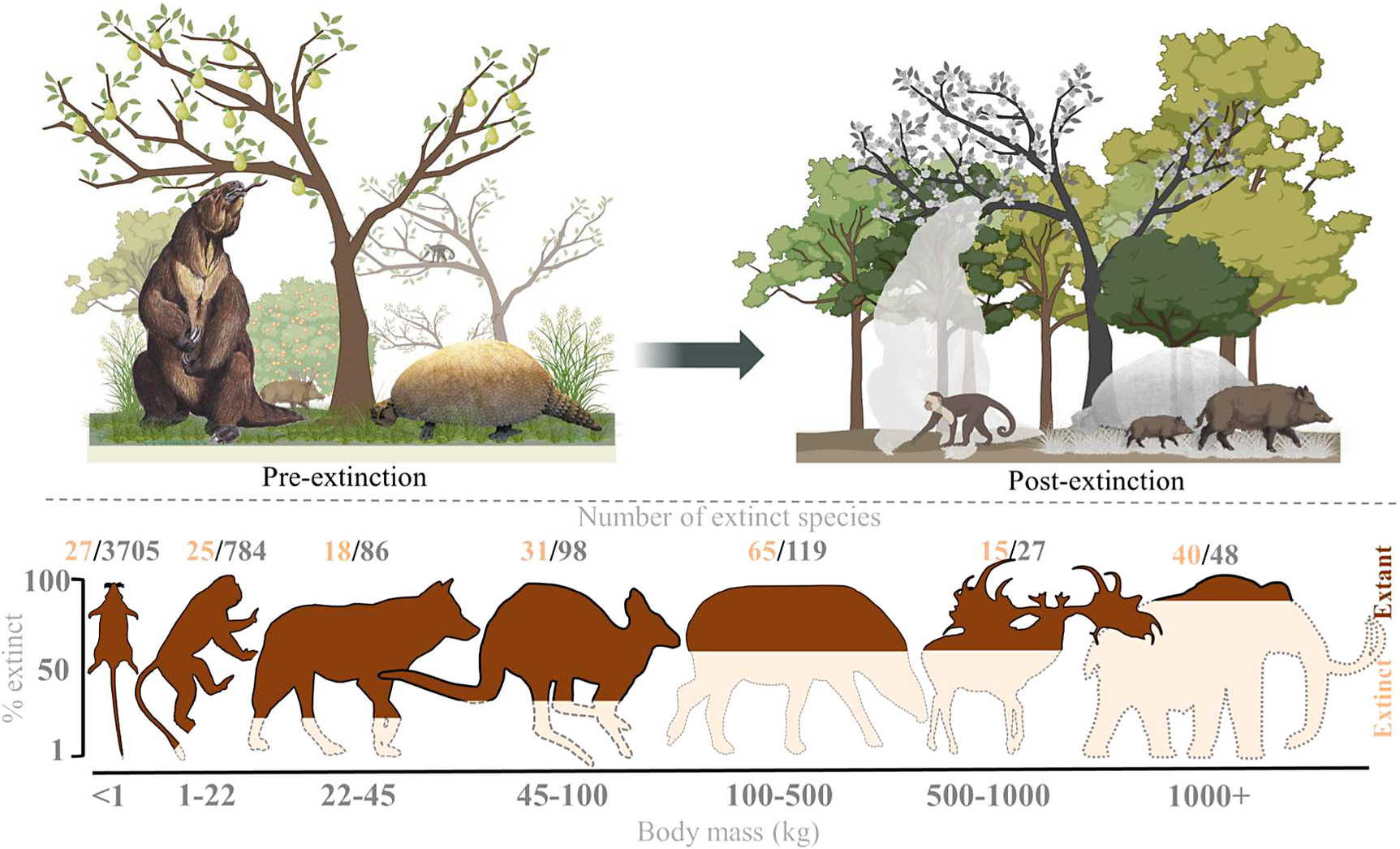
Across the last ~50,000 years (the late Quaternary) terrestrial vertebrate faunas have experienced severe losses of large species (megafauna), with most extinctions occurring in the Late Pleistocene and Early to Middle Holocene. Debate on the causes has been ongoing for over 200 years, intensifying from the 1960s onward. Here, we outline criteria that any causal hypothesis needs to account for. Importantly, this extinction event is unique relative to other Cenozoic (the last 66 million years) extinctions in its strong size bias. For example, only 11 out of 57 species of megaherbivores (body mass ≥1,000 kg) survived to the present. In addition to mammalian megafauna, certain other groups also experienced substantial extinctions, mainly large non-mammalian vertebrates and smaller but megafauna-associated taxa. Further, extinction severity and dates varied among continents, but severely affected all biomes, from the Arctic to the tropics. We synthesise the evidence for and against climatic or modern human (Homo sapiens) causation, the only existing tenable hypotheses. Our review shows that there is little support for any major influence of climate, neither in global extinction patterns nor in fine-scale spatiotemporal and mechanistic evidence. Conversely, there is strong and increasing support for human pressures as the key driver of these extinctions, with emerging evidence for an initial onset linked to pre-sapiens hominins prior to the Late Pleistocene. Subsequently, we synthesize the evidence for ecosystem consequences of megafauna extinctions and discuss the implications for conservation and restoration. A broad range of evidence indicates that the megafauna extinctions have elicited profound changes to ecosystem structure and functioning. The late-Quaternary megafauna extinctions thereby represent an early, large-scale human-driven environmental transformation, constituting a progenitor of the Anthropocene, where humans are now a major player in planetary functioning. Finally, we conclude that megafauna restoration via trophic rewilding can be expected to have positive effects on biodiversity across varied Anthropocene settings.
Both present-day and fossil molluscan assemblages offer an opportunity for a better understanding of the structure and organization of both modern and past benthic communities. In this framework, drill holes are used widely to explore predator–prey interactions. This research focuses on predation marks, especially drill holes, recorded on modern molluscan assemblages in a Patagonian sector of the Argentinean continental shelf. Shelled molluscs (n = 2179) were recovered from 27 to 135 m depths covering a long latitudinal extent (between 39° and 54°S). For each station, taxonomic position, ecological composition and relative abundance of taxa were determined, and then drilling frequency (DF) was calculated to infer drilling intensity. The collected molluscs belong to 37 families, with Veneridae being the most abundant in terms of the number of specimens (n = 419). Specimens with drill holes (n = 226) belong to 21 families (with at least 33 different species). Most of them are suspension feeders (85.8%) and the remaining percentage comprised other trophic types. Naticids and muricids, as main potential predators, together account for 19.6% of the gastropods present in the molluscan assemblages. DF across all the stations was moderate (9.9%) but varied between low (0–2.4%) and high (28.9%). These results do not show a trend linked to latitude or depth, and the great variability of DF between stations suggests that other local ecological or environmental conditions would influence drilling predation at a small spatio-scale.
Otolith morphological and microchemical analyses are relatively new scientific research methods used in fish stock evaluation and management. However, in Tunisia, only morphological methods have been used. The objective of this study was the Sarpa salpa stock discrimination of Djerba and Kerkennah by the otoliths morphological and microchemical analysis, while carrying out a fluctuating asymmetry analysis and a stock comparison of males and females for each population. The results revealed significant differences between the Djerba and Kerkennah populations, significant differences between the stocks of males and females in each population, and a highly significant fluctuating asymmetry for both populations. The results of the otolith morphological analysis were similar to those of the microchemical analysis. This result proves that both morphological and microchemical analyses are powerful tools for fish stock discrimination.
Historically, there have been two kinds of economic activities in northern Alaska. The first and oldest is the subsistence lifestyle of the Indigenous peoples. The second and more recent is the development of the oil and gas industry, which began in earnest in 1977 with the competition of the Trans-Alaskan Pipeline and construction of a new road, the Dalton Highway. Although first used only by commercial traffic for the oilfield, in 1994, the highway opened to the public and is now frequented by tourists travelling above the Arctic Circle. In this paper, we analyse the future of northern Alaska tourism by considering evolutionary economic geography and the area’s likely reduction in oil and gas activity. We consider how climate change may serve as a trigger, impacting tourism through the rise of last chance tourism, and conduct a scenario-based analysis. We argue that the oil and gas industry is likely to continue along its current path, exhausting accessible resources and innovating technology to push into new territories in the far north. However, should the culmination of extraneous factors render climate change a trigger, industry decline could be offset by investments that repurpose the area’s industrial heritage into tourism sites.
This article discusses Estonian author Andrus Kivirähk’s novel The Man Who Spoke Snakish in the context of language extinction and biocultural diversity. The novel is set in Medieval Estonia, but the viewpoint of the protagonist as a speaker of a vanishing language from a vanishing culture resonates with the lived experience of millions of people who have lost lifeways and livelihoods to colonisation and cultural assimilation. The fictitious language of Snakish allows its speakers to integrate fully into the natural world and to form complex interdependent relationships with non-human animals. This web of nature, culture and language is destroyed by a colonising society that is anthropocentric, ecologically destructive and socially hierarchical, and which views nature as something to exploit or fear. The novel explores the emotions of grief and loss for both a culture and an ecosystem heading for extinction.
Intertidal macrobenthos at the small Chernaya Bight (the White Sea) was surveyed six times during 1993–2018 in order to study spatiotemporal variability. Distributions of sediments and macrophytes were highly variable in both space and time, as were most macrofaunal community attributes. Biomass slightly increased with time, while no long-term trends were found in total abundance, diversity, or functional structure. All community attributes were patchily distributed across the beach, and their patterns were not spatially autocorrelated and poorly associated with sediment properties, but changed considerably from year to year. Temporal changes in the community composition were considerable but less substantial compared with the spatial variations. The overall dynamics of species structure did not show any regular trend-like pattern but formed quasicyclic trajectories in ordination space, with nondirectional, spatially noncorrelated fluctuations around some relatively stable state. Comparison with two other neighbouring intertidal sites, studied annually in 1987–2017, showed that macrofauna at every site had similar average biomasses and common dominant species; however, the communities maintained their specificity in structure and exhibited distinct types of dynamics. In particular, the communities demonstrated different long-term trends in total biomass and diversity and followed their own paths in dynamics, appearing as differently oriented interannual trajectories. Nine most abundant species revealed no significant among-site correlations in abundance, and only two bivalve species showed good intersite agreement in dynamics of biomass. We suggest that local benthic communities are largely influenced by site-specific environmental conditions, resulting in independent and even opposite patterns of dynamics in neighbouring localities.
Two separate sightings, two years apart, of the mimic octopus Thaumoctopus mimicus Norman & Hochberg, 2005 are reported from the Inhambane Province of southern Mozambique within the protected waters of the Vilanculos Coastal Wildlife Sanctuary. Individuals were encountered in May 2020 and 2022 in shallow waters, at a depth of less than 30 cm. Both individuals were fully exposed moving along a sandy substrate at the water's edge in a tidal flat. These represent the first documented sightings of T. mimicus in Mozambique, confirming the occurrence of the species along the eastern coast of Africa and extending this species' known range west from the Arabian Sea and south from the Red Sea.
Grey seals from both the Atlantic and Baltic Sea subspecies are recovering from dramatic declines and recolonising former ranges, potentially leading to overlapping distributions and an emerging subspecies transition zone in Kattegat between Denmark and Sweden. The two subspecies have asynchronous moulting and pupping seasons. We present aerial survey data from 2011 to 2023 in Danish Kattegat during the Atlantic subspecies' moulting (March–April) and pupping (December–January) seasons, as well as the Baltic subspecies' moulting season (May–June). During the Atlantic subspecies' peak moulting season, 82% of the grey seals were recorded north of the island of Læsø (N57°18′, E11°00′). In contrast, during the Baltic moulting season in those years, only 9% of the grey seals were recorded here. This indicates a predominance of Atlantic grey seals in the north and Baltic grey seals in central and southern Kattegat. In 2022 and 2023, three pups were recorded around Læsø during early January, which coincides with the pupping season of northern Wadden Sea grey seals. Previously, pups have been recorded in the same locations during the Baltic pupping season, which demonstrates overlapping breeding ranges. Grey seals are known to have plasticity in the timing of pupping indicated by a west to east cline of progressively later pupping in the eastern North Atlantic. Historical sources document that the Baltic pupping season in Kattegat was earlier than it has been in recent years. Thus, the expanding ranges may be associated with convergence of Atlantic and Baltic subspecies' pupping seasons and potential hybridisation in this emerging transition zone.