To save content items to your account,
please confirm that you agree to abide by our usage policies.
If this is the first time you use this feature, you will be asked to authorise Cambridge Core to connect with your account.
Find out more about saving content to .
To save content items to your Kindle, first ensure no-reply@cambridge.org
is added to your Approved Personal Document E-mail List under your Personal Document Settings
on the Manage Your Content and Devices page of your Amazon account. Then enter the ‘name’ part
of your Kindle email address below.
Find out more about saving to your Kindle.
Note you can select to save to either the @free.kindle.com or @kindle.com variations.
‘@free.kindle.com’ emails are free but can only be saved to your device when it is connected to wi-fi.
‘@kindle.com’ emails can be delivered even when you are not connected to wi-fi, but note that service fees apply.
Access to clean and reliable water is critically important for health, well-being, and economic development. The natural, built, and social systems – which interact with each other and comprise the water system-of-systems – are threatened by intensifying hazards and stressors like crumbling infrastructure, floods, droughts, storms, wildfires, sea level rise, population growth, cyber threats, and pollution. Marginalized communities, including disadvantaged and rural communities and Tribal nations with insufficient access to clean water or regenerative sources of water, are often the most impacted. Responses to these issues are hampered by fragmented and uncoordinated governance and management. A multi-stakeholder structured engagement process at the SWIM conference and workshop held in December 2023 identified the most critical current and future issues facing the water sector and what needs to change to find solutions. This paper synthesized these issues. Highlighted issues were the vulnerability and lack of resilience of water systems to hazards and stressors, inequities associated with water scarcity, and water quality problems – all affected by climate change, land-use change, and socio-economic changes. The Smart One Water (S1W) vision provided an important context for the conference. This paper expands the S1W vision with a synthesis of discussions about S1W-related fundamental concepts, practices, and implementation barriers.
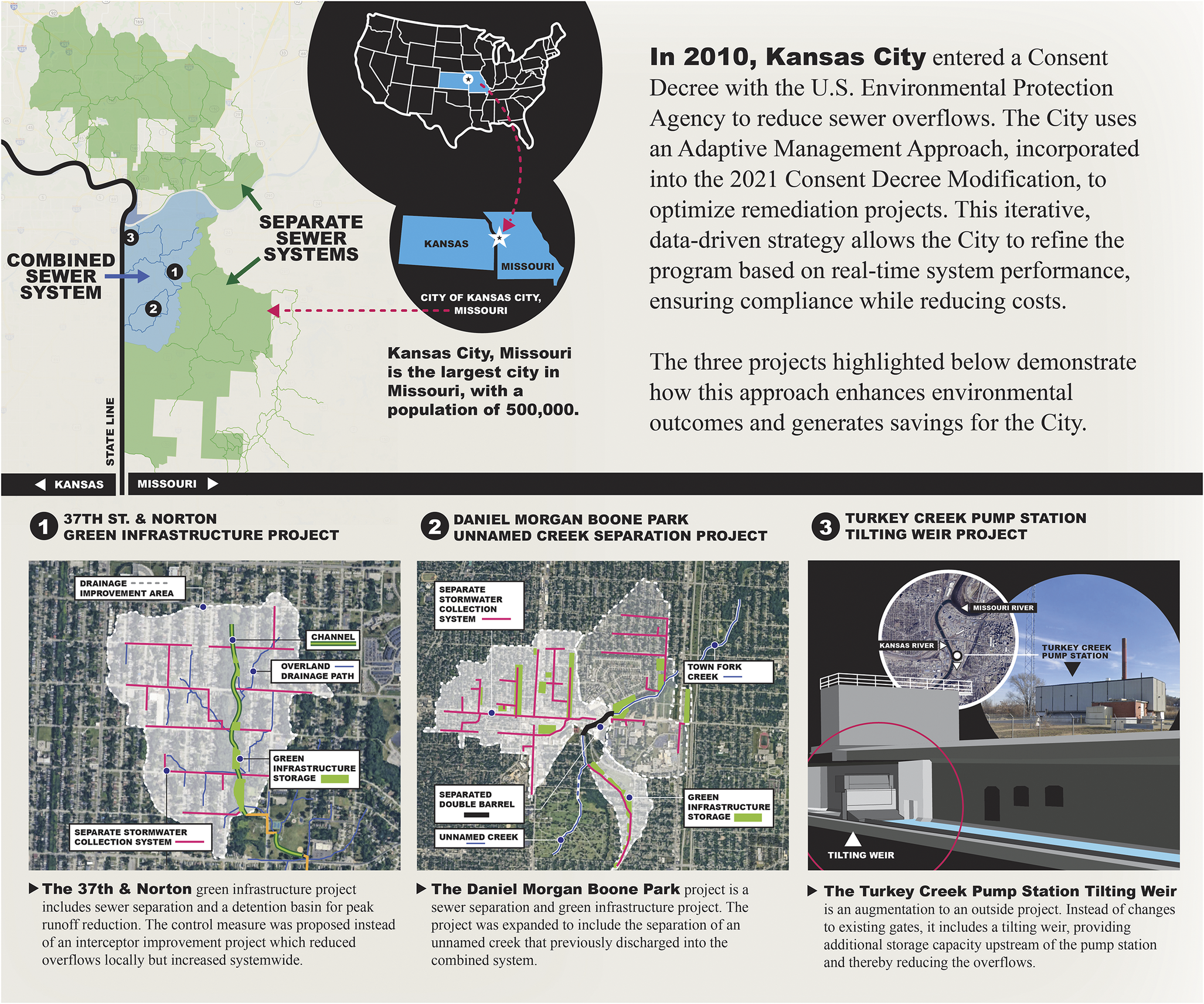
The Kansas City, Missouri Smart Sewer Program has successfully implemented an adaptive management approach to cost-effectively reduce sewer overflows. This approach was implemented under the guidance of the third Consent Decree modification, which mandates the level of sewer overflow reduction. This approach includes iterative decision-making, continuous monitoring and flexible strategies to optimize environmental outcomes while managing costs. The adaptive management framework integrates system performance and past project data into an iterative planning, implementation, monitoring and analysis cycle. This process enables cost-effective decision-making aligned with Consent Decree compliance by managing the uncertainties in sewer system data and the interdependency of proposed project outcomes. The Smart Sewer Program adopted this approach in response to financial challenges and environmental requirements, resulting in key modifications to its original Overflow Control Plan projects. The adaptive management approach, enabled by the third Consent Decree modification, has proven pivotal in optimizing project performance, reducing costs and protecting vulnerable populations. By leveraging the adaptive management approach, Kansas City has reduced program expenses by hundreds of millions of dollars while aligning with Environmental Protection Agency (n.d.) environmental justice goals. Key project modification examples from the program presented in this article illustrate the effectiveness of adaptive management in achieving better outcomes. The first example showcases a project substitution. In this example, green infrastructure replaced a proposed relief sewer project, resulting in a more cost-effective solution with enhanced overflow reduction and environmental justice benefits. The second example involves project augmentation with creek separation, resolving double-counted sewer overflows, and significantly reducing annual overflow volume at minimal cost. A third example demonstrates project modification for a City project that was not a part of the Smart Sewer Program, where alternative gate configurations increased overflow capture without additional costs, potentially eliminating the need for a costly deep tunnel project. This article demonstrates the potential of an adaptive management approach for urban wastewater management programs, offering a replicable model for other municipalities. The Kansas City Smart Sewer Program example demonstrates how adaptive management can drive cost savings, enhance environmental outcomes and ensure regulatory compliance for a Consent Decree.
This article charts the history of how system dynamics modelling (SDM) has evolved in the field of natural resource management from a relatively niche subject to a tool of increasing practical relevance and impact, and encourages practitioners to continue this trend with some suggestions for further promoting SDM for natural resource impact assessment and policy support. It not only traces key developments and thematic shifts but also advocates for SDM as a critical approach for addressing today’s complex and interconnected resource challenges. Starting in the 1970s with the Limits to Growth and a burgeoning environmental movement, the path of SDM applications for natural resource management and assessment is outlined. Models turned in the 1980s to a dominantly ecological focus, considering lake ecosystems and predator–prey dynamics, and tended to be largely single-sector focused, with feedbacks and complexity being used to describe sectoral system dynamics. Since about 2000, SDM has been applied to broader and more integrated natural resource systems and has frequently included stakeholders and participatory methods to co-develop models for increasingly practical applications and support. The emergence of the water–energy–food nexus around 2010 lends itself to SDM studies, including the assessment of climatic and socio-economic futures on resources supply, demand and security, and the impact of policy implementation across whole systems. Stakeholder engagement, participatory modelling, online tools and interfaces, machine learning and targeted, policy-facing studies are opportunities to further promote SDM and systems thinking for natural resource management in an increasingly complex and interconnected world, enhancing its practical impact.
Birds show considerable spatial and temporal fluctuations in their abundance due to variations in habitat conditions. The lowland wetlands of the Pampas region in Argentina are key wintering areas for two flamingo species. The Chilean Flamingo Phoenicopterus chilensis is a year-round resident, while the Andean Flamingo Phoenicoparrus andinus is a partial altitudinal migrant that uses these wetlands in winter when some of the wetlands in the high Andes freeze over. We studied the association between the annual abundance of both flamingo species, wetland condition (water surface area and water salinity), and environmental conditions (flooding) driven by the El Niño Southern Oscillation (ENSO) over 15 consecutive winters (July–August 2008–2022) in 24 lowland wetlands in central Argentina. There were notable differences in wetland surface area and water conductivity between years, with some wetlands ranging from flooded to almost dried out. For any given year, there were also large differences in water surface area and water conductivity between wetlands. Both flamingo species showed marked fluctuations in abundance over the study period. Each year, the Chilean Flamingo was more abundant than the Andean Flamingo. The Chilean Flamingo was recorded at least once in every wetland, while the Andean Flamingo was absent from three wetlands and was not observed in two years during the study. The Chilean Flamingo was recorded in wetlands covering a larger range of water conductivity values than the Andean Flamingo (2.53–58.23 ms/cm vs 2.94–16.20 ms/cm, respectively). The abundance of both flamingo species was higher at intermediate water conductivity values and decreased at higher or lower values. These results show that these lowland wetlands are subjected to strong interannual variation in climatic conditions which affect lake conditions, and thus the abundance of both flamingo species, highlighting the importance of conserving wetlands encompassing a broad range of environmental conditions.
Brittle stars undergo remarkable morphological changes during their transition to adulthood, extending beyond metamorphosis. Members of the genus Ophioderma exhibit particularly noteworthy morphological changes between the juvenile and adult stages. These growth changes have been a persistent source of misidentification in Ophioderma, even leading to the misclassification of juveniles to a different genus. In this study, the growth changes of three common eastern Pacific Ophioderma species were characterised: Ophioderma aija, Ophioderma occultum, and Ophioderma panamense. Their growth series, ranging from 2.5 to 26.7 mm disc diameter, were analysed by combining morphology, morphometrics, and DNA barcoding. Three size groups within the species were identified. In general, the morphological changes shown by the three species were highly similar and occurred at comparable sizes, allowing a pattern to be identified and reconstructed. However, differences between the species were observed throughout the series in quantitative (arm length, dorsal arm plates, number of arm spines) and qualitative (radial shields, colouration) characters. This work represents one of the few available contributions on the growth changes of Ophiuroidea from the eastern Pacific and so far in the genus Ophioderma.
Anthuroid isopods in the genus Mesanthura (52 valid species) typically have a body with conspicuous dorsal pigmentation, with differences in the female pigmentation pattern being one of the main characters used to distinguish species. Five Mesanthura species have been reported to date from Japan. Here, we describe Mesanthura solsp. nov. from Irabu Island and Okinawa main island, Okinawa, Japan, and illustrate its sexual dimorphism in colour pattern, with conspecificity between males and females confirmed with molecular data. We provide a description of Mesanthura miyakoensis based on specimens collected from Kochi, Shikoku, Japan. We present the first records of Mesanthura cinctula and Mesanthura nigrodorsalis, following their original descriptions. Finally, we provide partial sequences of the 16S rRNA gene for these four species and present a phylogenetic tree based on the sequences.
The Santa Marta Sabrewing Campylopterus phainopeplus is listed as a “Critically Endangered” hummingbird endemic to the Sierra Nevada de Santa Marta (SNSM) in Colombia. Prior to 2022, there were only three documented sightings of the sabrewing since it was described in 1879, including only one record between 1946 and 2022. As a result, this “lost” species has long been one of the most poorly known birds in Colombia. We located a resident population of Santa Marta Sabrewing along the Guatapurí River near the Chemesquemena and Guatapurí villages in July 2022, and at its type locality, San José, in January 2023. Based on historical data and newly collected field observations, we assess the species’ status and describe aspects of its natural history and ecology. Our review indicates that the species has been frequently misidentified in the past, and that to date, documented evidence of its presence is limited to four localities, all of them restricted to the south-eastern slope of the SNSM, along the mid Guatapurí River basin. Consequently, this bird appears to represent a case of microendemism. This species is likely to remain listed as Critically Endangered until conclusive evidence suggests otherwise. Field observations indicate that the species is highly associated with watercourses, where males hold year-round territories and form leks. We obtained records of males in mid-elevation habitats (1,150–1,850 m) for 16 consecutive months between July 2022 and October 2023, suggesting that the species might not be an elevational migrant, as previously speculated. More information is needed to understand the species’ ecology so that effective conservation actions can be designed in collaboration with the indigenous communities with which the species coexists.
Although octopuses are the third most fished marine invertebrate species in Puerto Rico, there is a lack of information about this fishery. Here, we present the first small-scale study assessing the genetic diversity and connectivity of Octopus vulgaris in Puerto Rico. To achieve this, we applied double-digest restriction-site associated DNA sequencing, using the restriction enzymes EcoRI and SphI in 43 specimens captured from ten locations representing three geographic regions. We used F-statistics and Bayesian analysis to evaluate over 2000 polymorphic loci. We found high genetic connectivity (FST = 0.0008, FST = 0.005), high nucleotide diversity (π ≈ 0.1), and moderate genetic diversity (HO ≈ 0.255–0.361, HE ≈ 0.258–0.373) between the studied regions. In contrast to our expectations, given oceanographic characteristics and distance between the geographic regions, our results suggest a single admixed population of O. vulgaris in Puerto Rico, with no differentiation between the sampled regions. Even though genomics techniques are powerful for inferring population connectivity, researchers should be cognizant of protocol limitations to retain the most reliable information possible.
Polychaetes (Phylum Annelida) respond to sensory stimuli through the usage of sensory organs and appendages, such as palps, which vary in shape and structure depending on lifestyle. The typical palps of nereidid polychaetes are tapered appendages constituted by two articles. The palpophore is the wider and longer basal article, followed by the thinner and shorter palpostyle that contains the majority of sensory cells. Previous studies on Hediste diversicolor palps were focused on these sensory cells. To achieve a more comprehensive view of the histology and ultrastructure of the palps, H. diversicolor specimens were collected from the northern Portuguese Atlantic coast and the palps were processes for light (semithin sections) and transmission electron microscopy. The current study revealed details of the cuticle, which is thinner in the palpostyle than in the palpophore. Five types of secretory cells were distinguished mainly based on the characteristics of their secretory vesicles. Two of these types could be classified as protein-secreting cells, and the other three as mucus-secreting cells. Granulocytes and eleocytes were found in the celom cavity of the palps. The latter contained lipid droplets and a very large amount of glycogen. In the central region of the palpophore, a ring of muscle cells responsible for the retraction of the palpostyle encircled the main palp nerve. The latter was formed by numerous axons and glial cells containing bundles of filaments and gliosomes.
Despite the importance of the commercially harvested benthopelagic fish Beryx mollis, little information is available on their adult phase and reproduction. This is likely due to the low abundance of this species compared to Beryx splendens and Beryx decadactylus as well as misidentification of Beryx spp. In this study, early life stages of B. mollis were found in the southwest region off Sri Lanka during a survey with research vessel Dr Fridtjof Nansen in 2018, coinciding with the southwest monsoon period. As morphological characteristics of eggs and larval stages of the three Beryx spp. are very similar, visual identification to differentiate to species level has always been challenging. Therefore, in this study, DNA barcoding was carried out targeting the mitochondrial COI gene. Molecular analysis confirmed that the collected egg and larvae belonged to the B. mollis species due to their high identity (>99%) with reference to previously submitted adult B. mollis sequences in the GenBank. Phylogenetic analysis showed a closer evolutionary relationship among B. mollis and B. splendens than with B. decadactylus. To the best of our knowledge this is the first genetic and morphological confirmation of B. mollis egg and larvae worldwide and suggests the southwest coastal area in Sri Lanka, in the north central Indian Ocean, as a potential spawning ground for this species.
One century ago, US Secretary of State Charles Evan Hughes made the first official statement regarding US policy toward Antarctica by declaring it would not recognise sovereignty in areas that could not actually be settled. The Hughes Doctrine formalised US opposition to countries dividing Antarctica into sovereign territory, a doctrine that has become the bedrock upon which subsequent US decisions toward the region were built. This paper gives a broad overview of the development of US policy toward Antarctica, starting with the Hughes Doctrine, including the period when the United States secretly considered making its own claim to sovereign territory before deciding to champion then maintain the multilateral, sovereign-free region based on the Antarctic Treaty in order to achieve its national goals. This paper also reviews how the policies are working today and considers the significant challenges and costs the United States would incur if it altered its century-old policy toward Antarctica.
Many ascidian (sea squirt) species are common members of fouling communities, particularly on floating substrates such as docks and pilings and through maritime transport, have been introduced worldwide. For the past 30 years, marinas in Southern California have been regularly monitored for introduced species due to their proximity to the international shipping terminals in Los Angeles and Long Beach Harbors. Here, we report on the first record in the eastern Pacific of an ascidian in the family Corellidae (O. Phlebobranchia), Corella japonica, found at the Newmarks Yacht Centre in Los Angeles Harbor. This study further highlights the importance of continuously monitoring harbors and marinas to detect the early arrival of new non-native species.
Fjord ecosystems serve as crucial habitats for elasmobranchs, supporting them across all life stages. Chilean Patagonia provides one of the most complex and extensive networks of fjord ecosystems in the world, displaying high marine biodiversity, including elasmobranchs. However, little is known about this ecologically important group of fishes in these ecosystems. This study investigates the biodiversity of elasmobranchs in the Comau Fjord over a period of 6 months by combining morphological and molecular data. In total, 309 specimens within a radius of 7.5 km were recorded, belonging to six families and nine species: Hexanchus griseus (77.5–178 cm LT), Notorynchus cepedianus (180.6 cm LT), Schroederichthys bivius (35–65.2 cm LT), Scymnodon macracanthus (37.3 cm LT), Centrophorus squamosus (87.4 cm LT), Deania calceus (58.3–98.6 cm LT), Squalus acanthias (25.5–101.1 cm LT), Dipturus chilensis (62.9–152 cm LT), and Dipturus trachyderma (69.8–194 cm LT). This included records of three species previously unknown in the fjord and was equivalent to nearly 20% of the elasmobranch richness found in Southern Chile. The results further suggest that the Comau Fjord could be a primary nursery ground for several species of elasmobranchs. This is the first time that a species inventory of elasmobranchs is conducted in a Chilean fjord system. The outcomes of this research provide an elasmobranch species checklist with biological aspects from the Comau Fjord, which are essential data to inform decision makers, conservation managers, and future research.
The goniadid polychaete Goniadella gracilis (Verrill, 1873), currently considered as a non-indigenous species in European waters, is reported for the first time in Italian waters of the Tyrrhenian and Ionian Seas. A detailed description of individuals of this species from the Mediterranean Sea is provided, including the pigmentation pattern of the specimens, which to our knowledge has never been reported before in literature. In addition, new molecular data, 18S and COI sequences, from Mediterranean specimens are presented and compared with data from the North-Eastern Atlantic. On the basis of the available evidence, the status of G. gracilis in the Mediterranean basin is discussed, and the species is here proposed to be considered as a questionable species in the area.
Calcifying macroalgae play a critical role in coastal ecosystems, but rising sea temperatures pose a significant threat to their survival. This study aims to investigate the thermal sensitivity of the three marine macroalgal species Padina boryana, Halimeda opuntia, and H. macroloba. Photosynthetic performance, metabolism, pigment content, and oxidative stress–related parameters were measured at temperatures of 28°C, 32°C, 36°C, and 40°C and the thermal performance curves (TPCs) were determined for Fv/Fm, Fv/F0, ϕPSII, and oxygen production to assess maximum rate (Rmax), optimum temperature (Topt), critical thermal maximum (CTmax), and thermal safety margin (TSM) of these three macroalgal species. The results showed that 40°C had the most negative effect on all three species with P. boryana demonstrating better performance compared to both Halimeda species. TPCs from photosynthetic performance revealed thermal sensitivity variations by species and P. boryana exhibited a broader thermal tolerance range compared to Halimeda. On the other hand, TPCs of oxygen production provided similar CTmax values. Based on TPC projections, all three species might survive future ocean warming and marine heatwaves, though these conditions will have significant effects, with P. boryana showing greater tolerance than both Halimeda species. This study highlights the differential thermal responses and sensitivities of these macroalgae, contributing to understanding their potential resiliencies under future climate change scenarios.
The present study describes a new Mediterranean terebellid, Spinosphaera latachaeta sp. nov., found along the Aegean coast of Türkiye and the Sea of Marmara, between 27 and 80 m depth in soft substrata. It can be morphologically distinguished from all other species of Spinosphaera having 18 pairs of notopodia, double rows of uncini present until the last notopodia, and 11 pairs of Spinosphaera-chaetae. A dichotomous taxonomic key and a table summarizing the morphological characters that distinguish all species of Spinosphaera are provided. This study also reports, for the first time, the transformations of Spinosphaera-chaetae and saw-like chaetae from the anterior to posterior segments of body.
The distribution pattern of species and habitats protected by the Habitat Directive is one of the main parameters used to assess their conservation status. According to the European guidelines, the assessment must be carried out at a biogeographical scale by implementing monitoring activities. The results of a national monitoring programme conducted on five invertebrates during the last reporting cycle (2018–2024) are presented and discussed. Monitoring activities on Patella ferruginea, Pinna nobilis, and Lithophaga lithophaga were performed using on a spatial design based on Italian administrative regions, whereas Scyllarides latus and Centrostephanus longispinus were surveyed within six marine protected areas (MPAs) representing the different Italian marine subregions.
The most critical situations, due to different reasons, were observed in the distribution pattern of P. ferruginea and P. nobilis, which were confined to few areas with very small populations. Data on the distribution of L. lithophaga, collected by assessing the quality of the habitat for the species, indicate the persistence of illegal fishing activities, at least in some of the areas investigated. The use of ‘opportunistic’ methodologies, typical of citizen science, to collect semi-quantitative data on the distribution of C. longispinus and S. latus in the six MPAs, chosen to conduct this type of monitoring, confirmed the effectiveness of this approach. Some differences in the number of individuals recorded emerged among MPAs for both species, likely due to an uneven sampling effort. Overall, our results revealed significant interspecific differences linked to intrinsic and extrinsic factors, providing valuable insights into the vulnerability of the investigated species.
Bobtail squids of the family Sepiolidae, which includes the genus Euprymna, are closely related to, but distinct from the true squids (Teuthoidea). Despite their ecological importance, there have been few studies on the age and growth of bobtail squids using hard parts. This study is the first to use statolith increments to estimate the age of Euprymna hyllebergi collected from the southeastern Arabian Sea. Statoliths were extracted from 80 individuals (24 males, 56 females) of dorsal mantle length (DML) 8–50 mm and total weight 0.45–37 g and assessed for their age. Statolith size ranged from 328 to 836 μm. Assuming a daily deposition of increments, growth was rapid and adult sizes were attained in around 2 months. The age of the individuals varied between 25 days (DML = 8 mm) and 91 days (DML = 37 mm) for males; 33 days (DML = 10 mm) and 92 days (DML = 44 mm) for females. The daily growth rate ranged from 0.20 to 0.49 mm DML day−1 for males and 0.23–0.59 mm DML day−1 for females. The lifespan of E. hyllebergi is short, based on the statolith increment analysis.
Obligate avian scavengers, such as the “Critically Endangered” California Condor Gymnogyps californianus, face significant threats from human activities and environmental changes. This study examines the home range and presence of reintroduced California Condors in a protected area in Baja California, Mexico, focusing on the influences of seasonality, biological factors, and food supplementation. Using spatial data collected over 12 months with telemetry equipment, we analysed condor movements within and beyond the boundaries of the Parque Nacional Sierra de San Pedro Mártir. Our findings reveal that condors spend over half their time within the protected area, with an increased presence during winter months. Supplementary feeding programmes significantly increased condor presence within the park, particularly in spring and summer. Home range analyses showed that season significantly influenced home range sizes, with smaller ranges observed during winter compared with other seasons. Additionally, male condors had larger home ranges than females during spring, but no significant sex differences were observed in other seasons. Age did not have a significant effect on home range size. This study emphasises the importance of protected areas and supplementary feeding programmes in condor conservation, highlighting the necessity of continuous monitoring and management to help support this iconic species.