To save content items to your account,
please confirm that you agree to abide by our usage policies.
If this is the first time you use this feature, you will be asked to authorise Cambridge Core to connect with your account.
Find out more about saving content to .
To save content items to your Kindle, first ensure no-reply@cambridge.org
is added to your Approved Personal Document E-mail List under your Personal Document Settings
on the Manage Your Content and Devices page of your Amazon account. Then enter the ‘name’ part
of your Kindle email address below.
Find out more about saving to your Kindle.
Note you can select to save to either the @free.kindle.com or @kindle.com variations.
‘@free.kindle.com’ emails are free but can only be saved to your device when it is connected to wi-fi.
‘@kindle.com’ emails can be delivered even when you are not connected to wi-fi, but note that service fees apply.
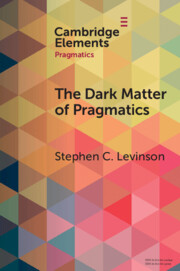
This Element tries to discern the known unknowns in the field of pragmatics, the 'Dark Matter' of the title. We can identify a key bottleneck in human communication, the sheer limitation on the speed of speech encoding: pragmatics occupies the niche nestled between slow speech encoding and fast comprehension. Pragmatic strategies are tricks for evading this tight encoding bottleneck by meaning more than you say. Five such tricks are reviewed, which are all domains where we have made considerable progress. We can then ask for each of these areas, where have we neglected to push the frontier forward? These are the known unknowns of pragmatics, key areas, and topics for future research. The Element thus offers a brief review of some central areas of pragmatics, and a survey of targets for future research. This title is also available as Open Access on Cambridge Core.
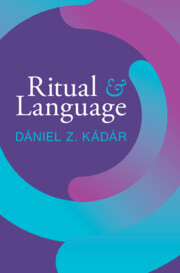
While ritual is often associated with phenomena such as ceremonies, cursing and etiquette, it actually encompasses something much more important: it includes all instances of communally oriented language use. As such, ritual manifests itself in many forms in our daily lives, such as politeness, swearing and humour, and in many different life situations, spanning trash talk in sports events, through market bargaining, to conventional social pleasantries. This pioneering book provides an introduction to ritual language use by providing a cutting-edge, language-anchored and replicable framework applicable for the study of ritual in different datatypes and languages. The framework is illustrated with a wealth of case studies drawn from Chinese and Anglophone rituals which demonstrate how to use it effectively. The book is essential reading for both academics and students, and is relevant to pragmatics, applied linguistics and other fields.
In mainland China, Reform and Opening up in the last few decades has opened a floodgate of foreign infusion. Foreign businesses such as KFC, Starbucks, Walmart, McDonalds, and Carrefour are seen everywhere. There have also been many loanwords. Some of the loanwords have become so much a part of the Chinese lexicon that their foreign origin may not even be clear to all. Apart from the social and cultural implications, the influx of things foreign presents quite a challenge to Chinese with its non-phonetic script. Various accommodation strategies have been used to represent foreign words with Chinese characters, including meaning translation, phonetic transliteration, or a combination of both, resulting in varying degrees of semantic and phonetic approximation. Incidentally, the fact that the Rebus (phonetic loan) Principle is extensively used for phonetic transliterations, whereby Chinese characters are used only for their sounds without regard to their meanings, gives the lie to the persistent ideographic myth concerning Chinese characters.
The rhetorical devices used in a language reflect both its linguistic characteristics and the cultural patterns of its users. Due to the extensive homophony in Chinese, punning is extensively exploited. The predilection for even numbers may account for the fondness for symmetry and parallelism. The special characteristics of Chinese characters naturally lend themselves to clever manipulation of graphic shape. As expected, rhetorical devices are seen more often in public writing such as advertisements and civic banners but less in strictly functional ones like road signs.
The signs in this chapter range from the strongest warnings to gentler reminders. 禁(止) ‘forbid’ and 严禁 ‘strictly forbid’ are used for the strongest warning possible. 请勿 ‘please don’t’ may be a tad less strong than 禁止. There are also other verbs of warning such as莫 ‘don’t’, 不得 ‘must not’, and 不可 ‘may not’. The most common reminders include verbs 当心 ‘beware of’, 小心 ‘be careful about’ and so on. To convey a sense of seriousness, the language of warnings and reminders tends to be formal, replete with classical Chinese elements.
Many signs in urban areas are bilingual in Chinese and English. It cannot escape the notice of even the most casual bilingual observer that many such signs are woefully (and sometimes hilariously) mistranslated. Mistakes can result from wrong segmentation, wrong word choice, wrong grammar, or inappropriate style, which is particularly important in Chinese. Mistakes can also result from missing crucial information or lack of understanding of English. There are also the ‘innovative analogies’, which give rise to non-existent English words. Also frequently observed are inconsistencies, wavering between the two strategies of pinyin transliteration and meaning translation. The inclusion of mistranslated signs can be pedagogically useful in more than one way. Studying mistranslated signs is an exercise in contrastive analysis. Through detailed analysis of the causes of the mistakes, such signs can be used as negative examples in the teaching of both Chinese and English. They can also be useful to the study and practice of translation.
For many visitors to China, airports may be where Chinese signs are first seen. This chapter will sample some signs that are commonly seen at airports, including those for customs, terminals, departure lounges, boarding gates, baggage claims, and transportation options. Most of the airport signs are bilingual with English translations. Most of the signs in this chapter are seen at the Pudong International Airport in Shanghai.
This chapter samples signs to do with eating out. They include names of restaurants, ordering and getting foods, dish names, and sample menus. The range of names for places to eat includes 饭店, 饭庄, 酒家, 酒楼, 餐厅, 馆, 店, 居, 厨房, 楼, 美食街, and 排档. As is the case with hotels, many restaurants have misleading names. For example, 酒家 and 酒楼 (distinct from 酒店 ‘hotel’) are not drinking establishments. In fact, few restaurants are straightforwardly called 饭馆 or 餐馆. 饭店 is used more for hotels than restaurants. To sound fancy and literary, aliases for place names are often used to refer to regional cuisines instead of official full names.
This introductory chapter provides the rationale for the book, as well as its organization. As part of the linguistic landscape, public signage provides glimpses of a culture and its changes. The ability to read signs is a practical skill essential for daily survival in the target language environment. But there seems to have been a general neglect of signs in the typical Chinese language curriculum, even at advanced levels of instruction. This book aims to rectify the situation.
This chapter includes civic signs and political banners, which seem to be particularly numerous in China. They are used to extol civic and cultural values reflecting the current social and political climate. From their contents, one can get a sense of what are considered important at a particular time. Like couplets, the rhetorical device of parallelism is frequently employed.
This chapter samples ads of three types: commercials, classified ads, and the so-called ‘small ads’. Ads can appeal to senses of good value, tradition and authenticity, novelty and popularity. To attract attention, they often employ rhetorical devices such as punning, parallelism, allusions to shared cultural knowledge, and unexpected juxtaposition for humorous effect.
Reflecting the changes that Chinese writing has undergone during the last century, Chinese signs are neither uniform in character style nor in text orientation. The mixing of different formats is also evident.
In this chapter, signs of basic services will be given, such as getting hydrated (and duly performing ‘bodily function’), getting connected and having access to funds.
Chinese can be found in most parts of the world. The signs in this chapter are mainly from the United States. A few are from Kyrgyzstan. Signs in the diaspora contexts are distinguished by the need to negotiate between Chinese and the local language(s), as Chinese is used to represent local contents. Both meaning-based translation and sound-based transliteration are used, as well as a combination of the two. Also notable are the dialectal elements. The language of the Chinese diaspora in North American is heavily Cantonese, as the earliest immigrants were from Cantonese speaking areas of China. Cantonese has also been adopted as sort of a lingua franca. Traditional characters are used as a rule, reflecting the dominance of traditional culture. The traditional vertical and right to left text orientation coexists with that of the modern horizontal and left to right format.