To save content items to your account,
please confirm that you agree to abide by our usage policies.
If this is the first time you use this feature, you will be asked to authorise Cambridge Core to connect with your account.
Find out more about saving content to .
To save content items to your Kindle, first ensure no-reply@cambridge.org
is added to your Approved Personal Document E-mail List under your Personal Document Settings
on the Manage Your Content and Devices page of your Amazon account. Then enter the ‘name’ part
of your Kindle email address below.
Find out more about saving to your Kindle.
Note you can select to save to either the @free.kindle.com or @kindle.com variations.
‘@free.kindle.com’ emails are free but can only be saved to your device when it is connected to wi-fi.
‘@kindle.com’ emails can be delivered even when you are not connected to wi-fi, but note that service fees apply.
In this chapter, we explore how multilingual Australian Aboriginal children who have Standard English as an additional language/dialect engage in translanguaging practices through both playfulness and precarity in the school context. We begin by exploring their various linguistic repertoires and then examine how they playfully use translanguaging to move fluidly between these languages as they engage interactively both inside and outside the classroom. We discuss how such ‘translanguaging’ can contribute to learning by enabling Aboriginal students to take advantage of all the linguistic resources they have at their disposal which allow them to ‘construct, manage, negotiate and perform’ activities in positive ways within the classroom. However, there is precarity in the classroom meaning-making process because of the inherent linguistic racism of school as experienced by such students. Teachers often lack any understanding of the languages the students bring to school, which can result in teachers viewing student languages within a deficit model as ‘poor’ or ‘broken’ English. Yet the students’ facility with their languages, and the ease and confidence with which they move across languages, amply demonstrates the equality of their language to that of English. We propose that despite the challenges, language play can mitigate against the precarity.
This chapter takes as a foundation that relations and understandings between people, particularly those from different social spheres, matter. Through dual lenses of critical cosmopolitanism- which posits the need for encounters based on openness, equity and caring, and transmodalities- which postulates five complexities of ‘trans’-era communications, we analyse digitally-mediated communications among groups of youth from disparate under-resourced communities as they create, share and discuss digital stories on a dedicated website. In particular, we explore exchanges between youth from a rural Ugandan village and those from a large Indian slum as they compose videos and messages intended to highlight their resourcefulness and innovation: through the entanglement of languaging, resources, materiality, culture, place and ideologies, each group mis/interprets and positions the other through a lens of ‘deficiency’. While translanguaging attends to flexibility and fluidity of language-in-use, transmodalities attends to semiotic processes through which people make sense of themselves, one another and the world. A transmodal analysis of videos, chats, interviews and group meetings recasts ‘disparity’ and ‘peripherality’, as, through transnational engagements, youths’ emergent understandings of global others’ lives and their own, and of relationships being forged, transcend labels to illuminate emic perspectives, challenging (and sometimes reifying) these constructs.
Immigrants with an undocumented status or those in mixed-status families live in a state of precarity and vulnerability due to the possibility of separation, detainment, or deportation. To publicly share their stories portends possible surveillance or discrimination. However, many still share their stories – and do so on their own terms – to shift mainstream discourses on immigration. While research on undocumented status narratives has mainly focused on textual structure, story lines, and negotiation of identities, more attention is needed on ways they negotiate precarity. That is, we must analyze how individuals utilize translingual practices to remain faithful to their identities and experiences while also navigating dominant discourses. This chapter will explore how translingual practices such as code alternation (i.e., code-switching and codemeshing) might provide resources for narrators to negotiate this vulnerability by helping them to index in-group values, mask relevant information from outsiders, represent belonging, and construct new textual homes that sidestep surveillance or appropriation. We will draw on two publicly available reclaimant narratives to examine the role of translingual practices in non-academic writing. Our analysis of these narratives will take translingual practices beyond the classroom to social spaces where the rights and livelihood of numerous people are at stake.
Based on fieldwork at a Japanese restaurant in Toronto, this study uncovers the transnational workers’ complex power dynamics that exist behind the façade of jovial translingual practices. Through the multi-layered analysis of the restaurant’s menus, video-recorded staff meetings and worker interviews, we found that linguistic and semiotic resources used to enhance the ethnic identity of the business can cause frictions among the workers, whose linguistic resources are embedded and valued differently at the local and global levels. Japanese managers hold institutional power over the decisions concerning the restaurant’s identity and language policy. These managers, who have limited English skills, actually rely on the creation of a Japanese-dominant space, supported by the global popularity of Japanese cuisine, as a means of survival in the English-dominant local community. The managers depend on English-speaking servers to interact with local customers. On the other hand, the servers, who have limited Japanese skills, consider the restaurant as just a temporary stop on their transnational journey and envision their future as being in the global English-speaking labor market. This study shows how translingual practices, often romanticized as a representation of cosmopolitan conviviality, are built on the precarious grounds of power negotiations and job security among transnationals.
In this Afterword, I provide additional comments on Sender Dovchin, Rhonda Oliver, and Li Wei’s edited book’s central argument, namely that a rather romanticized view of translingualism as the celebration of playfulness despite the precarious conditions of life of translingual users needs to be addressed. The chapters in this book do an interesting reading of precarity in terms of ontology, social practices, and the conditions of inequality in today’s world. To further enrich the response to the critique that translanguaging scholarship ignores the actually existing conditions of precarity and suffering under neoliberalism, I draw on my own experience as an editor of an applied linguistics journal in Brazil and on the (in)securitization of everyday life experienced by interlocutors in my fieldwork in Rio de Janeiro favelas. I conclude that imagining forms of life that do not surrender to or freeze in the face of precarity seems to be an urgent task for sociolinguists.
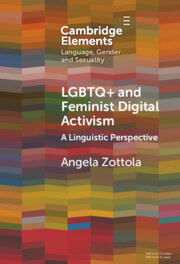
This Element focuses on the linguistic and discursive practices employed by digital citizens to promote their causes on social media, that is to engage in digital activism, drawing attention to the growing importance of this phenomenon in relation to gender identity and sexuality issues. I propose the label LGBTQ+ Digital Activism to join the already existing one Feminist Digital Activism and argue that, while these have been areas of interest from sociology and communication specialists, digital activism is still to be embraced as a field of research by applied linguists. I point out to a number of linguistic and discursive features that are popular among digital activists and support this through the analysis of the use of the hashtag #wontbeerased combining Social Media Critical Discourse Analysis and Corpus-Assisted Discourse Studies. I suggest that further research is needed to explore how language is used to propagate and popularize emancipatory discourses online.
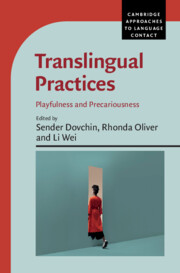
Bringing together work from a team of international scholars, this groundbreaking book explores how language users employ translingualism playfully, while, at the same time, negotiating precarious situations, such as the breaking of social norms and subverting sociolinguistic boundaries. It includes a range of ethnographic studies from around the globe, to provide us with insights into the everyday lives of language users and learners and their lived experiences, and how these interact in translingual practices. A number of mixed methodological frameworks are included to study language users' behaviours, experiences and actions, cover the complexity of language evolutionary processes, and ultimately show that precarity is as fundamental to translingualism as playfulness. It points to a future research direction in which research should be pragmatically applied into real pedagogical actions by revealing the sociolinguistic realities of translingual users, fundamentally addressing broader issues of racism, social injustice, language activism and other human rights issues.
Chapter 4 examines social protocols in public discourse, representing the realm of ‘overly’ ordinary language use. The term ‘public discourse’ means both monologues and dialogues that take place in public, often through mediatised events or written (online) pieces which are available for, or even addressed to, members of the public. ‘Social protocols’ describe forms of language use associated with ‘politeness’ in public discourse specifically, where ‘politeness’ in the interpersonal sense is hardly needed, i.e., such forms at first sight may seem to be entirely ‘superfluous’ if not ‘redundant’. Because if this, while social protocols and mediatised public aggression (studied in Chapter 3) may appear to have little in common at first sight, interestingly both of them have an ‘unreasonable’ element. This sense of unreasonableness however dissolves once one looks at such forms of language use through the ritual perspective. As a case study, Chapter 4 examines the ritual conventions of social protocols in a corpus of Chinese public announcements made in the wake of a major social crisis.
Chapter 5 focuses on the phenomenon of mimesis. All rituals are mimetic because ritual language use itself triggers replication and reciprocation. However, Chapter 5 will show that in various interactionally complex rituals one can observe a specific mimetic phenomenon – ‘performative mimesis’ – which has not received sufficient attention in the study of language use, and which is worth exploring if one wants to understand why in certain ritual contexts language users play ‘roles’. Simply put, the concept of ‘performative mimesis’ refers to contrived interactional performance whereby the performer sustains mimicking a predated interactional schema, just like an actor in a theatre manages a performance on stage by enacting a role. Performative mimesis is a particularly interesting phenomenon to consider because the participants of a ritual which necessitates such mimetic behaviour follow often invisible and uncodified scripts. Chapter 5 includes a case study which describes performative mimesis in Chinese university military training courses, representing an understudied ritual drawn from the realm of higher education in China.